Wednesday, September 2, 2009

All Influential Political Plays are Leftist

I just realized that all of our influential political playwrights are anti-capitalists.

Did they become the most influential because no right-of-center playwrights were worthy? More likely, leftist playwrights have been boosted because conservative plays (or books for that matter) rarely get selected for review let alone praise in such publications as the New York Times.

I worry about a society with inadequate intellectual checks and balances. Nearly all of society's mind-molders are leftist: the colleges, Hollywood, and the news media. And don't tell me about Fox News and right-wing talk radio. They have but a tiny mindshare of the public, especially among the intelligentsia--the people most likely to vote and to create policy.

Here is a list of the political playwrights I believe to be our most influential. All are leftist, what the media prefers to call "progressive."

Clifford Odets--e.g., Awake and Sing.

Sam Shepard-- e.g., Buried Child

Neil Simon--Where he is political, he is always anti-capitalist. For example, in Broadway Bound, the wisest character is a socialist.

George Bernard Shaw--e.g., Man and Superman

Lillian Hellman--e.g., The Little Foxes

Bertolt Brecht--e.g., Good Person of Szechuan

The current playwriting stars--e.g., Caryl Churchill, Tony Kushner, Moises Kaufman, David Hare.

Even musicals have become infected. Leading musicals of the 21st century, Rent and Urinetown are both anticapitalist as well as my otherwise favorite musical of the '90s, Little Shop of Horrors.

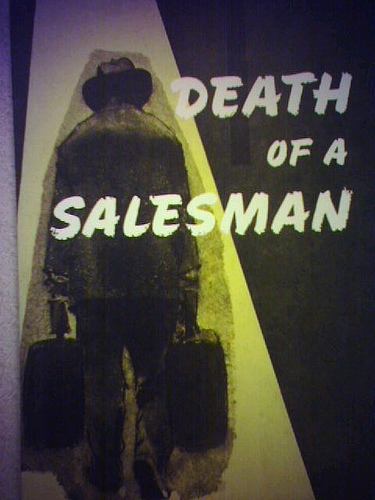
And most famously, Arthur Miller--e.g., the ultimate anti-capitalist play: Death of a Salesman.

I cannot think of one influential playwright who wrote pro-capitalist/anti-socialist plays. Can you?

Monday, August 31, 2009

Inspiration for Ex-Offenders

Two-thirds of felons are back in prison within a year.

And that's understandable. It's tough even for a college graduate with a straight-arrow employment record to land a decent-paying job. Imagine what it's like for robbers, drug dealers, and murderers, many of whom are barely literate, have a poor work history, and are a threat to steal or be violent in the workplace.

It can be awfully tempting for an ex-felon to go back to robbing or selling drugs: If you get away with it, you make a heckuva lot more than McWages; if you get caught, you qualify for three hots and a cot plus rent and gym membership, and health care, all free, compliments of the taxpayer.

Career counselor Maureen Nelson wrote this great piece on how ex-offenders can find the motivation to stay the course until they succeed, legally.

Saturday, August 29, 2009

A Career in Three Minutes

People often ask me how, on my radio shows, I help people find a career in three minutes. Here's an approach I often use:

1. Take 30 seconds to tell me what makes you different than most people?

2. What career fits your answers to that question? (Need ideas? Scan the careers in the Occupational Outlook Handbook or the 500 often more under-the-radar careers in my book, Cool Careers for Dummies.)

3. What does that career score on The Meter: 0 means you hate it. 10 means you love it?

4. What keeps that from being a 10?"

5. Repeat steps 3 and 4 until one or more careers score a 9 or 10.

Of course, you shouldn't make your final career choice in three minutes:
  • Learn more about the career(s) scoring 9 or 10 in the Occupational Outlook Handbook and/or Cool Careers for Dummies. Or google the name of that career and the word "careers." for example, "electrician careers."
  • If the career still sounds interesting, speak with or, better, visit a few (not one) people who work in that career to get a better sense of what it's like.
  • If a career still scores a 9 or 10, congratulations. You've found what will likely be a well-suited career.

Thursday, August 27, 2009

Careers Most Likely to Make a Difference

I had a fascinating conversation with an M.D. soon to be Ph.D. in physics. One topic we discussed is whether he thought he'd make a bigger difference seeing patients or working on the the next generation of medical imaging machines.

He reminded me that many patients, even when facing death, refuse to change their lifestyle, even modestly: "Please, eat fewer cheeseburgers. Not none, just fewer." Yet most heart patients don't. Indeed that is consistent with the findings of famed cardiologist Dean Ornish.

That reminds me of my experience as a career counselor. Nearly 100% of my clients walk out of my office with a plan they like, believe in, and know they should implement. Yet many implement their plan minimally if at all. When they come back for a subsequent session, the problem is rarely that the plan wasn't good nor that they didn't know how to implement it. They just couldn't make themselves change.

So I'm wondering whether, on average, the people who end up making the biggest difference are not those in the so-called helping professions, especially counseling and psychotherapy--because those require people to change. Rather, the people who are more likely to make a big difference are those involved in developing new technological tools that help people without requiring them to change much: for example: a better cardiac stent, a better search engine, a TV instead of a radio, a more efficient car.

What do you think?

Monday, August 24, 2009

Economic Armageddon, Here We Come?

The Obama administration admitted today that the federal debt will, over the next decade, grow wildly larger than it had previously said--so much for a recovery. Now the estimate is $9 trillion!

And that doesn't count the $1.0 to $1.6 trillion Congress is contemplating spending on ObamaCare.

Nor does it count the massive additional new spending Obama has promised, for example, legalizing the 13-20 million illegals, who will thereby become eligible for ObamaCare, increasing the debt further.

And Obama is considering "Stimulus" 3. For our trillion dollars, "Stimuli/Bailouts" 1 and 2 have resulted in the highest unemployment rate since 1983 and wildly accelerating debt, yet he contemplates Grandson of "Stimulus"/Bailout.


China owns ever more of America and the U.S. is becoming ever less creditworthy. Just the interest on the national debt is approaching the total budget for national defense!

And federal spending is accelerating?! Will we, not to mention our children and grandchildren, suffer profoundly from our government's profligacy?

Government programs (yes, Republican-initiated programs, for example, the Bush bailouts and the Iraq War, are equally at fault) are usually terribly inefficient. Think Amtrak, the Postal Service, the public schools, the nearly bankrupt Social Security and Medicare, the Bailouts, $85 hammers, the Bridge to Nowhere.

Many government programs are actually negative in effect. Consider, for example, Cash for Clunkers: dangling taxpayer dollars in front of people poor enough to own bad-gas mileage clunkers so they can go deeply in debt to buy a new car (80% of which have been foreign, by the way). And of course, dumping much of their toxic components and fluids into landfills is an environmental disaster. Plus, car dealers are screaming that they have laid out the $4,500 per car to customers and often have not yet been paid by the government, thereby killing their cash flow, a business's lifeblood. The government can't even write a promised check in a timely manner and it wants to run a "public option" health care system?

An individual and especially a nation in debt is at-risk. A nation that has assumed unprecedentedly, incomprehensibly mammoth debt is doomed. Even Keynes did not imagine this magnitude of government spending.
To pay for its metastasizing number and scope of programs and interest on its soon-to-be $9 trillion debt, the government will, unchecked, continue to raise taxes and print ever more money, thereby decreasing the value of our life's savings and purchasing power.

As a result, American workers will likely end up joining most of the world's workers in earning a net $1 an hour.
As reported in a recent blog post, we already work into August just to pay all the costs imposed by government. Does anyone really think we get fair value for the government's taking over half our money from us each year?

Our only savior is for us to demand that the government to return most our tax dollars to us and for government to live within its then more modest means: scale down so it can balance its budget and pay down its debt. Anything else is too likely to lead us to economic Armageddon.

A Modest Health Care Reform Proposal

Most of me thinks that two health care reform options are most worthy:
1. Consumer-paid fee-for service with a spartan government-provided safety net for the poor. OR
2. A single-payer system.

But I met a primary care physician involved in health care reform planning whose views represent a more middle-of-the-road approach that seems a good balance between concern with quality and cost. So I invited him to summarize his key recommendations in 500 words and that if I thought the document was worth your reading, I'd post it.

Here it is. As always, comments are welcome.

Health Care Reform: Viewpoint from a Primary Care Perspective
by Michael Rosenblum, M.D.

There are three essential issues for health care reform in the United States

1) We need a uniform national digital health record--Many errors are made due to illegible handwritten entries in patient records.A majority of prescriptions are still written by hand, and a majority of outpatient medical records are written by hand. We could greatly improve the quality of care, and save a considerable amount of money, by having national standards for digital data entry and making all health care records accessible from any point of care in the nation. There are political barriers to instituting this policy. Proprietary electronic systems would have to yield to uniform national standards. There are concerns about the privacy of patient records. We need to overcome such obstacles and get health care into the digital age.

2) We need to re-emphasize primary care—In the United States we are culturally addicted to the latest technological advances. We spend a disproportionate amount of the health care dollar on the latest laser surgery and the latest high-tech drugs. To provide health care to all citizens, we need to train more primary care doctors like pediatricians and internists and family doctors. The importance of the primary care doctor in providing preventative care, and coordinating the patient’s journey through a complex system, cannot be overemphasized. Insurance reimbursement needs to be increased for primary care, and decreased for specialists if we are to achieve this goal.

3) We need to fix Medicare and Medicaid before establishing costly new federal programs—The Medicare “trust fund” is on the verge of insolvency. Medicaid (MediCal in California) reimburses doctors and hospitals typically at 20-30% of the current market rate, resulting in poor access for patients. Both of these programs need to repaired and reinvigorated. Fortunately, this can be achieved without creating vast new federal agencies and hiring hundreds of thousands of new federal employees, as would be needed for the new programs proposed by the administration and Congress. The infrastructure for these programs has been in place since the 1960s. We merely need to fund them and they can reach their full potential. For example, Medicaid could be made available to uninsured adults up with incomes up to 400% of the Federal Poverty Level, rather than the current 125%, to make a large proportion of currently uninsured adults eligible. There are huge political barriers to reforming Medicaid. For example, Medicaid uses a formulary of generic drugs, and there would be strong opposition from the pharmaceutical industry to increasing funding for this program. Funding for Medicaid is partly from the states, and they are pushing back on any increase in the program that would require them to fund more health care. Clearly, the federal government will have to shoulder the fiscal burden of Medicaid expansion, but this is cheap by comparison to setting up a whole new program.

Tuesday, August 18, 2009

How to Not Procrastinate a Big Project

It's tough to determine how long a big project will take. So waiting until the last minute greatly increases the risk it will be done poorly.

THE KEY: Make this rule inviolate: I will start a big project the hour or at least the day it is assigned to me. If I don't know how to get started (for example, how to structure the project,) I'll get help immediately.

How to motivate yourself to stick with that rule? Remind yourself that if you get started right away, the project will be more FUN:
  • You'll avoid the stress of trying to get it done well at the last minute.
  • You'll have time to play with the parts of it you enjoy, for example, wordsmithing or illustrating it.
  • If you're done early, you'll have gotten yourself a chunk of time that you can enjoy without the project hanging over your head.
  • You'll likely have done a better job, which will yield more praise and make you proud of yourself.
 

blogger templates | Make Money Online