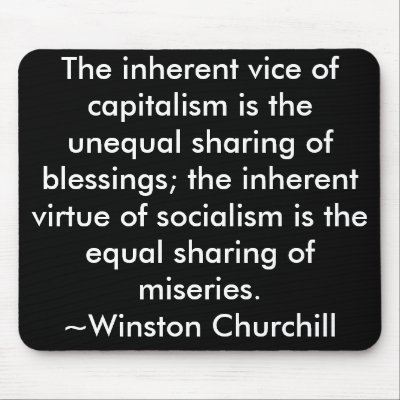
The anti-establishment protests, for example, "Occupy Wall Street" has pushed me over the edge into believing it's more likely than not that, within the decade, "The Revolution" will indeed come. There just are too many forces moving America in that direction:
- Demographics. Because of differential birth rates and immigration, an ever higher proportion of the population will be left-leaning.
- The U.S. economy is in deep trouble, with many more people underemployed than the government's statistics indicate.
- The gap between rich and poor is increasing. The middle class is shrinking.
- Society's main mind molders--the schools, colleges, and media--are ever bolder in making their messages leftist rather than truly "fair and balanced."
- The recent precedent set by the overseas protests--the "Arab Spring," riots in France and England, etc.
- Our short memory. Memories of the liabilities of living in, for example, Communist Russia and Eastern Europe, are fading.

Of course, there are countervailing forces:
- Except among hard leftists, ardor for The Revolution is tempered by the collapse of the Greek economy, the tottering of other socialist countries, and Scandinavia's, Germany's, and France's now questioning the wisdom of a generous cradle-to-grave welfare policy.
- The American citzenry's long-standing valuing of capitalism.
- The already leftward movement of our government,. Of course, the 2010 election was a pivot rightward but I believe that a fair-minded look at U.S. policy over the last 100 years demonstrates a clear leftward trend. What the media and politicians call "conservative" today is more leftist than would have been considered "conservative" just a half-century ago. For example, no conservative politician today would dare argue even against such redistributive "justice" programs as No Child Left Behind, in which the vast majority of educational effort is redistributed from those with the greatest potential for excellence to the lowest achieving students. The government's move leftward reduces the need for revolution to what may well be soon done without the pain of revolution.
Going yet further out on the limb, I predict that within a decade of The Revolution, a move back rightward will begin. Logically, to me at least, the core principle of The Revolution dooms America in the medium to long-term, to, net, more misery. The Revolution's core principle is Marx's exhortation to redistribute from those with the most to those with the least, without regard to the people's merit, their previous or likely contribution to society. Viscerally that's appealing, especially because the media has conditioned us to picture that redistribution as mansion/yacht owners giving up much of their ill-begotten wealth to honest, oppressed people living in squalor.
The problem with socialism and its even more radical cousin Communism is that the pool of wealthy individuals and corporations is simply smarter, yes smarter, than the pool of the poor. Society's "Haves," may have some ill-begotten wealth but compared with the poor, they, on average, I stress, on average, are more likely to have created jobs, cured diseases, not to mention invented, manufactured and distributed critical products at a price that even low-income people can afford, everything from an aspirin to a refrigerator, a telephone to Google.
Another terrible liability of redistributing wealth is that it reduces people's incentive to, and in turn, desire to work, or at least to work beyond a minimum. As was learned not only in the former Soviet Union but in many cradle-to-grave countries, many people in socialist or Communist countries, with the need to accomplish diminished by the social welfare system, many people work as little as possible or not at all.
Finally, as Margaret Thatcher said, "The problem with socialism is the ultimately you run out of other people's money."
Of course, I cannot be certain of my predictions; too many forces can affect America. For example, just one vial of mutated biovirus released in a U.S. international airport lobby could change everything, in unpredictable ways. But I believe that as we do our strategic planning, as individuals, companies, and government, we'd be wise to at least consider the possibility that The Revolution indeed may be nigh.
Of course, I cannot be certain of my predictions; too many forces can affect America. For example, just one vial of mutated biovirus released in a U.S. international airport lobby could change everything, in unpredictable ways. But I believe that as we do our strategic planning, as individuals, companies, and government, we'd be wise to at least consider the possibility that The Revolution indeed may be nigh.