


Showing posts with label reinventing college. Show all posts
Showing posts with label reinventing college. Show all posts
Wednesday, October 29, 2014
Higher Education Needs Not Reform but Reinvention


Thursday, June 23, 2011
Reinventions: Undergraduate Education
Here's a video of my six-point plan for reinventing undergraduate education.
For those who'd rather just read the transcript of the video, it appears below.
In this video, I present my proposal for how to reinvent higher education. From Time to the New York Times, higher education is finally being called to task for its ever worsening value added. Students and families spend fortunes and so many don't graduate. A major study out of the University of Chicago, Academically Adrift, found that almost half of those who graduate grow so little in writing, reading, critical thinking and so on. So many of those students are able to only find a job they could have gotten without college. But these criticisms of higher ed ar e usually accompanied by only the vaguest or palliative of suggestions for improvement. Here, I present a six-point plan for higher education's reinvention:
For those who'd rather just read the transcript of the video, it appears below.
REINVENTIONS
Undergraduate Education
by Marty Nemko
(transcript of the above video)
Undergraduate Education
by Marty Nemko
(transcript of the above video)
In this video, I present my proposal for how to reinvent higher education. From Time to the New York Times, higher education is finally being called to task for its ever worsening value added. Students and families spend fortunes and so many don't graduate. A major study out of the University of Chicago, Academically Adrift, found that almost half of those who graduate grow so little in writing, reading, critical thinking and so on. So many of those students are able to only find a job they could have gotten without college. But these criticisms of higher ed ar e usually accompanied by only the vaguest or palliative of suggestions for improvement. Here, I present a six-point plan for higher education's reinvention:
1. Colleges should be required to post a Report Card on itself. If each car tire is required to mold its treadline, temperature, and traction rates into its sidewall, should not colleges, one of our largest and most important purchases be required to post their graduation rates and learning growth amounts, broken down by student high school record? Shouldn't colleges be required to report the percentage of graduates within each major who are professionallly employed within a year of graduation? A substantive college report card prominent posted would enable students, counselors and families not only to pick the right college but to decide, if for that student, a wiser path might be a community college, an apprenticeship, a military, or on-the-job training, for example, learning how to run your own business at the elbow of a successful and ethical entrepreneur. After all, according to the U.S. Dept of Education, of the 200,000 students that so-called four year colleges admit each year, fewer than 1 in four graduate even if given 8 1/2 years. And of those who graduate, most do so with a very low GPA in a major unlikely to excite many employers, for example, sociology, physical education, or art rather than computer science, accounting, or engineering. A College Report Card is the least we can do--ensure informed consent for the consumer.
2. There should be two categories of professors: teaching professors and research professors. Universities find it more economical to have their professors do both, but the skills and interests required to teach the typical undergraduate are orthogonal to, the opposite of what's required to do publishable research. Teaching faculty should be selected and promoted on how well they can be transformative, inspirational instructors of undergraduates , not how well they can write a research proposal on the arcana that gets funded, of interest mainly to a few dozen other theoretically oriented PhDs.
3. All existing teaching faculty should be required to successfully complete a teaching bootcamp, consisting in part of master instructors videoing each participant teaching and providing individualized feedback. Any teaching faculty member who subsequently has a year of average student evaluations below a 4 on a 5 point scale should be required to successfully complete a remedial teaching bootcamp.
4 General education courses are the 10 to 15 courses that most colleges require to help ensure a well-rounded education, but which most students view as "courses to get out of the way." While it's true that life should be informed by the wisdom embeddeed in typical general educartion courses such as philosophy and literature, in fact, most young people simply cannot be convinced of that, so poor attendance, cheating, inattention, and minimal learning is more the norm than the exception. Rather than going through the motions, realism dictates that we revise the general education curriculum to focus more on issues of more immediate concern to the vast majority of undergraduates: public speaking, financial literacy, practical problem solving, entrepreneurship, practical ethics, interpersonal communication, career-finding and job-landing, etc.
5. Use Dream-Team-Taught courses. Especially for widely taught and difficult courses such as calculus and organic chemstry, the U.S. Dept of Education should fund development of highly-interactive, immersive courses team-taught on video, disseminated online by a dream team of the nation's finest instructors. The courses would be made available free to all colleges. This would save the colleges money, enabling them, hopefully, to lower tuition, and more important would ensure that all students from the most poorly funded college to Harvard would receive world-class instructor. A university could elect to provide a professor or teaching assistant on site to provide the personal touch or allow students to complete the dream-team-taught courses at home, thereby saving the need for classroom buildings and/or allowing colleges to serve more students with minimal additional expense.
6. the notion of the traditional country-club-like campus is obsolte. Not only does it contribute to enormous cost, it is to the green values espoused on most universities. I believe that most campuses could be shrunk by 80% with little or no loss in quality of experience, perhaps even a gain. In addition to the aforementioned dream-team-taught courses, which students could complete at home, in-person classes could be taught in professors' homes that sit vacant while professors trek to campus, try to find parking spots on campus, etc. Instead of building expensive swimming pools, big, expensive shrub-filled campuses, utlize pools at with local community centers, hotels, and so on. Campuses could be quite compact, consisting of just a streamlined administration building to accommodate a streamlined administration, a student activities building for student club meetings, concerts, and so on, and a reduced number of classroom buildings.
To summarize, the six points in my plan to reinvent higher education are: 1. Require all colleges to prominently post a College Report Card. 2. Have separate faculty for teaching and for research. 3. Require all faculty to successfully complete a teaching bootcamp. 4. Revise general education courses to reflect the content that most undergraduates are open to learning. 5. Use Dream-team-taught courses: Courses taught on interactive video, disseminated online by a dream-team of the nation's finest instructors, with an in-person teaching assistant locally to provide the human touch. 5. Streamline the enormously costly country-club campuses, which would enable colleges to cut student costs of attending dramatically. That's my reinvention of higher education. Thanks for watching. I'm Marty Nemko.
Monday, May 30, 2011
My Most Frustrated Post on How to Reinvent Higher Education
 The Atlantic, to its credit, is being a pit bull in not letting higher education continue to get away with the terrible education it provides. The latest is an article calling for "genius" professors to make their courses available online, a la what MIT and Yale have done.
But that would be merely a drop of water in what could be an oceanic change. After reading the article on The Atlantic's website, I posted this as a comment. Forgive the frustrated and know-it-all tone but I decided to allow myself the luxury of letting 'er rip:
THE answer is to, for a given course, say Intro to Economics:
1. Assemble a team NOT of the great genius professors but those MOST TRANSFORMATIONAL TO UNDERGRADUATES.
2. Have them divide the course into the segments each best teaches.
3. Have a genius in online instructional design work with each professor to develop their segment to maximize INTERACTIVITY, SIMULATION, and other wonders possible online.
4. The resulting course would be SOLD to individual universities to offer to their students.
I've written about this so many times for DECADES, most recently:http://www.martynemko.com/arti... Yet, the world has virtually been silent to my call.
Now I'm getting old and I fear that this true reinvention of higher education will not occur. We will continue to be so, so, so incremental. Only a fool would argue that the method of teaching, virtually unchanged in 2,000 years, will change because Joel Klein, Peter Thiel, Richard Vedder, and a few other outsiders decry it.
It's a political problem--There is TREMENDOUS vested interest in maintaining the status quo--the research-oriented professoriate and administrations who LOVE being allowed to get away with research-first professors teaching undergraduates cheaply, and of course, that's reinforced by the mammothly powerful higher education lobby. Higher education lobbying machines litter the halls of our government.
I sure hope I'm wrong. Truly, the world's future could be dramatically improved through higher education's reinvention along the lines I propose.
Tuesday, March 15, 2011
The video of my talk at Berkeley: America's Most Overrated Product: Higher Education
 HERE is the video of the first section of my talk last week at Berkeley, America's Most Overrated Product: Higher Education. Most or all of the other six parts are accessible on the right side of that page.
I've now been asked to give that talk again at Santa Clara University on April 1. It's a free public event. For info, click HERE.
Sunday, December 26, 2010
"Why Doing a Ph.D. is Often a Waste of Time"
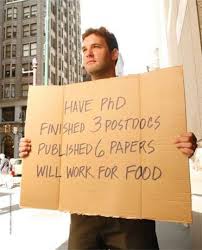 I thank Peter Christiansen for sending me this article from The Economist: The Disposable Academic: Why Doing a Ph.D. is Often a Waste of Time.
After reading the article, I posted this response on The Economist's website:
I speak with some knowledge here: I hold a Ph.D. from the University of California, Berkeley specializing in evaluation of education and subsequently have been on the faculty of four graduate schools, including Berkeley.
In my view, the key to abbreviating the length of a Ph.D.and post-doc program is to eliminate the arcana, of which there are mountains. Primarily teach the tools required for excellent research: e.g., research design, how to critique research, and yes, expose the students to core cutting-edge areas in a discipline to help them identify their desired research focus. Such training could, in my judgment, most time-effectively be learned if the program were just two years long.
As important, I'd cut by 80% the number of slots in Ph.D. programs, referring the other applicants to equally abbreviated, practically-oriented doctorates (e.g., Psy.D, Ed.D.) taught not by Ph.D.s (disproportionately esoterica-focused theoreticians) but by master practitioners with the rare ability to convey their mastery to students.
So much university research is known, apriori, to be of trivial value, certainly known upfront to be cost-ineffective expenditures of taxpayer dollars--and much of such research indeed is funded by the taxpayer. Especially in these tough economic times, it would be wiser to allow taxpayers to retain their money than to fund yet another study on, for example, the deconstruction of the use of the doppelganger in 19th century literature.
UPDATE: Upon reading this post, a reader forwarded me this even more powerful caution against pursuing a Ph.D.
And I'm reminded of an article on the topic that now, five years later, still remains top-of-mind for me.
Wednesday, October 6, 2010
GeneralEd.Org: General Ed Reinvented
 Think of all the minutes you spent in undergraduate classes. Add the homework and study time. Add the travel time. Now be honest with yourself: Do you believe you derived sufficient useful learning to justify all that time and money? Might that time and money have been better spent?
Perhaps these statistics will startle you into realizing how little most people gain from their undergraduate classes:
- A study supported by the Pew Charitable Trusts found that 50 percent of college seniors scored below "proficient" levels on a test that required them to understand the arguments of newspaper editorials or compare credit card offers. Almost 20 percent of seniors had only basic quantitative skills. The students could not estimate if their car had enough gas to get to the gas station.
- The Spellings Report, released by a federal commission on higher education, found that: "Over the past decade, literacy among college graduates has actually declined...Employers report repeatedly that many new graduates they hire are not prepared to work, lacking the critical thinking, writing and problem-solving skills needed in today's workplaces."
If you're like many people, you say, "Perhaps I didn't learn enough of enduring value from my $100K and 4-6 years of classes but I needed the bachelor's degree to get a job or get into graduate school." True, today, more than ever, employers are demanding a degree.
But there has to be a better bachelors degree, a way you can learn more of greater value at less less cost. That shouldn't be too difficult. After all, colleges continue to teach virtually as they did 2,000 years ago minus the toga and plus Powerpoint: a sage on the stage plus discussion.
Here, I propose a better way--a much superior kind of online bachelor degree. I call it Utopia U. Of course, online degree programs are already available but as you will see below, Utopia U promises to indeed be clearly superior.
I would gladly give away the concept to entities willing to run with it but if I'm forced to proceed myself, I will try to get it funded by tuition fees and housing it on Google.com, and/or with grants from the U.S. Office of Education (where it might be called U.S. U) one or more universities or foundations (e.g., Gates or Kauffman,) and/or investments from corporations, for example, Apple or Warren Buffett's Berkshire Hathaway.
Central to each course are these features:
- The core screening criterion for course content: Is that content central to the life well-led? The primary focus of each course will be to maximize the probability that the students will incorporate each course's core skills and knowledge into the way they function professionally and personally.
- Most courses should make heavy use of of immersive simulations plus lecturettes with options to click on links to explanatory text, video, etc.Each instructor would develop the course in collaboration with a top instructional designer and a specially selected computer programmer.
- The instructors, selected from within and outside academia, will be selected on: demonstrated ability to explain complicated concepts so average students understand them fully, motivate students to love learning, and be transformational: help students grow in important ways beyond learning the course material. I will likely reach out to winners of state and national professor of the year awards.
- There will be student-to-student online interaction: discussions about lecturettes, group immersive projects, forums to address problems (as on most website help sections), etc.
- Iris or fingerprint recognition technology and open-book exams will reduce cheating to levels below that at traditional universities.
All students will graduate with a Bachelor of Professional Studies. For a version of this document that includs the courses and modules, click HERE.
As I mentioned, my preference is to give the idea of Utopia U away to a person or entity motivated to run with it. I'd be pleased to serve as a consultant. Anyone interested? Contact me at mnemko@comcast.net or 510-655-2777.
Tuesday, April 21, 2009
Will Campuses Become Irrelevant?
A BYU professsor thinks that in a world of YouTube and iPhones, paying $100,000+ for a campus-based education will be seen as absurdly not worth the money. Also see the nearly 100 comments that follow the article.
Monday, September 22, 2008
Higher Education's Iconic Status Continues to Erode
 I've long written, for example, in an article in the Chronicle of Higher Education, that higher education is America's most overrated product.
 I've also pointed to growing support for that contention in major media outlets. The most recent occurred today in a BBC editorial denigrating no less than Harvard Business School.
It is ironic that the more prestigious a college, the worse the instruction is likely to be. That's because colleges gain most of their prestige from their professors' research productivity, which is inversely correlated with the ability and desire to teach. Also, compared with low-prestige colleges, prestigious universities spend a higher proportion of their budgets on research.
Designer-label colleges can get away with charging so much and providing so little because students are brand-name driven in choosing a college, knowing that, with a designer-label diploma, employers will hire them, whether or not they learned anything at college.
Interestingly, the BBC invited Harvard Business School to respond to the scathing segment--Harvard declined to.
Thursday, August 21, 2008
What I Plan to Say About College on ABC-TV's 20-20

I've been invited to appear on ABC-TV's 20-20 to discuss whether college is worth it. Here are my planned talking points:
After adjusting for financial aid, the amount families pay for college has skyrocketed 439% since 1982--to subsidize silly research, pay for fancy buildings, bloated administrations, palatial dorms, and fancy gyms complete with rock-climbing walls.
The statistic that colleges most often cite to justify their astronomical costs is that you earn much more with a college degree. That’s terribly misleading: If you locked the pool of college-bound students in a closet for four years, they’d earn more than the pool of non-college-goers: They’re brighter, more motivated, and have better family connections.
Yes, employers increasingly require college degrees, but there’s no need to attend an expensive college. That’s especially true of the thousands of private colleges that do not have a designer label, but it’s even true of a designer-label college:
A study by Princeton professors Krueger & Dale found no difference in earnings whether a student graduated from an Ivy League institution or State U. Implication: Start at a community college: Dorm life is overrated anyway--kids living together for the first time too often end up creating Animal House environments. That’s why the dropout rate is so huge: More than 40% of students attending so-called four-year colleges don't graduate even if they're given--and pay for--six years of college. And the learning rate is equally low. (See below.) Besides, teaching quality is usually BETTER at community colleges than at the Ivies because faculty is hired and promoted mainly on how well they teach, not how much research they crank out--The kinds of people likely to be good researchers are the OPPOSITE of the kinds likely to be good undergraduate instructors.
Parents can save the money without short-changing the child if they beg their kids to do the few things that enable one to make the most of college:
-- Choose professors carefully; for example, read online student reviews of them. Pick the professors most likely to teach you to think and write better and who will inspire you.
-- Take writing-and reasoning centric courses: for example, rhetoric.
-- Participate in extracurriculars such as debate, student govt, and student newspaper.
-- Take classes that expose you to a wide range of political perspectives.
-- Search out great peer and adult mentors.
If your child did poorly in high school (bottom half of his high school class), do NOT take a four-year college’s willingness to admit your child as an indication of his likely succeeding there. Among students at so-called four-year colleges who graduated in the bottom 40% of their high school class, 2/3 never graduate even if given 8 1/2 years. Meanwhile they’re accumulated a mountain of debt, devastated self-esteem, and the huge opportunity cost: what they could have been doing if they hadn’t been taking academic courses. Such students should consider apprenticeships, career-prep programs at community college, the military, or learning at the elbow of a successful small business owner.
The higher ed lobby is very powerful (for example, ACE and AASCU)--pushing, for example, for increases in financial aid, which turn out NOT to mainly benefit students but the universities: giving students more financial aid allows colleges to raise tuition further. So, when a politician says “I voted to increase financial aid,” he actually mainly voted to use people's tax dollars to line the pockets of colleges, not to make college more affordable.
Those lobbying organizations also fight against colleges being required to be accountable for how much value they’re providing for all the time and money students spend on college. The Spellings Commission (a 2006 federal panel looking at higher ed) pointed out how frighteningly little learning accrues from college and recommended that colleges be held more accountable.
For example, a 2006 study supported by the Pew Charitable Trusts found that 50 percent of college seniors scored below "proficient" levels on a test that required them to do such basic tasks as understand the arguments of newspaper editorials or compare credit-card offers. Almost 20 percent of seniors had only basic quantitative skills. The students could not estimate if their car had enough gas to get to the gas station.
Unbelievably, according to the Spellings Report, things are getting even worse: "Over the past decade, literacy among college graduates has actually declined … According to the most recent National Assessment of Adult Literacy, for instance, the percentage of college graduates deemed proficient in prose literacy has actually declined from 40 to 31 percent in the past decade. … Employers report repeatedly that many new graduates they hire are not prepared to work, lacking the critical thinking, writing and problem-solving skills needed in today's workplaces."
But the higher ed lobby effectively quashed the Spellings Report’s recommendation that colleges be more accountable. Congress instead, in 2008, did just what the higher ed lobby wanted: increased financial aid without making colleges more accountable for the quality of education they dispense.
We require tire manufacturers to mold into the sidewall of every tire its treadlife, temperature, and traction ratings. Yet colleges, which are so much more expensive and could so affect students’ lives, have virtually no accountability.
Government should require colleges to prominently post on its website a College Report Card:
- the amount of freshman-to-senior value added in writing, reading, thinking, and math reasoning
- the percentages of students with varying high school records who graduate in four years
- the average amount of cash families with varying income and assets must pay and the average amount of loan that is assumed
- the results of its most recent student satisfaction survey
- the executive summary of the institution's latest accreditation visiting team report
- the average earnings of its graduates
Friday, August 15, 2008
"College is a Waste"

It's rewarding when the contention you've long asserted--that the college degree is America's most overrated product--makes it to the lead editorial in the Wall Street Journal. This op-ed by Charles Murray appeared yesterday.
Thursday, July 31, 2008
More Projects That Can Make a Difference

As I wrote yesterday, I have many more project ideas than I have time for. So, if you don't want to do any of those I mentioned yesterday, how about one of these?
- A private elementary school for high-ability kids or a chain of them. No Child Left Behind and other public school programs driven more by politics than pedagogy are denying bright kids their right to an appropriate education, curtailing their ability to live up to their potential.
- A career counselor who does the job searching for clients. This person would cold-call and answer want ads on behalf of clients, so all the client would have to do was show up at the interview.
- Create Utopia College, an undergraduate college whose sole mission was to help undergraduates grow in important ways and to land good employment after graduation.
- Advocate for men. On behalf of the National Organization for Men, continually send op-eds and letters to the editors of the major media. Offer to appear on major TV shows, perhaps having debates on such propositions as: Who has it better: men or women?
- Intelligent Choice: A high-school or college course helping young women to realize that the choice of their child's father has a profound effect on both their child and themselves.
- A parenting education course: Taught in high schools, colleges, as part of LaMaze classes, or in maternity ward hospital rooms, this course, based on the critical incidents in parenting ,would help ensure that, from day one, parents had the skills to raise their children well.
- A financial literacy course: Taught in high schools or colleges, this would teach students how to get good deals, avoid getting ripped off, manage checkbooks and credit, and invest wisely (The word "Vanguard" would appear prominently.)
- An entrepreneurship course: This, unlike courses commonly taught in universities, would not focus on building scalable large innovations, which are too risky for the average self-employment aspirant. This course would focus on replicating low-investment, proven successful businesses as well as the art of unearthing out new, practical ideas and how to bring them to fruition.
- Champion three-week-long, publicly funded elections. That would encourage good candidates to run and ensure they weren't in special interests' hip pockets. To help ensure an informed electorate, voter information pamphlets and websites would include the candidates' voting record and position on key issues.
Thursday, July 24, 2008
One More U.S. Advantage is Eroding
 America has always prided itself on having the finest universities in the world. Of course, that reputation is built almost completely on their research, not the quality of education provided, especially to undergraduates. Indeed, as I've documented in previous posts and articles, the quality of teaching is, on average, abominable, and the feeble student growth is evidence of that.
I recently bought two audio courses offered by The Teaching Company, which claims to comb America's most prestigious universities to find its very finest instructors. Both courses were horrible. The first was on Beethoven sonatas. The course leeched the life out of every note. Each bar was intellectually analyzed until all pleasure had been excised. In the course on argumentation, the instructor attempted to reduce argumentation to an elaborate model of principles, which I am certain will not improve my argumentation skills, nor could I imagine they'd improve anyone else's, certainly not enough to justify the 12 hours of listening time.
At the same time as American universities continue their atavistic, abstruse ways, Chinese, Indian, and other Asian universities are improving, balancing their traditional emphasis on students mastering copious material and acquiring high-level skills with a new focus on enhancing students' creativity and problem solving ability. Those improved Asian universities will both better educate their already capable, hard-working people, and encourage their best and brightest to not come to the U.S but to stay in their homeland. Meanwhile a new study reported in USA Today finds the number of American students taking classes abroad has tripled in the last decade.
The U.S. desperately needs to convert most of its universities from arcana research factories to undergraduate-centered colleges in which immersive simulations and not lectures are the norm, in which courses' primary goal is to improve students' reasoning, writing, speaking, and mathematical reasoning skills, and in which faculty is hired and promoted based on how well they can educate and inspire, not how many useless, self-indulgent, often outre research articles they can crank out.
Wednesday, July 9, 2008
If I Could Reinvent Undergraduate Education
 My previous posts and articles such as America's Most Overrated Product: A Bachelor's Degree document how little value added the average college student accrues for all the years and money spent.
Here, I allow myself the luxury of dreaming up Utopia College. Here would be its major components:
1. Faculty would not have PhDs. They'd have a masters in higher ed. teaching. Their training would focus on how to help typical undergraduates grow in those critical elements of an undergraduate education: writing, critical thinking, mathematical reasoning, ethics, how to learn, and as Ralph Wolff, president of the Western Association of Schools and Colleges advocates, unlearning: We get very stuck in our ways, which will be ever more dysfunctional as the pace of new knowledge accelerates.
2. Courses would be problem-centered rather than discipline-centered. So they'd bear such titles as "What, if anything, should we do about climate change?" "The art of finding and nurturing a great romantic relationship" and, "Reducing the racial achievement gap."
3. Provide extensive opportunities for long-term, one-on-one relationships with faculty, peer mentors, etc. All faculty and students would receive training on how to be a mentor and protege.
4. Cost of attendance would be dramatically reduced. There are many ways to lower cost without reducing quality:
- Utilize faculty and student residences as classrooms. They lie vacant during the day.
- Using non-PhDs as faculty would be less expensive and more effective. The disparity between the way PhDs and undergraduates think is too great. Also, many PhDs’ primary interest is research, often arcane research that shouldn't be core to undergraduate education. Carefully selected holders of an M.A. in undergraduate instruction would be both less expensive and better.
- Forgo fancy administration buildings.
- Forgo country-club-like campuses with their arboretum-like lawns and shrubs and amenities such as swimming pools and golf courses. Instead, make deals with nearby swimming and golf facilities that enable students to participate at reasonable cost.
- Reduce the cost of marketing. By providing crucial data about Utopia College (see below) on its website, the college should be able to sell itself. And because Utopia would offer a superior undergraduate education at a very low price, the media will likely provide lots of marketing assistance of greater credibility than any brochures a college could create. What sorts of data would be provided?
-- Results of the most recent student-satisfaction survey, to be conducted by the institutions themselves.
-- The most recent accreditation report.
-- The average cash, loan, and work-study financial aid for varying levels of family income and assets. And because some colleges use the drug-dealer scam — give the first dose cheap and then jack up the price —Utopia College would list the typical financial aid packages, not just for the first year, but for years 2 through 6.
-- Retention data: the percentage of students returning for a second year, broken out by SAT score, race, and gender.
-- Safety data: the percentage of an institution's students who have been robbed or assaulted on or near the campus.
-- The four-, five-, and six-year graduation rates, broken out by SAT score, race, and gender.
-- Employment data for graduates: the percentage of graduates who, within six months of graduation, are in graduate school, unemployed, or employed in a job requiring college-level skills, along with salary data.
And so now, dear readers, what do you think? Have any suggestions for improving Utopia College?
I want to thank Ralph Wolff for the stimulating discussion that spawned this blog post. Of course, I take full responsibility for any and all weaknesses herein.
Subscribe to:
Posts (Atom)

