Showing posts with label underemployment. Show all posts

Friday, February 23, 2018

When There Aren't Enough Good Jobs to Go Around

Most routine and moderate-judgment jobs will be automated. Many high-judgment jobs will require exceptional reasoning ability and technical skills. That means that hundreds of millions of Americans, not mention the billions worldwide, won't sustainably earn enough income.

Most of them will live very modestly, perhaps relying on a Guaranteed Basic Income. But even if they are thus financially supported, they will lack the satisfaction of a job: being productive, needed, appreciated. The obvious sequelae are depression, anger,  crime, and drug abuse. Is there a way to avoid all that?

My PsychologyToday.com article today offers a proposal. Your agreement, amplification, disagreement, and alternate proposals are welcome.

Wednesday, November 11, 2015

A Workover: She Has a Master's from Berkeley Yet Makes $11 an Hour

On my NPR-San Francisco radio program, I do Workovers: Callers call in with a career problem.

I've been posting edited transcripts of Workovers that might interest PsychologyToday readers. Here's today's offering.

Wednesday, October 8, 2014

Diary of a Job Seeker

A caller to my radio show yesterday called for help: He has a degree from Berkeley and the best job he’s been able to get is pizza deliverer.

In my PsychologyToday.com article today, I create a fictitious diary that embeds some career lessons. HERE is the link. 

Friday, February 18, 2011

An Attempt to Scare You into Working Harder to Land a Job

We all like reassuring news. So when job seekers read the headline: "Unemployment down to 9%," the feeling is, "Well, 9% is bad but a little better, so maybe it won't be so hard to land a job."

Anecdotally, my career counseling clients are having a much tougher time than ever trying to land a decent job, and two analyses of the unemployment statistics explain why. The self-serving government statistics grossly underestimate how difficult the job market really is:

The Editor-in-Chief of U.S. News wrote THIS, and this week's, Business Insider contained THIS even more frightening piece: 19 Scary Facts About Getting a Job in America. I too wrote on this topic.

The Business Insider report concluded with, "Getting a job today means going up against terrifying odds."

Yes, if a job seeker is a star and/or has a powerful network, s/he will find a job without undue pain. But the more typical job seeker must face today's reality that to land a decent job, you may be in the fight of your life. I say this knowing it's scaring you but I'm finding that most job seekers still delude themselves into thinking that the normal job search efforts that worked in the past will still work. I want you to be employed, so I feel I should try to shake you from your complacency.

Today, average, let alone below-average candidates must do an A+ job search: some combination of compelling cold and warm contacts with employers who are not advertising jobs, outstanding internet/social media presence, cover letters and resumes that prove, not just assert, your ability to be a superior employee in the applied-for position, and perhaps most important, knock-em-dead collateral material. Examples: A salesperson sends 50 great leads he'd call if hired. A CFO describes the top 10 trends in C-level financial work that would be crucial for that company to consider. An applicant sensing a fluid job description, writes a post-interview thank-you note that tactfully proposes a reinvented job description that would be better for the employer and for which the candidate is an ideal fit.

I wish I could say, as I have in earlier years, that a moderate, steady, well-targeted job-search will usually work. Unfortunately, today, everything has changed. We are forced to ratchet-up our efforts...significantly. Alas.

Monday, December 6, 2010

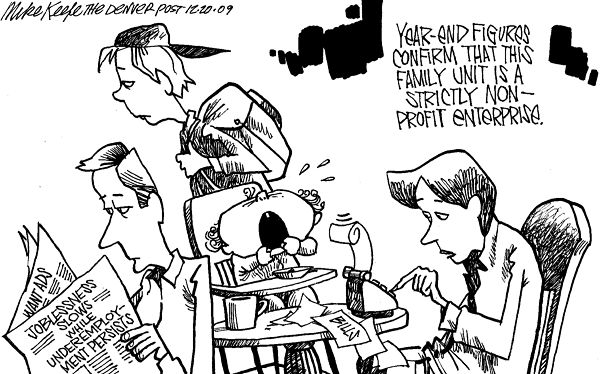
The True Underemployment Rate

A more accurate way to compute the underemployment rate would include:
  • Unemployed and actively looking for work (currently 9.8%)
  • Discouraged workers. Those who'd like to work but have given up. (another 10%)
  • Underemployed. Those working part-time who'd like to work full time (another 10%)
  • Misemployed job level. Those working at a lower-level job than they're qualified for (I estimate another 15%)
  • Misemployed interest area. People who dislike their field of endeavor but felt forced to be in it because of a lack of jobs in a field they're interested in, for example, the arts. (I estimate another 20%).
In sum, I believe that well over half of Americans are not doing work they're satisfied with. (And that doesn't count the many people who don't like something about their particular job: their boss, coworkers, the employer's ethics, etc.)

What to do to reduce the underemployment rate?
  • A national jobs database so employers and employees could more efficiently be matched.
  • Career advising starting in the 8th grade so more people could, early on, identify a well-suited career goal.
  • A public service announcement campaign encouraging people to hire tutors for their kids, personal assistants for themselves, and companions for their elderly relatives. That would create millions of pro-social jobs that currently don't exist.
  • Have all high school students take a course in ethical entrepreneurship. People with new business ideas create jobs while meeting the citizenry's unmet needs.
 

blogger templates | Make Money Online