Showing posts with label climate change. Show all posts

Monday, June 20, 2011

Reinventions: Climate Change

I've decided to make YouTube videos describing some of the reinventions I plan to include in my book, Reinventions: Fresh Ideas on the Big Issues. Here's the first of those videos. If you'd rather just read the text, the transcript appears below:


REINVENTIONS
Climate Change
by Marty Nemko
(transcript of the video above)

I'm Marty Nemko and this is the first of my reinventions. I want to reinvent our approach to climate change from one of nearly religious zeal to one of dispassionate agnosticism. Here's why.
The science is NOT yet clear enough to justify the enormous cost and severe restrictions on our freedoms--for example the gridlock we'll ever more be forced to sit in because environmentalists are blocking freeway building. And then there are the opportunity costs: what the money and efforts could otherwise be devoted to, for example, figuring out how to cure cancer, or improve education.

You might ask, "How can you say the science justifying making major efforts to try to cool the globe is unclear? The UN's International Panel on Climate Change, consisting of 1,200 scientists say it's true."
Fact is, of those 1,200 scientists, only a few have power and those few are a politically stacked group--scientists ideologically predisposed, data or not, to want to be "strongly green."

When one looks dispassionately at the data on climate change, it's clear that more and better data are needed. Remember, to justify the huge costs, all of five things must be true:

1. Climate change must be occurring.

2. The climate change must be significantly manmade. The most recent study by the prestigious European agency, CERN, calls that into serious question.

3. The climate change must be a net negative. (In fact, global warming will make much of the world's cold climates more livable and arable.)

4. The plan to cool the planet must actually work.

5. There must be substantial worldwide compliance with the greatly increased costs and severe incursions of freedom that the effort to cool the planet would require. Even more problematic, that worldwide compliance would need to remain in place for the 50 to 100 years until technology advances enough to make such costs unnecessary.

The odds of all five of those things occurring are tiny--and that assumes that the computer prediction models are valid. And no less than top scientists MIT's Richard Lindzen, Harvard's Willie Wei-Hock Soon, and Princeton's Freeman Dyson (arguably the world's most eminent living physicist,) and many less well-known but credible scientists are convinced that the computer models are based on very dubious assumptions. That too is the upshot of Climate Change Reconsidered, a 430-page, September 2011 report written by 11 scientists and sponsored by three climate-change-related nonprofits. (It should be stressed that their questioning the wisdom of making massive efforts to cool the planet remains only a dissent from the dominant position held by the IPCC, Al Gore, etc.)

Certainly, bang-for-the-buck efforts to reduce our carbon footprint should be implemented, for example, raising gas-mileage standards. That minimally impedes freedom yet saves a fortune, reduces pollutants, and increases energy independence.

The reinvention I ask for is for scientists, the media, and all of us to recognize that there are responsible narratives other than "The world is doomed unless we spend, virtually without limits, to attempt to cool the planet." We need to replace the censorship of the dissenting view I outline here with a careful consideration of it. It's time for research and for debate, not massive spending. There are too many surer ways to spend money and effort to improve humankind: immunizing children in developing countries, better funding research on sudden heart attack, improving the quality of education everywhere so it lives up to its yet unrealized promise as a magic pill.

Saturday, February 5, 2011

What I'd Say to the United Nations

If I were to give a talk to the United Nations in light of the coming regime change in Egypt, here is what I would say:

The lack of well-paying jobs, especially in countries that are subject to political and religious extremism, for example, Egypt, will result in continued increases in terrorism.

Those increases will engender ever greater risk of worldwide cataclysm as weapons of mass destruction become ever more miniaturized.

Think, for example, what would happen if a terrorist released a vial of highly communicable deadly smallpox in an international airport check-in area. (That's before the TSA screening.) Or a terrorist in one of the millions of trucks that visit crowded downtowns detonated a suitcase- or larger nuclear or radiologic device.

The solutions are:
1. We must talk with terrorist organizations. Engagement has a better risk/reward ratio than vilification. More important,
2. We must be far smarter in how we spend our money. We currently spend fortunes far in excess of their likely benefit on, for example, military adventurism, stopping airline shoe bombers, space exploration, politically popular social programs known not to work, and dubious schemes to try to cool the planet.

We must redirect that spending to efforts far more likely to improve humankind, for example:
  • teaching entrepreneurship (the key to creating jobs)
  • encouraging an Assistance Army, in which people are encouraged to hire assistants: new-parent helpers, parenting coaches, homework helpers, personal assistants, companions for the elderly, etc.
  • decreasing people's belief in materialism. There will no doubt be times when there are not enough well-paying jobs to go around. People need to realize that materialism, even the holding of private property, is not key to the life well-led. In the end, kindness, productivity, and simple pleasures are more central.
  • the primacy of ethics. Regarding the latter, everyone must be taught again and again, through adults' actions as well as their words, that all of us must consider, before undertaking any action, what's best, not just for us, but for humankind.
Even as I write this, I worry that perhaps I'm overestimating the potential for the full range of humankind to behave according to universal wisdom. After all, I must admit that typically, my behavior is altruistic only as long as it doesn't hurt me. Too often, I forgo the unpleasant altruistic act. Occasionally, my behavior is even mildly malevolent, as when I sneer at a driver who's driving only at the speed limit unlike my usual 10 mph over.

But I prefer to err on the side of optimism. So I would like to close by stipulating to my proposed solutions being very difficult to implement although perhaps not as difficult as the effort to cool the planet. But I believe the results, even if imperfect, would do more to improve the lives of humankind than anything else, yes, anything else. Certainly, my plan is far better than what we're currently doing. Should we begin?

Tuesday, February 16, 2010

I Have Deleted One of My Posts

My post yesterday touted a front-page article in the February 14, 2010 Sunday London Times titled "Earth May Not Be Warming, Scientists Say."

I've since received compelling emails from a "Cheryl H' and from an anonymous reader that convinced me that the article's author, Jonathan Leake, has a record of being biased in his reporting on the subject and that some of his cited experts are insufficiently credible. So I have decided to remove that blog post.

I remain an agnostic on whether the opportunity costs justify the massive but likely to be unsuccessful effort to cool the globe. But I've become convinced that that London Times article does not add to the quality of the debate.

Friday, September 25, 2009

Is Watch-and-Wait A Wiser Strategy Re Global Warming?

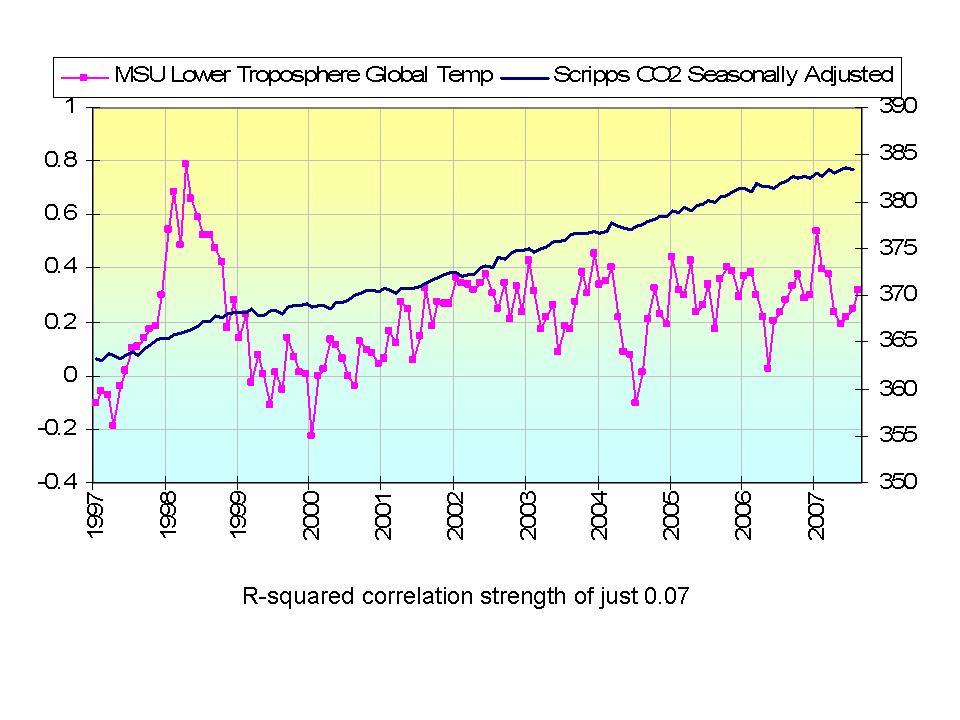
With so many compelling problems facing the world--from cancer to world poverty--I cannot understand why liberal leaders such as President Obama are so eager to immediately start spending so massively in perpetuity in an attempt to cool the planet when average global temperature has gone up just 1/2 of one degree since 1880 and flat or declining for the past decade, even if we don't count the aberrantly warm year of 1998. Here's another chart, this one from MIT, reporting that there's been essentially no increase since 1995!

Insisting on immediately and massively spending to try to cool the planet seems particularly foolish because key evidence suggests that even that 0.5 degree warming since 1880 is at least partly natural variation, not man-made. For example, there has been a major CO2 increase during most recent decade, a period in which temperatures have been flat or declining. Atmospheric CO2 is a proxy for man-made hydrocarbon emissions. If man-made behaviors were causing global warming serious enough to justify the world making massive efforts to cool the earth, global temperatures should not be declining. Even if other factors are masking the man-made contribution to global warming, the amount and rate of global warming is small, far less than predicted by Al Gore and his anti-corporation-motivated allies. And remember the climate change alarmists' data is based heavily on highly conjectural computer models: garbage in-garbage out.

Another untested assumption: Even if, over the next 50 years, average global temperature were to reverse trend and rise, would the net effect be so negative as to justify an immediate and massive indeed quixotic effort to slow it? For example, many areas, for example in Canada and Russia, previously too cold to grow crops, would become farmable. An article in Germany's leading magazine, Der Spiegel makes the case that it's impossible to predict whether global warming, if any, will yield a net positive or negative effect on the earth.

Perhaps the most dispositive reason to watch-and-wait instead of, right now, spending massively to try to cool the planet, is the extraordinary difficulty, indeed unrealism, of trying to get the worldwide spending of incomprehensibly large amounts of money, curtailment of development and of travel in perpetuity that would be required to possibly achieve even a one- or two-degree decline in average global temperature.

Charles Siegel of preservenet.com commented on today's New York Times editorial that said:
"The hope is these [Copenhagen] talks will produce commitments from each nation that, collectively, would keep temperatures from rising 2 degrees Celsius above preindustrial levels. That will require deep cuts in emissions — as much as 80 percent among industrialized nations — by midcentury." Siegel commented, "In reality, it requires at least an 80% cut in emissions in the entire world by 2050, not just from the industrialized nations." Is it realistic to do that?

There are only so many fiscal and human resources to go around. If we immediately and forever spend so massively on trying to cool the globe, we will have to shortchange initiatives with a higher probability of improving humankind--such as a true war against cancer or world poverty.

Of course, some efforts to cool the planet also facilitate energy independence, for example, nuclear energy and conservation efforts that minimally impinge on our freedom such as higher CAFE standards. I support both of those measures. But the sorts of permanent massive spending and incursions on our freedoms (for example, restricting road building thereby encouraging gridlock, and eliminating already scarce city parking spots, forcing us into inevitably time-wasting mass transit) being proposed by President Obama and other liberal world leaders is incomprehensible to me.

It seems to me that in light of the 15-year flat global temperature and below-average extreme weather such as hurricanes despite the CO2 increase (the opposite of what Al Gore and the IPCC's politically stacked panel predicted,) and that the money and effort could be diverted to better address the world's enormous pressing needs, a few years of watch-and-wait, accompanied by continuing, non-politically-motivated research on the above questions, along with private-sector research into improved alternative energy sources is a wiser path than immediate massive spending to try to cool the planet. What am I not understanding?

Wednesday, May 6, 2009

We Must Come to Accept a Measure of Uncertainty

Now that the probability of the swine flu becoming a major worldwide killer appears to be declining, it would be easy to criticize public health officials and the media for overreacting. And you might think that I, as libertarian-leaning and a frequent critic of the media, would do so.

However, in this case, I believe both public health officials and the media performed admirably.

No one could have, apriori, decided with reasonable confidence that this new virus would not become a megakiller. So the wisest approach was to alert the public to take the measured precautions (wash hands, avoid nonessential travel to Mexico), carefully monitor all suspected cases of swine flu, immediately conduct research to see if the new virus's molecular structure suggests high virulence, and wait as long as possible before deciding whether it's worth diverting vaccine manufacturing from seasonal flu vaccine to swine flu vaccine. The world's public health apparatus did all of the above.

They did not take the more extreme steps such as closing borders and prohibiting air and subway travel. Officials wisely recognized that we cannot reduce risk to zero. It rejected the absurd Precautionary Principle, which is many environmentalists' guiding principle. The Precautionary Principle argues that we should not undertake something new if it entails any risk. That black-and-white rule would have stifled immense amounts of scientific research that have benefited mankind--for example, human or even animal testing of any drug that now routinely saves lives.

Yet for example, the environmentalists that oppose "genetically modified foods" are trying to force farmers not to grow, for example, special high-protein, disease-resistant corn despite reasonable although not absolutely dispositive evidence that the resulting food causes no health risk.

Just as Israelis choose to live in that dangerous state despite the clearly non-zero risk of living next to people who elected a political party, Hamas, sworn to the Israelis' destruction. we must accept that there is greater likelihood of a worse life if we insist on reducing risk to near zero.

I believe that we should, for example, be willing to accept greater risk in hopes of much greater rewards in deciding policy regarding genetic engineering and, yes, whether it's worth expending unprecedentedly massive resources--2% of world GDP for decades is widely proposed--to attempt to cool the globe.

Thursday, April 16, 2009

More Evidence That Going Green is Very Risky

My friend, Jeffrie Givens, sent me this new study on "green jobs" in Spain. It finds that for every green job created by the government, 2.2 jobs were lost by the private sector. The study goes on to report that the financial costs and the loss in jobs are not unique to Spain and that only one in ten jobs created were permanent jobs.

Will America's green job mandate do this to America too? A 2009 report by the Institute for Energy Research predicts that indeed it will. Here's an excerpt:

"It is highly questionable whether a government campaign to spur “green jobs” would have net economic benefits. Indeed, the distortionary impacts of government intrusion into energy markets could prematurely force business to abandon current production technologies for more expensive ones. Furthermore, there would likely be negative economic consequences from forcing higher-cost alternative energy sources upon the economy. These factors would likely increase consumer energy costs and the costs of a wide array of energy-intensive goods, slow GDP growth and ironically may yield no net job gains. More likely, they would result in net job losses."

Indeed, I am finding, in my career coaching practice, that most of the new green jobs are short-term, temp project work. When the government stimulus runs out, the sense is that these jobs will evaporate. And most of them are not good jobs, even if they did last. For example, the stimulus package includes $5 billion to weatherize low-income homes. Well, those jobs usually include such unpleasant activities as crawling into tight attic spaces to blow (and breathe) treated-cellulose insulation.

And now let's turn to whether trying to stop climate change is worth it. Ever more scientists are saying no. For example, to have even a trivial impact on global warming would require the world to reduce its carbon footprint by a politically unrealistic 70(!) percent. Those scientists argue that it's far wiser to spend the far more moderate amount of money needed to adapt to global warming than to attempt to cool the planet.

We must stop treating environmentalism like a religion but rather as one of many possible areas for expenditure that society must, in a clear-eyed way, decide whether to fund and to what extent. To spend massive sums on a boondoggle means that many, many other initiatives go unfunded, and in turn, unimaginable and avoidable human suffering will occur.

For example, while the massive green spending and incursions into freedom being contemplated are of truly uncertain benefit, it is a certainty that giving that sum of money directly to the African people could save millions of lives and dramatically improve the standard of living of millions more. Yet we're making the largest bet in world history that "going green" will be worth the costs and opportunity costs. I truly do not understand.

I must be wrong. Indeed, most nations, led by the extraordinarily respected Barack Obama are betting so many chips on Green. But what, in fact, am I not understanding?

Wednesday, March 11, 2009

A Summary of My Environmental Views

Today, I received an email inviting me to join an environmentalist organization. Here was my response:

I would not join such an organization. I am distressed at how environmental policy has become "religion," going well beyond the science, claiming consensus where it doesn't exist, and censoring the hundreds of dissenting, responsible scientists.  (They had to create their own annual conference because they were shut out of the UN/IPCC's, which these scientists blast as politically motivated.) Here is Reason Magazine's coverage of this year's conference, which concluded today.

Especially in these tight economic times, we should not be doing what Obama and the Al Gore-led ExtremeGreens want to force us to do--divert massive amounts of our precious fiscal and human resources in a (vain) attempt to cool the earth.

Nor do I support the onerous restrictions on our lives that Obama and his ExtremeGreen-packed team plan to force upon us in an attempt to obtain energy independence, for example, pressuring us onto time-wasting mass transit by building no new freeways and converting existing ones into toll roads. Meanwhile, TeamObama is  wildly spending our tax dollars on physics-delimited solar and wind power and his green allies are throwing as many roadblocks as possible in front of building nuclear plants, which Europe and China wisely recognize as core to the energy-independence solution. 

If America intentionally were trying to destroy itself, it could hardly do a better job than Obama and his ExtremeGreens are doing, powerfully promulgating policies most of which, at their root, are based on bailing out bad and irresponsible businesses and individuals with money from the good and the responsible. He generally follows Marx's core tenet: from those who have to those who don't. Per the fall of the Soviet Union, all the Eastern bloc countries, and Cuba, that's a formula for a society's demise. 

When our children grow up, they will shake their heads wondering what we did to America.

Wednesday, January 28, 2009

Obama Exaggerates Expert Consensus

President Obama claims broad expert agreement with his economic and global warming plans.

Unfortunately, it's untrue. First, let's look at Obama's stimulus plan:


From the
Cato Institute's Fiscal Reality Center:

President Obama says that "economists from across the political spectrum agree" on the need for massive government spending to stimulate the economy.

In fact, hundreds of leading economists disagree including Nobel laureates and other prominent scholars. They have all signed the statement that appears in the Cato Institute's ad in the New York Times and in other national publications.

With regard to the need to spend massively to stop global warming, Obama has appointed only true believers to his science, environment, and energy committees. Yet hundreds of leading climate scientists dissent from the so-called consensus. Indeed, the International Conference of Climate Change to be held this March "calls attention to new research that contradicts claims that the moderate warming during the 20th century was primarily man-made and is a crisis." Speakers will include dozens of eminent scientists including Richard Lindzen .the Alfred P Sloan Professor of Meteorology at MIT, Willie Soon, physicist at the Solar and Stellar Physics Division of the Harvard-Smithsonian Center for Astrophysics, and Lord Christopher Monckton, chief policy advisor to Britain's Science and Public Policy Institute and former advisor to Prime Minister Margaret Thatcher.

Sure, "economists (and scientists) from across the political spectrum" support Obama's policies but Obama carefully avoids saying whether it's 1 or 1,000 right-of-center experts. Could Obama be taking word-parsing lessons from Bill Clinton? Is IS Is.
Cato Stimulus

Thursday, December 11, 2008

U.S: Senate Report: 650 Scientists Dissent From Man-Made Global Warming Claims

Yesterday, in a photo op with Al Gore, president-elect Obama reiterated his agreement with the Gore/UN position on global warming and pledged to "take action" (translation major tax dollars) to try to stop it. This occurred just as this report was being released by the U.S. Senate Dept. of Public Works and the Environment Minority Committee. Here are its highlights:

Link to Full Printable PDF Report  

OVERVIEW

Over 650 dissenting scientists from around the globe challenged man-made global warming claims made by the United Nations Intergovernemntal Panel on Climate Change (IPCC) and former Vice President Al Gore. This new 231-page U.S. Senate Minority Report report -- updated from 2007’s groundbreaking report of over 400 scientists who voiced skepticism about the so-called global warming “consensus” -- features the skeptical voices of over 650 prominent international scientists, including many current and former UN IPCC scientists, who have now turned against the UN IPCC. This updated report includes an additional 250 (and growing) scientists and climate researchers since the initial release in December 2007.  The over 650 dissenting scientists are more than 12 times the number of UN scientists (52) who authored the media-hyped IPCC 2007 Summary for Policymakers.

 The chorus of skeptical scientific voices grow louder in 2008 as a steady stream of peer-reviewed studies, analyses, real world data and inconvenient developments challenged the UN and former Vice President Al Gore's claims that the "science is settled" and there is a "consensus." On a range of issues, 2008 proved to be challenging for the promoters of man-made climate fears.  Promoters of anthropogenic warming fears endured the following: Global temperatures failing to warm; Peer-reviwed studies predicting a continued lack of warminga failed attempt to revive the discredited “Hockey Stick”; inconvenient developments and studies regarding CO2; the Sun; Clouds; Antarctica; the Arctic; Greenland; Mount Kilimanjaro; Hurricanes; Extreme Storms; Floods; Ocean Acidification; Polar Bears; lack of atmosphieric dust; the failure of oceans to warm and rise as predicted.  

In addition, the following developments further secured 2008 as the year the “consensus” collapsed.  Russian scientists “rejected the very idea that carbon dioxide may be responsible for global warming”. An American Physical Society editor conceded that a “considerable presence” of scientific skeptics exist.  An International team of scientists countered the UN IPCC, declaring: “Nature, Not Human Activity, Rules the Climate”.  India Issued a report challenging global warming fears.  International Scientists demanded the UN IPCC “be called to account and cease its deceptive practices,” and a canvass of more than 51,000 Canadian scientists revealed 68% disagree that global warming science is “settled.”  

This new report issued by the Senate Environment and Public Works Committee's office of the GOP Ranking Member is the latest evidence of the growing groundswell of scientific opposition challenging significant aspects of the claims of the UN IPCC and Al Gore. Scientific meetings are now being dominated by a growing number of skeptical scientists. The prestigious International Geological Congress, dubbed the geologists' equivalent of the Olympic Games, was held in Norway in August 2008 and prominently featured the voices of scientists skeptical of man-made global warming fears. [See Full report Here: & see: Skeptical scientists overwhelm conference: '2/3 of presenters and question-askers were hostile to, even dismissive of, the UN IPCC' ]

Even the mainstream media has begun to take notice of the expanding number of scientists serving as “consensus busters.” A November 25, 2008 article in Politico noted that a “growing accumulation” of science is challenging warming fears, and added that the “science behind global warming may still be too shaky to warrant cap-and-trade legislation.” Canada’s Financial Post noted on October 20, 2008, that “the number of climate change skeptics is growing rapidly.” New York Times environmental reporter Andrew Revkin noted on March 6, 2008, "As we all know, climate science is not a numbers game (there are heaps of signed statements by folks with advanced degrees on all sides of this issue)," Revkin wrote. (LINK) In 2007, Washington Post Staff Writer Juliet Eilperin conceded the obvious, writing that climate skeptics "appear to be expanding rather than shrinking."

Skeptical scientists are gaining recogniction despite what many say is a bias against them in parts of the scientific community and are facing significant funding disadvantages. Dr. William M. Briggs, a climate statistician who serves on the American Meteorological Society's Probability and Statistics Committee, explained that his colleagues described “absolute horror stories of what happened to them when they tried getting papers published that explored non-‘consensus’ views.” Briggs, in a March 4, 2008, report, described the behavior as “really outrageous and unethical behavior on the parts of some editors. I was shocked.” (LINK) [Note: An August 2007 report detailed how proponents of man-made global warming fears enjoy a monumental funding advantage over skeptical scientists. LINK and a July 2007 Senate report detailing how skeptical scientists have faced threats and intimidation - LINK & LINK ]

Highlights of the Updated 2008 Senate Minority Report featuring over 650 international scientists dissenting from man-made climate fears:  

“I am a skeptic…Global warming has become a new religion.” - Nobel Prize Winner for Physics, Ivar Giaever.  

“Since I am no longer affiliated with any organization nor receiving any funding, I can speak quite frankly….As a scientist I remain skeptical. “The main basis of the claim that man’s release of greenhouse gases is the cause of the warming is based almost entirely upon climate models. We all know the frailty of models concerning the air-surface system” - Atmospheric Scientist Dr. Joanne Simpson, the first woman in the world to receive a PhD in meteorology, and formerly of NASA, who has authored more than 190 studies and has been called “among the most preeminent scientists of the last 100 years.”  

Warming fears are the “worst scientific scandal in the history…When people come to know what the truth is, they will feel deceived by science and scientists.” - UN IPCC Japanese Scientist Dr. Kiminori Itoh, an award-winning PhD environmental physical chemist. 

“The IPCC has actually become a closed circuit; it doesn’t listen to others. It doesn’t have open minds… I am really amazed that the Nobel Peace Prize has been given on scientifically incorrect conclusions by people who are not geologists,” - Indian geologist Dr. Arun D. Ahluwalia at Punjab University and a board member of the UN-supported International Year of the Planet.  

“So far, real measurements give no ground for concern about a catastrophic future warming.” -  Scientist Dr. Jarl R. Ahlbeck, a chemical engineer at Abo Akademi University in Finland, author of 200 scientific publications and former Greenpeace member.

“Anyone who claims that the debate is over and the conclusions are firm has a fundamentally unscientific approach to one of the most momentous issues of our time.”  - Solar physicist Dr. Pal Brekke, senior advisor to the Norwegian Space Centre in Oslo. Brekke has published more than 40 peer-reviewed scientific articles on the sun and solar interaction with the Earth.

“The models and forecasts of the UN IPCC "are incorrect because they only are based on mathematical models and presented results at scenarios that do not include, for example, solar activity.” - Victor Manuel Velasco Herrera, a researcher at the Institute of Geophysics of the National Autonomous University of Mexico  

“It is a blatant lie put forth in the media that makes it seem there is only a fringe of scientists who don’t buy into anthropogenic global warming.” - U.S Government Atmospheric Scientist Stanley B. Goldenberg of the Hurricane Research Division of NOAA. 

“Even doubling or tripling the amount of carbon dioxide will virtually have little impact, as water vapour and water condensed on particles as clouds dominate the worldwide scene and always will.” – . Geoffrey G. Duffy, a professor in the Department of Chemical and Materials Engineering of the University of Auckland, NZ.

After reading [UN IPCC chairman] Pachauri's asinine comment [comparing skeptics to] Flat Earthers, it's hard to remain quiet.” - Climate statistician Dr. William M. Briggs, who specializes in the statistics of forecast evaluation, serves on the American Meteorological Society's Probability and Statistics Committee and is an Associate Editor of Monthly Weather Review.  

“The Kyoto theorists have put the cart before the horse. It is global warming that triggers higher levels of carbon dioxide in the atmosphere, not the other way round…A large number of critical documents submitted at the 1995 U.N. conference in Madrid vanished without a trace. As a result, the discussion was one-sided and heavily biased, and the U.N. declared global warming to be a scientific fact,” Andrei Kapitsa, a Russian geographer and Antarctic ice core researcher.

“Nature's regulatory instrument is water vapor: more carbon dioxide leads to less moisture in the air, keeping the overall GHG content in accord with the necessary balance conditions.” – Prominent Hungarian Physicist and environmental researcher Dr. Miklós Zágoni reversed his view of man-made warming and is now a skeptic. Zágoni was once Hungary’s most outspoken supporter of the Kyoto Protocol.

“For how many years must the planet cool before we begin to understand that the planet is not warming? For how many years must cooling go on?" - Geologist Dr. David Gee the chairman of the science committee of the 2008 International Geological Congress who has authored 130 plus peer reviewed papers, and is currently at Uppsala University in Sweden.  

“Gore prompted me to start delving into the science again and I quickly found myself solidly in the skeptic camp…Climate models can at best be useful for explaining climate changes after the fact.” - Meteorologist Hajo Smit of Holland, who reversed his belief in man-made warming to become a skeptic, is a former member of the Dutch UN IPCC committee.  

“The quantity of CO2 we produce is insignificant in terms of the natural circulation between air, water and soil... I am doing a detailed assessment of the UN IPCC reports and the Summaries for Policy Makers, identifying the way in which the Summaries have distorted the science.” - South Afican Nuclear Physicist and Chemical Engineer Dr. Philip Lloyd, a UN IPCC co-coordinating lead author who has authored over 150 refereed publications.

“Many [scientists] are now searching for a way to back out quietly (from promoting warming fears), without having their professional careers ruined.” - Atmospheric physicist James A. Peden, formerly of the Space Research and Coordination Center in Pittsburgh.

“All those urging action to curb global warming need to take off the blinkers and give some thought to what we should do if we are facing global cooling instead”  - Geophysicist Dr. Phil Chapman, an astronautical engineer and former NASA astronaut, served as staff physicist at MIT (Massachusetts Institute of Technology)

 “Creating an ideology pegged to carbon dioxide is a dangerous nonsense…The present alarm on climate change is an instrument of social control, a pretext for major businesses and political battle. It became an ideology, which is concerning.” - Environmental Scientist Professor Delgado Domingos of Portugal, the founder of the Numerical Weather Forecast group, has more than 150 published articles.

“CO2 emissions make absolutely no difference one way or another….Every scientist knows this, but it doesn’t pay to say so…Global warming, as a political vehicle, keeps Europeans in the driver’s seat and developing nations walking barefoot.” - Dr. Takeda Kunihiko, vice-chancellor of the Institute of Science and Technology Research at Chubu University in Japan.

“The [global warming] scaremongering has its justification in the fact that it is something that generates funds.- Award-winning Paleontologist Dr. Eduardo Tonni, of the Committee for Scientific Research in Buenos Aires and head of the Paleontology Department at the University of La Plata

“Whatever the weather, it's not being caused by global warming. If anything, the climate may be starting into a cooling period.” Atmospheric scientist Dr. Art V. Douglas, former Chair of the Atmospheric Sciences Department at Creighton University in Omaha, Nebraska, and is the author of numerous papers for peer-reviewed publications.

“But there is no falsifiable scientific basis whatever to assert this warming is caused by human-produced greenhouse gasses because current physical theory is too grossly inadequate to establish any cause at all.” - Chemist Dr. Patrick Frank, who has authored more than 50 peer-reviewed articles.  

“The ‘global warming scare’ is being used as a political tool to increase government control over American lives, incomes and decision making. It has no place in the Society's activities.” - Award-Winning NASA Astronaut/Geologist and Moonwalker Jack Schmitt who flew on the Apollo 17 mission and formerly of the Norwegian Geological Survey and for the U.S. Geological Survey.  

“Earth has cooled since 1998 in defiance of the predictions by the UN-IPCC….The global temperature for 2007 was the coldest in a decade and the coldest of the millennium…which is why ‘global warming’ is now called ‘climate change.’” - Climatologist Dr. Richard Keen of the Department of Atmospheric and Oceanic Sciences at the University of Colorado

“I have yet to see credible proof of carbon dioxide driving climate change, yet alone man-made CO2 driving it. The atmospheric hot-spot is missing and the ice core data refute this. When will we collectively awake from this deceptive delusion?” - Dr. G LeBlanc Smith, a retired Principal Research Scientist with Australia’s CSIRO.  (The full quotes of the scientists are later in this report) 

 

blogger templates | Make Money Online