


Showing posts with label rudeness. Show all posts
Showing posts with label rudeness. Show all posts
Saturday, February 24, 2024


Sunday, August 5, 2018
Ghosting at Work

Alas, ghosting has metastasized into the work world. As my PsychologyToday.com article today, I offer the Ghosted's 3-Step as a way to respond to getting ghosted, as well as offer a tongue-lashing for ghosters.
Friday, September 5, 2014
Copiing With People Who Don't Respond to Your Emails and Phone Calls

Friday, April 26, 2013
Make Conscious Your Deciding to Interrupt or Not
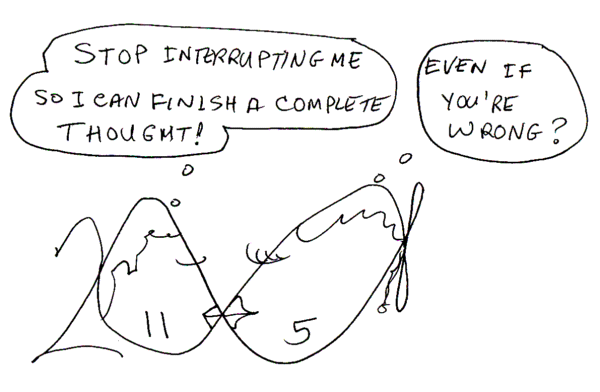
In conversation, you pay a price every time you interrupt:
- It makes the person feel invalidated and thus more likely closed to what you have to say.
- It makes the person feel you're rude and thus less likely to support you in anything.
- You are making your point when their mind is still focused on what they were saying. As a result, the person may not fully hear what you're saying.
- We think it saves time---After all, we're confident we know what they're going to say. We often are right but, for the reasons above, we're less likely to obtain the desired result than if we let the person finish talking. True, you can cram more ideas into a conversation by interrupting but that's a poor metric for assessing the conversation's value. What counts is the amount of benefit that the convo yields and on that metric, you may save time by not interrupting.
- We think that interrupting shows we're motivated, that we care. It may, instead, be interpreted as rudeness, inability to control ourselves, even narcissism.
- We think that interrupting shows we're smart. It may but the value of that is often outweighed by the above negatives.
The no-interrupt/wait-a-second principle also applies to meetings. Often, the person who hangs back until the end of a discussion and then, carefully, tactfully, comments or asks a question, will be taken more seriously and liked more than the person who has peppered the discussion with comments, especially if s/he interrupted others.
Of course, if you're an inveterate interrupter, changing is much easier said than done. I believe your best chances of succeeding are:
- Trying a zero-tolerance policy at least for a while: No interrupting, under any circumstance. It's more likely that you'll make progress with that all-or-nothing policy than if you try to ease off. Having to decide, in the moment, whether to interrupt, is just too difficult. You can later back off, replacing the no-interrupt rule with a rule of staying conscious to interrupt only when it will yield net benefit.
- Tell someone close to you that you're trying to develop a new habit: interrupting less and that you'd appreciate it if, every time you interrupt, s/he not complain but simply raise one finger. That's a quick, minimally threatening way to give you feedback.
- In business meetings, if you're afraid you'll forget what you want to say, simply jot it down.
The good news is that you needn't be perfect. If you interrupt inappropriately, forgive yourself but get back on that wagon. You will reap significant professional and personal benefits.
Subscribe to:
Posts (Atom)

