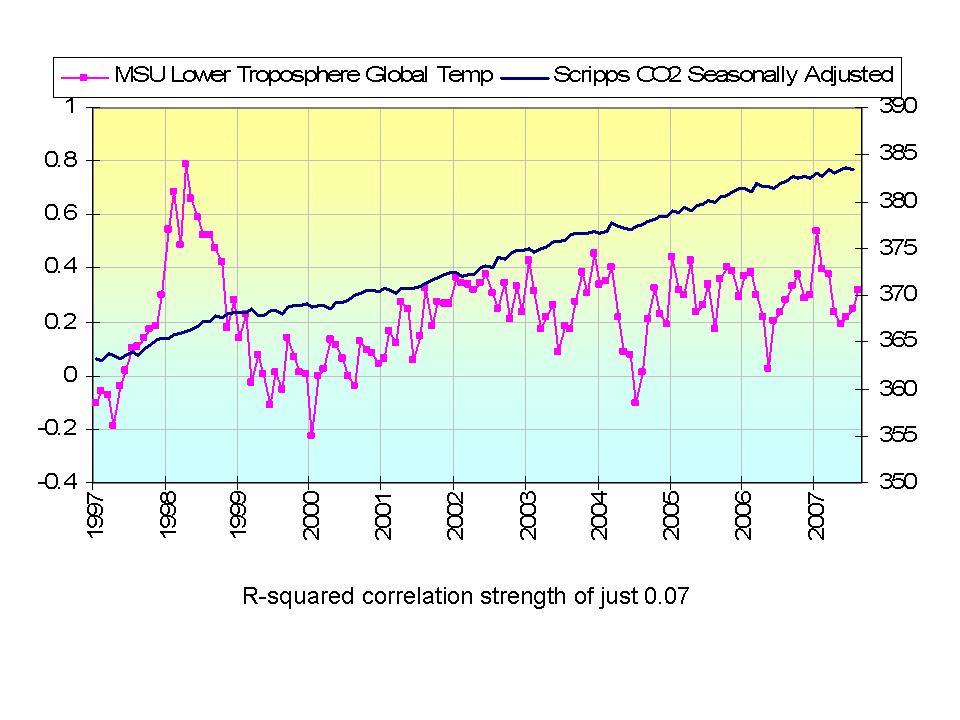
With so many compelling problems facing the world--from cancer to world poverty--I cannot understand why liberal leaders such as President Obama are so eager to immediately start spending so massively in perpetuity in an attempt to cool the planet when average global temperature has gone up just 1/2 of one degree since 1880 and flat or declining for the past decade, even if we don't count the aberrantly warm year of 1998. Here's another chart, this one from MIT, reporting that there's been essentially no increase since 1995!
Insisting on immediately and massively spending to try to cool the planet seems particularly foolish because key evidence suggests that even that 0.5 degree warming since 1880 is at least partly natural variation, not man-made. For example, there has been a major CO2 increase during most recent decade, a period in which temperatures have been flat or declining. Atmospheric CO2 is a proxy for man-made hydrocarbon emissions. If man-made behaviors were causing global warming serious enough to justify the world making massive efforts to cool the earth, global temperatures should not be declining. Even if other factors are masking the man-made contribution to global warming, the amount and rate of global warming is small, far less than predicted by Al Gore and his anti-corporation-motivated allies. And remember the climate change alarmists' data is based heavily on highly conjectural computer models: garbage in-garbage out.
Another untested assumption: Even if, over the next 50 years, average global temperature were to reverse trend and rise, would the net effect be so negative as to justify an immediate and massive indeed quixotic effort to slow it? For example, many areas, for example in Canada and Russia, previously too cold to grow crops, would become farmable. An article in Germany's leading magazine, Der Spiegel makes the case that it's impossible to predict whether global warming, if any, will yield a net positive or negative effect on the earth.
Perhaps the most dispositive reason to watch-and-wait instead of, right now, spending massively to try to cool the planet, is the extraordinary difficulty, indeed unrealism, of trying to get the worldwide spending of incomprehensibly large amounts of money, curtailment of development and of travel in perpetuity that would be required to possibly achieve even a one- or two-degree decline in average global temperature.
Charles Siegel of preservenet.com commented on today's New York Times editorial that said:
"The hope is these [Copenhagen] talks will produce commitments from each nation that, collectively, would keep temperatures from rising 2 degrees Celsius above preindustrial levels. That will require deep cuts in emissions — as much as 80 percent among industrialized nations — by midcentury." Siegel commented, "In reality, it requires at least an 80% cut in emissions in the entire world by 2050, not just from the industrialized nations." Is it realistic to do that?
There are only so many fiscal and human resources to go around. If we immediately and forever spend so massively on trying to cool the globe, we will have to shortchange initiatives with a higher probability of improving humankind--such as a true war against cancer or world poverty.
Of course, some efforts to cool the planet also facilitate energy independence, for example, nuclear energy and conservation efforts that minimally impinge on our freedom such as higher CAFE standards. I support both of those measures. But the sorts of permanent massive spending and incursions on our freedoms (for example, restricting road building thereby encouraging gridlock, and eliminating already scarce city parking spots, forcing us into inevitably time-wasting mass transit) being proposed by President Obama and other liberal world leaders is incomprehensible to me.
It seems to me that in light of the 15-year flat global temperature and below-average extreme weather such as hurricanes despite the CO2 increase (the opposite of what Al Gore and the IPCC's politically stacked panel predicted,) and that the money and effort could be diverted to better address the world's enormous pressing needs, a few years of watch-and-wait, accompanied by continuing, non-politically-motivated research on the above questions, along with private-sector research into improved alternative energy sources is a wiser path than immediate massive spending to try to cool the planet. What am I not understanding?