Thursday, October 8, 2009

How to Get Promoted...But is the Effort Worth It?

Dan Schwabel, a biggie in the personal branding arena sent me these questions for an article he's writing for Details magazine. Here were my answers. At the end, I wrote something that surprised me and may be worthy of your reading.

What does it take to get a promotion at work right now?
One or more of these, the more the merrier: a better job offer, demonstrated greater value added compared with peers, promise of doing a better job than the person currently in the desired position, an industry award, a bold proposal, sleeping with the boss.


What is the most unique strategy you would recommend for current workers who are looking to get ahead in this economy?
Write a proposal for an initiative that, while consistent with the culture and mission of the organization, would be an exciting yet realistic quantum leap ahead for the organization. Send it, in advance, to the attendees of an important meeting. Get their input. Get permission to present the revised version at the meeting. Make that presentation with CEO-like crispness.(Watch C-Span, CNBC, and YouTube to see CEO types in action.)


What is your take on going the extra mile at work and helping out other teams if you have those skills?
Working s generally more rewarding, both financially and in accomplishment, than going home, watching TV, playing golf, and/or drinking or doing drugs.


What do you think about transparency at work? Should all workers be that honest?
It's not realistic. Especially in tough times, inside knowledge can be very helpful. It's all well and good to say "Share for the common good," but in the end, most people act in their self-interest--they want to get ahead or at least don't want to be a victim of the next round of layoffs.


How important is it to be connected to your colleagues through social networks? I know you think it's key. I think it's usually overrated---Most people spend more time at it than the benefits they derive (e.g., participating in the discussions on LinkedIn.) I do like Guy Kawasaki's YouTube video 10 Ways to Use LinkedIn and his article Ten Twitter Tips.

Do you believe that growing your brand outside of your company can help you inside?
Yes. Give speeches at conferences, get articles written about you in trade publications.


But Dan, frankly, having had a zillion clients play these games to "get ahead," it feels a little sickening, kind of like the movie, They Shoot Horses Don't They, in which everyone's pitted against each other to see who can dance the longest. All but the winner collapse and even the winner is exhausted. Trouble is, I don't know what the answer is. Socialism is probably, net, worse.

Monday, October 5, 2009

Another Letter from a Victim of Prejudice Against White Males

Here is the latest of the many letters I've received from white males who feel the pendulum has swung so far that it's slamming them in the chest:

Hello Mr. Nemko,


I have spent most of my life priding myself on my open-mindedness while living in a state where that commodity can be in short supply.

Unfortunately, over the last 10 years, my open attitude is being returned less and less often.

At first, I thought I was at fault, but with time and awareness, I have come to realize that the white middle-aged male is now the low person on the totem pole and everyone, including many white men, seem determined to keep it that way.


I have experienced racism and sexism. I have been ignored, berated, and ridiculed. I have been passed over for jobs and promotions that have been given to people with less experience and fewer abilities. Unfortunately, when I bring up these realities, people seem to look at me as if I were speaking a different language.


For a while, I was angry. At this point, I simply feel resigned. I’ve been around long enough to understand that a pendulum always swings and now, white males are the victims of that swing. I sure do feel sorry though for the young white men out there.


Sincerely,

David Dickson

whynotnow@mail.com

Saturday, October 3, 2009

Finding the Willpower

The cure for your lack of willpower depends on what causes it:

Many previous failures. If you too often fail, eventually you understandably figure it's not worth trying. In other words, you lose willpower.

The usually most successful solution: Choose more attainable goals: an job better suited to your strengths, a more attainable romantic partner, etc.

Hedonism. Here, you fail to realize that to the extent you prioritize pleasure over productivity, you are a drain on your family and on society. The wise person realizes that productivity is key to the life well-led, and that requires frequent impulse control and sacrificing of pleasure for the greater good of accomplishing something.

Genetically low energy. Some people emerge from the womb driven while others are laid back. That is very difficult to compensate for. It may help to pair up for work and avocationally with someone with moderately higher energy. It may rub off.

If you have long been depressed (not just because of a specific situation you're facing,) drugs such as Prozac or Wellbutrin may help, especially if combined with regular exercise and short-term cognitive therapy.

Drug or alcohol problems. The stereotype of the lazy pot smoker is true. To find willpower you must find the--well--willpower to stop doing drugs and alcohol. You are fooling yourself if you think it isn't hurting your work and personal life, not to mention your health.

People of faith are often best helped with a 12-step program such as Alcoholics Anonymous. More purely rational people are often helped with cognitive therapy. Some people are helped by a physician-prescribed drug that reduces cravings or makes you feel nauseous if you drink or do drugs. For some people, a combination works best. Here is a review of alcoholism treatments.

You're pampered or have been. For example, you were too often indulged by your parents, you're a trust fund baby, welfare recipient, or have a spouse or parent who pays your bills. Unless you're an intrinsically motivated person, if you're taken care of, you lose much willpower. The following may be unrealistic but it may be wise: Cut the purse strings and try to make it on your own. Much easier said than done, I'm sure.

Unearned high self-esteem. Many people have been led to believe they deserve high self-esteem merely because all people are worthy or because they're "The Chosen People," "Black is beautiful," etc. That mindset is likely to reduce your willpower. True self-esteem comes only from accomplishment. If you think otherwise, you're deluding yourself.

Misinterpreted theology. Some religious and otherwise spiritually oriented people believe canards like, "The world is abundant. It will provide" or "If it's meant to happen, it will," Many people misinterpret the Christian precept "Do not be willful" as "God will provide," rather than "Make all reasonable effort but at some point realize it's out of your control."

Along with intelligence and ethics, nothing is more key to the life well-led than willpower. I hope you might find at least one of the above suggestions helpful in improving yours.

Reactions to this article, including other suggestions on how to build willpower are, of course, welcome.

Tuesday, September 29, 2009

What I've Learned in Six Decades

In his play, Broadway Bound, Neil Simon wisely said, "Wisdom doesn't come with age. Wisdom comes with wisdom."

With that caveat, as I approach my seventh decade, here is the wisest advice I can muster:

On career: If I haven't acquired wisdom in this area, I'm in trouble. I've been a career coach for 25 years. Here are some things I've learned:

¨ For most people, there is no one best-suited career. They could be equally happy and successful in many careers as long as it met their non-negotiables, for example: using your head vs. your hands, people-centric vs. isolated, employed vs. entrepreneurial, artistic vs. scientific, plus a decent boss, pay, commute, learning opportunities, and workplace ethics.

¨ It's wise to hire an inexperienced smart hard worker over an experienced person of average intelligence and drive.

¨ Procrastination is a career killer. Avoid those psychotherapist-concocted excuses for inaction, for example, "fear of failure," and "fear of rejection." Feel the fear and do it anyway; the fear will dissipate. And if you're lazy, recognize that you pay a price far greater than any benefits you derive--not only lack of success but ultimately feeling like a parasite on others, or at least having made far less of a difference to your family, community, and world than you could have or your peers have.

On money: Only fools chase money beyond a moderate income. After taxes, your quality of life's improvement is too small to justify what it often takes to get big bucks: a career you enjoy far less than a less remunerative one, inordinate stress, ethical compromises.

On friends: They're more important than family. Other than your spouse, you don't choose your family. You do choose your friends, so you're more likely to be compatible. I have seen so many family members cause each other misery. Compatible, close friends are a treasure. If you have such friendships, nurture them. If you don't, prioritize making one.

On marriage: A good marriage should get a passing grade on all these characteristics:

¨ enjoying each other in bed

¨ enjoying each other out of bed

¨ respecting each other deeply

¨ no fatal flaw in either of you (for example, chronic addiction or violence)

¨ that ineffable thing called love--in which you feel warm whenever you see the person, and you care as much about the other person's wellbeing as your own.

Of course, no marriage scores a permanent A on all those factors but if, for an extended time, your or your partner rate the marriage as a C or lower on two or more of those, you may be better off single or with another partner.

Few people fundamentally change and even fewer change because of another person's attempt to make them change. Sure, encourage tweaks but key to a good relationship is accepting each other for who they essentially are. If you can't, consider separating.

On sex: The key is to find a partner with a compatible sexual appetite and to communicate your desires to your partner, verbally if necessary.

On politics: Liberal ideals appeal to the hearts of all good people but fail to adequately consider how most humans behave: that handouts and other compensatory programs reward incompetence and laziness and thus encourage more of it while punishing the more worthy. Liberals, who ever expand government, fail to accept that the security of government jobs causes government services to be of low quality and to cost the taxpayer vastly more than they should. Also, liberals seem to care about everyone but the taxpayer, who usually gets terrible value received for the amount paid. Government must take much more seriously their responsibility to steward taxpayer money as though it was their own.

Conservatives fail to realize that people's failures are often beyond their control: the genes and environment bestowed by their parents. It is government's (as well as individuals') responsibility to help compensate those who lost in the genetic and environmental lottery. Conservatives also fail to acknowledge that unbridled capitalism does lead to excesses requiring regulation, although only a non-onerous and realistically enforceable level of regulation.

On faith: There is no God worth praying to. If there were, s/he wouldn't have allowed billions of people, including infants, to suffer weeks or months of horrific pain only to die of diseases such as cancer or AIDS, leaving bereft family members. "A loving God," hmmph.

The potential for holiness resides within each of us: the impulse to do good. We should keep that impulse top-of-mind.

Friday, September 25, 2009

Is Watch-and-Wait A Wiser Strategy Re Global Warming?

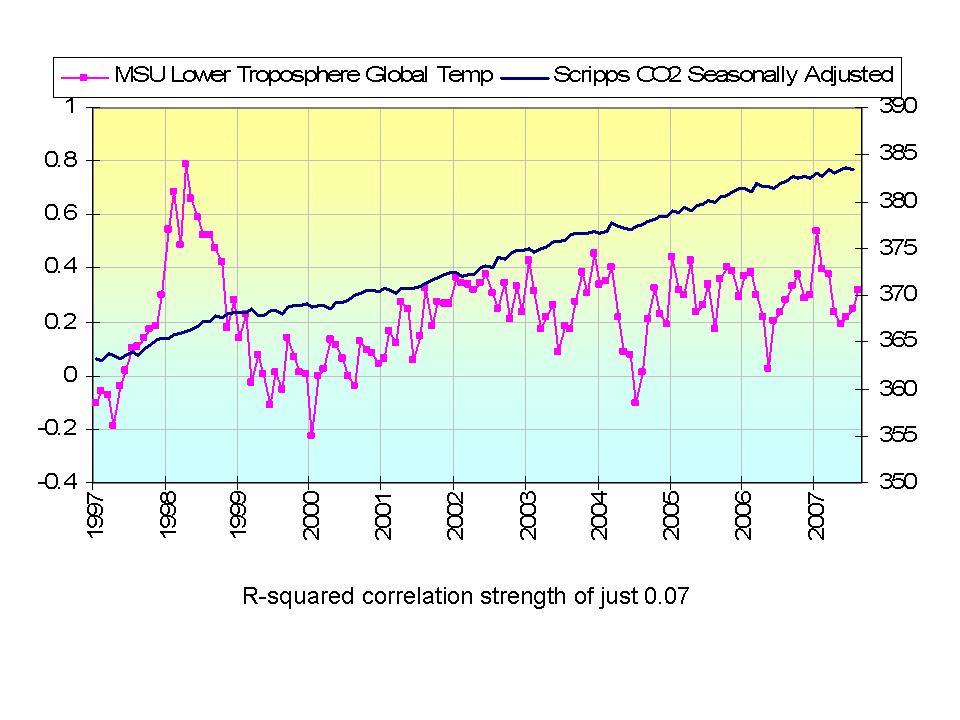
With so many compelling problems facing the world--from cancer to world poverty--I cannot understand why liberal leaders such as President Obama are so eager to immediately start spending so massively in perpetuity in an attempt to cool the planet when average global temperature has gone up just 1/2 of one degree since 1880 and flat or declining for the past decade, even if we don't count the aberrantly warm year of 1998. Here's another chart, this one from MIT, reporting that there's been essentially no increase since 1995!

Insisting on immediately and massively spending to try to cool the planet seems particularly foolish because key evidence suggests that even that 0.5 degree warming since 1880 is at least partly natural variation, not man-made. For example, there has been a major CO2 increase during most recent decade, a period in which temperatures have been flat or declining. Atmospheric CO2 is a proxy for man-made hydrocarbon emissions. If man-made behaviors were causing global warming serious enough to justify the world making massive efforts to cool the earth, global temperatures should not be declining. Even if other factors are masking the man-made contribution to global warming, the amount and rate of global warming is small, far less than predicted by Al Gore and his anti-corporation-motivated allies. And remember the climate change alarmists' data is based heavily on highly conjectural computer models: garbage in-garbage out.

Another untested assumption: Even if, over the next 50 years, average global temperature were to reverse trend and rise, would the net effect be so negative as to justify an immediate and massive indeed quixotic effort to slow it? For example, many areas, for example in Canada and Russia, previously too cold to grow crops, would become farmable. An article in Germany's leading magazine, Der Spiegel makes the case that it's impossible to predict whether global warming, if any, will yield a net positive or negative effect on the earth.

Perhaps the most dispositive reason to watch-and-wait instead of, right now, spending massively to try to cool the planet, is the extraordinary difficulty, indeed unrealism, of trying to get the worldwide spending of incomprehensibly large amounts of money, curtailment of development and of travel in perpetuity that would be required to possibly achieve even a one- or two-degree decline in average global temperature.

Charles Siegel of preservenet.com commented on today's New York Times editorial that said:
"The hope is these [Copenhagen] talks will produce commitments from each nation that, collectively, would keep temperatures from rising 2 degrees Celsius above preindustrial levels. That will require deep cuts in emissions — as much as 80 percent among industrialized nations — by midcentury." Siegel commented, "In reality, it requires at least an 80% cut in emissions in the entire world by 2050, not just from the industrialized nations." Is it realistic to do that?

There are only so many fiscal and human resources to go around. If we immediately and forever spend so massively on trying to cool the globe, we will have to shortchange initiatives with a higher probability of improving humankind--such as a true war against cancer or world poverty.

Of course, some efforts to cool the planet also facilitate energy independence, for example, nuclear energy and conservation efforts that minimally impinge on our freedom such as higher CAFE standards. I support both of those measures. But the sorts of permanent massive spending and incursions on our freedoms (for example, restricting road building thereby encouraging gridlock, and eliminating already scarce city parking spots, forcing us into inevitably time-wasting mass transit) being proposed by President Obama and other liberal world leaders is incomprehensible to me.

It seems to me that in light of the 15-year flat global temperature and below-average extreme weather such as hurricanes despite the CO2 increase (the opposite of what Al Gore and the IPCC's politically stacked panel predicted,) and that the money and effort could be diverted to better address the world's enormous pressing needs, a few years of watch-and-wait, accompanied by continuing, non-politically-motivated research on the above questions, along with private-sector research into improved alternative energy sources is a wiser path than immediate massive spending to try to cool the planet. What am I not understanding?

Wednesday, September 23, 2009

Two Ideas for Career Websites

Despite the plethora of career-related websites, I believe that creating these could enable someone to do well by doing good:

APlayer.com.
Many sites attempt to match employee with employer but none use the most potent predictor of how well an employee will do on the job: simulation.

APlayer.com would make it easy for an employer to upload a simulation of a task(s) the employee must do well on that job.

Candidates whose resume and application match the job description would be invited to participate in that online simulation.

High-scoring candidates would be invited to in-person interviews.

InterviewFinder.com.
Nearly every job seeker hates looking for a job: networking, cold-calling prospective employers, creating resumes, filling out applications, getting letters of recommendation, etc.

Career counselors looking for more clients would, on interviewfinder.com, offer to handle the entire job search except for the interview, of course.

A Blueprint for Long-Term Prosperity

This wonderfully centrist article in The Economist perfectly defines what I believe to be the ideal roles of business and government. The article's major contentions are:
  • Entrepreneurship is the key because only new products and services can keep quality of life improving.
  • Non-entrepreneurial businesspeople, such as corporate raiders, arbitragers, financial instrument brokers (e.g., those exotic CDOs and CMOs that helped trigger the financial crisis) are the bad guys.
  • A modest amount of government regulation is needed to control the aforementioned bad guys.
 

blogger templates | Make Money Online