Tuesday, August 24, 2010

What If You Don't Want to Work?

Most people feel an ethical obligation to be productive. Some less wise people don't. Still others would like to be productive but feel doomed to a low-pay/low-reward career.

In fact, some people do have dim career prospects: If you're not bright, not driven, have personality issues, and excel at little, your chances of earning a good living aren't great in our ever-more-demanding global economy and with a U.S. empire that's likely in its decline and fall while China and India ascend.

Rather than guilt-trip you on the importance and wisdom of being productive, here I'll simply accept your self-assessment. I find anathema an able-bodied/able-minded person living off the taxpayer. I can more readily accept such people making the effort to become a stay-at-home spouse of a good income-earner. Agree to be a great spouse, homemaker, and perhaps parent in exchange for she or he providing the bulk of the family's income.

Saturday, August 21, 2010

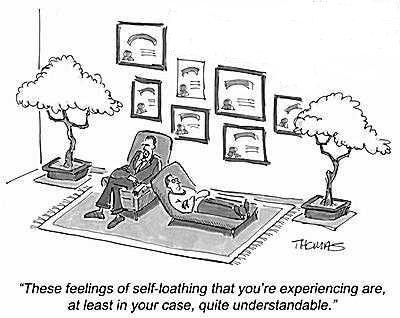
Coping with Self-Hatred, Self-Loathing

Some of my clients admit to self-loathing.

Okay, so do I. Despite my impressive list of accomplishments and current work, I honestly hate myself. I hate that I'm ugly, kind of a curmudgeon, and virtually a hermit. I overeat, am intense, am not quite as capable as I was just a few years ago. I hold libertarianish political views that most people hate. I roll my eyes at unthinking liberals who believe all wisdom resides left of center. I too often forgo tact and hit people between the eyes with candid input, often unsolicited. Plus I decry my aging self.

I'm well aware that my glass is more than half full but that awareness doesn't make me feel better. So I can't tell you to focus on your positives.

Perhaps like most things, the answer is simply self-acceptance. Loathe yourself if that's how you feel. Maybe, like me, doing that for a while will desensitize you, take the edge off your self-hatred. You'll still hate yourself but it will bother you less.

There is an important silver lining to self-loathing, at least mine: It motivates me to work ever harder. And indeed, as Michael Lopp, author of Being Geek told me yesterday, nearly every successful person in Silicon Valley suffers from the same malady. Indeed, no less than Abraham Lincoln suffered from grave self-doubt. The opposite syndrome--high self-esteem--usually leads to complacency and no growth.

Wednesday, August 11, 2010

The Speech Every High School Principal Should Give...and None Will

Note: While I applaud most of what the author writes here, I am opposed to the nationalism he encourages. I do believe we are world citizens: our thinking should be governed by what's best for the world, not just for the U.S.

A Speech Every American High School Principal Should Give

by Dennis Prager

If every school principal gave this speech at the beginning of the next school year, America would be a better place.

To the students and faculty of our high school:

I am your new principal, and honored to be so. There is no greater calling than to teach young people.

I would like to apprise you of some important changes coming to our school. I am making these changes because I am convinced that most of the ideas that have dominated public education in America have worked against you, against your teachers and against our country.

First, this school will no longer honor race or ethnicity. I could not care less if your racial makeup is black, brown, red, yellow or white. I could not care less if your origins are African, Latin American, Asian or European, or if your ancestors arrived here on the Mayflower or on slave ships.

The only identity I care about, the only one this school will recognize, is your individual identity -- your character, your scholarship, your humanity. And the only national identity this school will care about is American. This is an American public school, and American public schools were created to make better Americans.

If you wish to affirm an ethnic, racial or religious identity through school, you will have to go elsewhere. We will end all ethnicity-, race- and non-American nationality-based celebrations. They undermine the motto of America, one of its three central values -- e pluribus unum, "from many, one." And this school will be guided by America's values.This includes all after-school clubs. I will not authorize clubs that divide students based on any identities. This includes race, language, religion, sexual orientation or whatever else may become in vogue in a society divided by political correctness.

Your clubs will be based on interests and passions, not blood, ethnic, racial or other physically defined ties. Those clubs just cultivate narcissism -- an unhealthy preoccupation with the self -- while the purpose of education is to get you to think beyond yourself. So we will have clubs that transport you to the wonders and glories of art, music, astronomy, languages you do not already speak, carpentry and more. If the only extracurricular activities you can imagine being interesting in are those based on ethnic, racial or sexual identity, that means that little outside of yourself really interests you.

Second, I am uninterested in whether English is your native language. My only interest in terms of language is that you leave this school speaking and writing English as fluently as possible. The English language has united America's citizens for over 200 years, and it will unite us at this school. It is one of the indispensable reasons this country of immigrants has always come to be one country. And if you leave this school without excellent English language skills, I would be remiss in my duty to ensure that you will be prepared to successfully compete in the American job market. We will learn other languages here -- it is deplorable that most Americans only speak English -- but if you want classes taught in your native language rather than in English, this is not your school.

Third, because I regard learning as a sacred endeavor, everything in this school will reflect learning's elevated status. This means, among other things, that you and your teachers will dress accordingly. Many people in our society dress more formally for Hollywood events than for church or school. These people have their priorities backward. Therefore, there will be a formal dress code at this school.

Fourth, no obscene language will be tolerated anywhere on this school's property -- whether in class, in the hallways or at athletic events. If you can't speak without using the f-word, you can't speak. By obscene language I mean the words banned by the Federal Communications Commission, plus epithets such as "Nigger," even when used by one black student to address another black, or "bitch," even when addressed by a girl to a girlfriend. It is my intent that by the time you leave this school, you will be among the few your age to instinctively distinguish between the elevated and the degraded, the holy and the obscene.

Fifth, we will end all self-esteem programs. In this school, self-esteem will be attained in only one way -- the way people attained it until decided otherwise a generation ago -- by earning it. One immediate consequence is that there will be one valedictorian, not eight.

Sixth, and last, I am reorienting the school toward academics and away from politics and propaganda. No more time will devoted to scaring you about smoking and caffeine, or terrifying you about sexual harassment or global warming. No more semesters will be devoted to condom wearing and teaching you to regard sexual relations as only or primarily a health issue. There will be no more attempts to convince you that you are a victim because you are not white, or not male, or not heterosexual or not Christian. We will have failed if any one of you graduates this school and does not consider him or herself inordinately lucky -- to be alive and to be an American.

Now, please stand and join me in the Pledge of Allegiance to the flag of our country. As many of you do not know the words, your teachers will hand them out to you.

Dennis Prager hosts a nationally syndicated radio talk show and is a visiting fellow at the Hoover Institution at Stanford University. He is the author of four books, most recently "Happiness Is a Serious Problem" (HarperCollins). His website is www.dennisprager.com. COPYRIGHT 2010 CREATORS.COM

Monday, August 9, 2010

The Myth of the Gender Pay Gap

Endlessly, the media parrots feminist organizations' grossly misleading assertion that women earn 77 to 80 cents on the dollar compared with men. Indeed, President Obama cites it all the time.

In many of my writings , for example, "Men Don't Have it Easy, Either" I've provided solid evidence of why that's so misleading: that for the truly same nature, quality, and quantity of work, women earn the same as men. When there is a pay gap, it's because women have chosen less rigorous, odious, or otherwise less demanding careers or jobs.

I've expressed frustration at the media's double standard of vetting: If you make a pro-male assertion, the media will nix it apriori or based on on a standard of rigor unrealistic in social science. But make a woman-as-victim assertion and it's published with little or no vetting. Rare exceptions are this op-ed in the New York Times and the book, Why Men Earn More.

The media's unwillingness to publish the lack of a pay gap is particularly frustrating in that the unemployment rate among men is now more than 25% higher than for women. And the gender ratio of 2010 degree recipients is 41% men, 59% women, the precise reverse of 40 years ago.

I've had five books and 600 articles well published but dare I write a pro-male piece it's almost never published. For example, in response to the irresponsibly written "The End of Men" that was the cover story in last month's The Atlantic, I wrote the far more solid "The Beginning of Men," and none of 20 publishers would publish it.

It finally took a woman to get published what I've been saying so long about the myth of a gender pay gap: One of the leading career bloggers, Penelope Trunk, just wrote this piece entitled, "A Salary Gap Between Men and Women? Oh please!"

I truly am tired of men getting treated unfairly. Perhaps it's time to take a cue from the immigration advocates who staged A Day Without Immigrants. Is it time for a national Day Without Men?

Tuesday, August 3, 2010

U.S. Middle Class Shrinks

In an attempt to create positive perceptions, President Obama is proclaiming that "we're turning it around."

But using data from such sources as the U.S. Bureau of Labor Statistics, Business Insider reports 22 statistics that indicate that the decline and fall of the American Empire is accelerating, with the middle class being the canary in the coal mine:
  • 61 percent of Americans now "always or usually" live paycheck to paycheck. That's up from 43 percent in 2007 and 49% in 2008.
  • More than 40 percent of employed Americans now work in service jobs, which are often very low paying.
  • The average time to find a job has risen to 35.2 weeks.
  • For the first time in U.S. history, more than 40 million Americans are on food stamps, and the U.S. Dept of Agriculture projects it to rise to 43 million in 2011.
  • 21 percent of all U.S. children now live below the poverty line, the highest rate in 20 years.
  • 43 percent of Americans now have less than $10,000 saved for retirement.
  • 24 percent of American workers now say they have postponed their planned retirement age.
  • The average federal worker now earns 20 to 60 percent more (different studies report different findings) than the average private sector worker. That is the most recent evidence of my assertion that now, because the federal government doesn't balance its budget and can--for the short-term at least--keep printing money, the federal government and federal contractors are, for all but star employees, the best source of employment.
As shocking and dispiriting as those statistics are, I was shaken even more when I read that when the Tacoma, Washington Utilities District posted a job opening for a single $17.76/hour meter reader job, 1,600 people applied.

These statistics provide yet more evidence that America is in a long-term jobless non-recovery.

Monday, August 2, 2010

Leadership and Management Lessons in Directing a Play

Directing plays offers a particular challenge to my leadership and management skills. That's because the same emotionality and artistic personality that enables actors to do so well on stage can make actors (and theatrical designers) a challenge offstage.

Here are some things I've done to make the play I'm currently directing, Neil Simon's, Broadway Bound (which has two weeks left in its run) to be a success--standing ovations, fine reviews, for example, this one in the Berkeley Daily Planet.

My cast and crew get little or no pay, so I must otherwise inspire them to work hard. To that end, I pointed out that community theatre is among the only recreations aimed at older people and that our audiences are really excited to come see you perform. I explained that our theatre is an ideal one for older people: Because it seats only 100 and has perfect acoustics and sight lines, even the elderly can easily see and hear everything. I also explained that the theatre gave me the opportunity to direct whatever play I wanted and that Broadway Bound was my choice because it has the rare combination of great humor, deep poignancy, food for thought, and yet is fully understandable by mainstream audiences. In another attempt to motivate my cast and crew, throughout the rehearsal process, I looked for all legitimate opportunities to praise them and I bent over backwards to meet their every need. I wanted them to know that if I'm to ask them to work hard, I need to work at least as hard.

Especially when dealing with a mainly volunteer cast and crew, I keep in mind that each person has only so much energy to give to the production before s/he runs out of gas. Each cast and crew member has a different-sized fuel tank. And there's no gas station, so when a person runs out of gas, s/he stops. So, unlike the standard management advice to treat everyone equally, before asking something of a cast or crew member, I assess whether it's worth the gas that person is likely to expend. And in general, I consider whether a task I might assign will yield sufficient miles per gallon: sufficient benefit to the production to justify the energy that would be expended.

So, for example, I believe insufficient benefit derives from the standard practice of having all-day tech rehearsals on the Saturday and Sunday before the play opens. So I held rehearsal only on the Saturday. Another example: I have a crew member who loves to clean--if he had his way, he'd spend endless hours cleaning the theatre, but that doesn't yield maximum audience benefit for the time that would be expended. So to explain that to him without offending him, I said, "I look forward to your doing those tasks. They'll be of real benefit to the theatre but for now, I need you to focus on getting the right props and furniture for the set. After that's done, if there's still time, it will be great for you to focus on sprucing up the theatre."

Staying with that car metaphor, if I'm to get maximum gas mileage from my cast and crew, I must keep them tuned up. I do that, for example, by, as I said, looking for legitimate opportunities to praise them, and offering suggestions with maximum tact. (Candidly, I blew it one time, really laid into someone, and feel bad about that.) If necessary, I offer a low-key pep talk. For example, I might say, "Yes, I'm being pretty perfectionistic in offering you these suggestions but I believe we have the potential to create a truly memorable production here. I do want to reassure you that I fully realize that none of us, least of all me, can be perfect, so when mistakes happen, I'll probably never get mad. I'll just see if we can fix them and if not, I'll simply shrug my shoulders and move on."

Might any of the lessons above be applied to your work in managing people?

Saturday, July 31, 2010

A Theatre Director's Checklist

I have been asked to contribute my checklist for directing plays to the 11th edition of Stage Management. Here it is.

By the way, three weekends remain in the run of the wonderful play I'm directing, Neil Simon's Broadway Bound at Chanticleers Theatre, in Castro Valley, CA. I also play 1940s and ragtime songs on the piano during the half hour before the show. Tickets are at www.chanticleers.org.

The Checklist I Use in Directing a Play

Of course, I'd vary these, depending on the theatre, play, cast and crew, etc.

A year before opening

Pick the play YOU want to direct. Find a theatre company willing to let you direct it.

Cast a wide net to recruit the best possible cast and crew. Good people are hard to find--especially in community theatre, where cast and crew usually are paid little or nothing. Of course, consider people you've successfully worked with before.

Four months out

Read the script a number of times.

Meet with the set designer. Discuss opportunities and limitations of the space. Have a ground plan ready for the first production meeting

Purchase a script for each cast member (usually required in the playwright's licensing agreement.) Then scan the script into an editable Microsoft Word file and add your draft blocking and business. (Use the ground plan and chess pieces to help you envision it.)

Three months out

Hold your first production meeting. Present your artistic vision to your set, costume, lighting, and sound designers, and prop master. Solicit the theatre's artistic director's input. Invite crew to auditions.

Hold auditions. Distribute a draft rehearsal and show schedule (including any possible extra midweek fundraising performance dates) and have auditioners note all conflicts. Make casting decisions both on acting ability and how easy the actor is to work with, whether s/he is likely to contribute to or detract from esprit de corps. Before casting someone, call directors they've acted for.

Consider inviting or even requiring casted actors to get offbook by the first rehearsal. Their having received the scripts with the first-draft blocking should make that easier. Requiring them to get offbook fast enables the rehearsals to focus on creating great theatre, not memorizing lines. Most actors will still need some line calling but it will be minimized.

Email the tentative schedule, of course, taking into account all actor, stage manager, and director conflicts.

Two months out

Meet with your public relations person. Identify angles and copy to use in pitches to patrons and the media.

Meet with your group sales person. These are often critical to filling houses. That person may also pitch organizations buying out the house for a special midweek performance. Include offering organizations serving low-income people free tickets to the preview performance.

Write copy for the website, show program, third-party ticket sellers, etc. Get it approved by the PR person.

Six weeks out

Hold first rehearsal. (You may wish to start earlier, especially if it's a musical.) Establish your rules. Mine are rehearsals start on time, the schedule is subject to change, input is welcome, the draft blocking is cast not in stone but jello, most notes are communicated by email, and unless an actor objects, I may send actors notes during the run. Rather than having them do an in-the-chair readthrough, I have them read while walking the draft blocking. After that first rehearsal, have a bonding party.

As soon as possible, get the cast solid on lines, blocking, and business.

Retain a videographer to make a trailer and -if the script licensing agreement allows--to record a performance for the theatre's archive and-for the cast and crew to have as a souvenir.

Four to five weeks out

Work the scenes. Each rehearsal focuses on two or three five-to-ten-minute chunks (usually French scenes,) each usually worked three times. Catch them doing something good: When I see something I like, without stopping them, I say "Good" or "Keep it." If it's something I don't like and I can say it in a pleasant word or two, I may do so but most notes are communicated by email when I get home from rehearsal.

As needed, coach actors one-on-one. If it's an actor who needs a lot of work, I often invite them to my home for coffee and homemade scones before we work. That sets the stage for a pleasant, constructive coaching session.

Meet again with production staff to get progress reports and provide feedback. Meet with the set builder to gain final agreement on the plan and reaffirm the deadline for the completed set.

Meet with prop master to decide on how to decorate the lobby. Get headshots from actors to hang in the lobby.

Two to three weeks out

Dress the set. (furniture, walls, floors)

Costume parade, publicity photo shoot, trailer shoot.

Post trailer on the theatre's site, third-party ticket seller sites, Facebook, YouTube, and Twitter.

Introduce and revise props, ensuring their efficient placement.

Run acts and then the full play. Focus on acting and pacing issues.

One week out

Cue-to-cue with sound and light operator.

Tech Saturday or Sunday: Full runthrough with tech, no stopping if possible. Give notes. Take a pizza/salad break, then another full runthrough with tech, no stopping if possible. (Costumes may be optional if not necessary for lighting adjustments.)

Dress rehearsals.

Preview performance.

Opening night.

The 2nd-to-last performance

Record the performance to create the archival DVD.

Final performance

Cast/crew strike party.

Dr. Nemko is a director and President of the Board of Chanticleers Theatre, Castro Valley, CA. www.chanticleers.org.

 

blogger templates | Make Money Online