Redistribution already has many manifestations in public policy. For example:

- A progressive income tax in which the top 5 percent of earners already pay 59 percent of the tax but the call is to additionally "soak the rich."
- Welfare/food stamps/subsidized housing. There now are 47.4 million people on food stamps, one in six adults.
- File "sharing." Producers of music, especially record companies have more money than the pool of illegal downloaders. File "sharing" (stealing) redistributes to lower-income people. Congress, last week, held a hearing to explore legalizing file sharing.
- Extending unemployment benefits. The pool of taxpayers (predominantly working people) are 'haves" compared with the unemployed, so extending unemployment checks to 99 weeks redistributes more money to lower-income people.
- Raising the minimum wage. That redistributes money to the poor not only from the employer but from the customer. Why? When the minimum wage rises, for example, in a fast food restaurant, the employer raises prices. That forces the customers (disproportionately of modest income) to pay for that redistribution to lowest-wage workers. And do remember that the people who end up working in fast-food restaurants didn't end up there at random. Better-paid workers generally, for example, were willing to defer gratification and income by attending college.
- Disparate impact policies.The current federal government wants to prohibit use, for example, of credit checks or being long-term unemployed as a criterion for employment or apartment rental because it has disparate impact on people of color. As a result, we have the Alice-in-Wonderland reality that people who have good credit and been employed are penalized. Now the Dept of Justice is meeting with leaders from the Society of Industrial and Organizational Psychology to try to replace tests, for example, of reasoning, with tests that won't have disproportionate negative impact on "underrepresented" minorities.
- No Child Left Behind--the dominant federal education policy--mandates carrots and sticks for dealing with low-achieving kids but none for average and high achievers. As a result, schools have dumbed down their curriculum, disproportionately benefiting low-income kids and hurting everyone else. More broadly, the U.S. has spent literally trillions of dollars over the past 75 years, starting with Lyndon Johnson's anti-poverty/New Society program yet the racial achievement "gap" is as wide as ever. In our personal lives, we lament wasting even a few dollars yet we've wasted literally trillions and no one seems unduly exercised. Indeed the call is to spend more to try to close the achievement "gap."
- Most colleges admit weaker students if they come from low-income households. Also, colleges employ Robin Hood pricing: Overcharge the middle- and upper income people to subsidize the poor. In addition, government financial aid redistributes from the taxpayer to a pool of lower-income people.
- Some employers, in part because of government and activists' pressure, use reverse discrimination in hiring and promotion. Indeed a study conducted by Harvard and Tufts researchers found that both whites and blacks believe discrimination against blacks has decreased and whites feel that discrimination against whites is a bigger problem.
- ObamaCare redistributes the health care pie to the poor from everyone else. The number of doctors, nurses, MRI machines, operating rooms, etc will grow too slowly to accommodate the planned 40 million additional covered people plus 11.7 million illegals when President Obama achieves his promise to legalize them. That will mean 50+ million disproportionately lower-income people with high health care needs will take a larger share of the health care pie but pay little into the system. They will be paid for by employers and, indirectly by employees because their premiums will be raised to compensate for the costs of providing health care to the poor. The already overwhelmed health care system kills 440,000 people a year just in hospitals because of medical errors. The result of adding 50+ million more who pay little will mean that their addition will kill many thousands of people who do pay for health care. That may be the ultimate redistribution.
- Legalizing the illegal immigrants. Poor people who sneaked into the U.S. illegally and their families will receive the benefits of US citizens, compliments of the taxpayer.
- Unrecorded redistributions: Every time we do something good for someone, even if part because they are poor, a woman, or minority, we are redistributing.
- Nonprofits' mission is to solicit donations from the haves to redistribute to the have-nots: literacy, food, health, etc, here and worldwide.
- Indeed, redistribution policies extend beyond the U.S., for example, foreign aid from the U.S. and other developed nations to "developing" nations. Another example: the World Bank and EU pressure successful countries to bail-out unsuccessful ones such as Greece or Rwanda, and for private banks to forgive loans to developing nations. A final example: the worldwide support of the (have-not) Palestinians over the (have) Israelis. The Israelis have contributed more to the world in science, literature, women's rights etc, than any nation in the world, yet it is viewed as equivalent to the Palestinians. Worse, we have a double-standard: We expect Israel to allow Palestinians to have equal rights when their government calls for Israel's extermination while we accept without question the many Muslim countries insisting that only Muslims can escape punishment. We should be rewarding merit more than redistributive egalitarianism.
- And a catchall: In every industry, nonprofit, and government agency, in recent years the focus has been redistributed from what's best overall for society or for the middle class to how to better serve the have-nots.
Assumptions
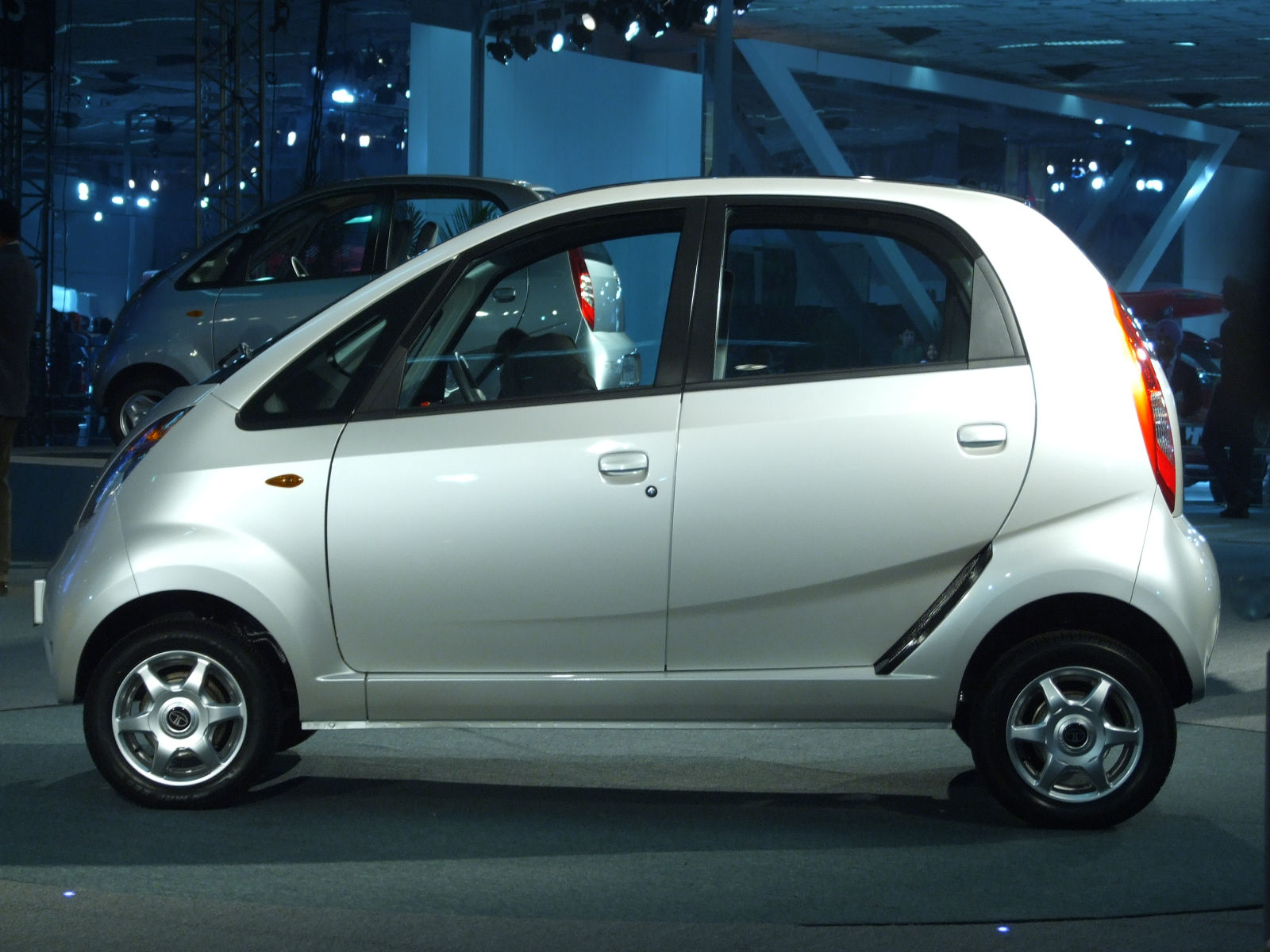
Immigration, differential birth rates, the Democrats' superior ground game and Internet marketing, and making Puerto Rico and D.C. the 51st and 52nd states, will result in an ever more Democratic-party-run government, resulting in ever more redistribution. Within about 20 years, except for the tiniest sliver of the ultra-wealthy, most people will be living at about 200% of the poverty line, approximately $45,000 in today's dollars for a family of four. People will thus afford only basic food, clothing, shelter, education, and health care. As a result, whole industries, for example, car manufacturers, will not be able to survive because few could afford a new car. As a result, government will nationalize it, making only tiny utilitarian vehicles, which could be sold new for under $10,000 like the Tata Nano. The shutting down of industries producing non-essentials will cause an even greater shortage of jobs, and the egalitarian ethos will result in government passing a 20-hour maximum workweek.
A positive scenario
The deemphasis on material acquisition will result in people living more rewarding lives, finding pleasure in creative expression, relationships, and life's simple pleasures: nature, beauty, sex, etc. The more egalitarian society will reduce competition and increase cooperation among people, reducing stress and increasing a communal sense of purpose. The small percentage of entrepreneurial types will start small businesses, mainly simple service businesses: repairing, garden preparation, artistic performance, etc. While health care won't be as good, the lower stress lifestyle will result in less need for elaborate health care and people will come to accept dying without high-tech intervention. The more cooperative, less materialistic society, with most people being of relative equal financial condition, will result in less violence. Life will resemble that on an Israeli kibbutz.
A negative scenario
The lack of financial incentive will make most people work minimally. That will cause the food and service shortages that existed in the Communist Soviet Union, Eastern Europe and exist today in Cuba and socialist countries such as Venezuela and Bolivia. Single-payer health care will be adopted but lead to lack-of-access and vastly increased deficits as is occurring even in countries liberals like to point to as models: Sweden, Canada, and Great Britain. As is often the case with welfare recipients, an egalitarian society will cause an increase in entitlement and frustration with shortages and, in turn, an increase in drug abuse to anesthetize the pain and in violent social upheaval as has occurred in recent years in, for example, the thousands of car torchings in socialist France. For example, gangs will flash-mob-invade the homes of people who have more than they do and rob them empty. Life in the U.S. will become more like life in a "developing" nation.
Which scenario do you think is more likely?