Thursday, September 30, 2010

A Business Idea: All-Natural, Organic Perfume

The ingredient list on perfumes scares the health-conscious, not to mention those with "chemical sensitivities."

Yet when I went to Sephora, which has an incredible collection of fragrances, I saw only a couple that were all-natural. And when I googled "All-natural fragrances," there were limited options. Example.

I believe a well-marketed, delicious-smelling, all-natural fragrance, made of carefully crafted blends of organic lemon, orange, tuberose, and other fragrant flowers and fruits could be a terrific seller, even a category killer. Not to worry that there are a few already out there--there are hundreds of non-natural fragrances out there that have millions of dollars in sales.

I'd call it: O. (evoking orgasm and The Story of O, as well as organic.)

Because it wouldn't include chemical preservatives, customers would need to replace it frequently, which, of course, would be good for sales.

Whaddya think?

Wednesday, September 29, 2010

How to Get Hired in the C-Suite: CEO, CFO, COO, CIO.

I just finished a session with a client who is looking for a CEO or COO job. I told him these ways of landing one:
  • Using the Red Book or your connections, identify the key 20 retained headhunters who specialize in C-Suite biotech companies and get your high-level connections to tout you to them.
  • Email, phone, and/or meet with all your colleagues who are or are connected to C-Suite or corporate board members. Tell them the sort of position you're best at. (In his case it's mid-stage startup neurobiology-centric companies.)
  • Do high-level volunteerism, for example, join a board.
  • Write an article for a leading industry publication, especially an article that includes interviews with industry leaders.
  • Give a presentation at an industry conference, perhaps co-presenting with an industry leader.
  • Throw a party in which your connections plus others are invited.

Does It Matter?

I just opened the collection of junk mail that comes with my snail mail. That's the last thing I'd expect to cause me to feel useless. But it did.

One of those ads was this week's Safeway four-page supermarket circular. It's emblazoned with pink breast cancer ribbons and crowned by a headline, "Together for a Cure." Throughout, there are large sections urging focus on breast cancer. Example.

Of course, that reminded me of my earlier efforts to educate the public, the media, and Safeway in specific, that men die much younger and, for example, that far more men die younger of unexplained sudden heart attack than do women of breast cancer, yet the large majority of gender-specific health care research and outreach for the last 60 years(!) has been on women. The male death gap has grown from just 1 year in 1900 to 5.2 years today! I urged Safeway to address this. Other than the tiny-in-comparison prostate cancer promotion Safeway had done before I started my efforts to convince its president Steven Burd, nothing changed. In today's feminist dominated world, men are the disposable sex.

Then I turned my thoughts to all my other decades-long activist efforts, toward reinventing education, reinventing career counseling, fighting for fair treatment for males, against big government, for gifted kids' getting at least as appropriate-leveled education as special ed kids' do. None of my efforts have made a bit of difference.

So I wonder, "Why waste my time doing any more of that "make a difference" stuff?" Maybe I'd be wiser to leave the activism to the next generation of wide-eyed youth and spend my remaining years watching movies, playing with my dog, playing the piano, being my wife's acting coach, and going out to eat. As Peggy Lee sung, "If that's all there is my friends, then let's keep dancing and break out the booze."

Yet as soon as I finish this blog post, I'm going to continue my search for someone who can get more people to read my articles. People aren't explainable simply.

By the way, if you know someone who'd be great at that, let me know: mnemko@comcast.net.

How to Choose a Career

It's probably not your fault if you still don't know what you want to be when you grow up. Reasonably, you assumed school would help you figure it out.

Alas, instructors live in an ivory tower, so most are ill-suited to helping you find a career. And even most students who go to their school's career center leave still unsure what they want to do.

This is a better approach:

Step 1. Scan annotated lists of careers in such guides as the online Occupational Outlook Handbook, or my book, Cool Careers for Dummies.

For even more under-the-radar but currently in-demand careers, go to indeed.com and search on a work-related skill that you'd like to use in your work, for example, writing, analyzing, organizing, selling, or programming. Pick out the one, two, or three careers you find most intriguing.

Step 2. Google the name of that career and the word "careers," for example, "geologist careers." or "writing careers." Read a few articles that seem on-point.

Step 3. For any career that still seems interesting, search Amazon for a book on that career. In the best such books, each chapter is a different person's report on what it's like in that career.

Step 4. For any career that's still of interest, job shadow at least three (one or two might give unrepresentative perspectives) people in the field. Find them in the Yellow Pages, on the website of the profession's professional association, for example, The American Optometric Association (www.aoa.org), your alumni association, or simply ask your in-person or LinkedIn and Facebook networks for referrals.

While you're job shadowing, ask questions such as, "What's your typical day like?" "What ends up being most important for success in this career?" "Why might someone leave this career?" and "What's the best way to get training so you're excellent in this career?"

Step 5. If a career still sounds good, choose it, even if you're not sure. Otherwise, you may be waiting for Godot. Career contentment usually only comes after you've entered it and, like a great-looking suit, tailored and accessorized to fit you.

For example, career coaching fit me only moderately but I now love it, in large measure because I adapted it to fit me: I made nonnegotiable that I'd work from home and that I'd be a more active participant in sessions than the typical counselor who mainly just listens. I also stayed committed to getting better and better rather than giving up after a couple of years of mediocre performance.

Tuesday, September 28, 2010

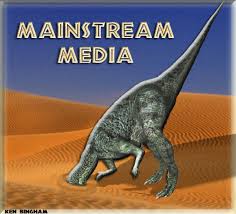
How the Mainstream Media Could Thrive

The demise of the traditional media outlets (newspapers, TV, magazines) has long been predicted, and indeed revenue has plummeted. The mainstream media has largely failed to figure out how to remain relevant in an era of nearly infinite free content: blogs, YouTube videos, Twitter streams, etc.

I think I've come up with the answer.

It has now become cost-effective for a major media outlet to create a rich, multi-faceted presentation of each story it covers. That is a level of sophistication and cost beyond the capability of most bloggers. I call it rich reporting.

So for example, while a blogger could certainly write a good article on whether Obama has been good for business, that piece would be grossly inferior to this week's Economist feature on that topic. That consists of a text-based debate between two world-class opponents on the issue. It's moderated by another world-class person. Readers can vote during the debate and change their votes as the debate proceeds. The up-to-the-minute pro/con voting is published in real time as are reader comments. After the debate, there's a post-mortem in which readers can participate. Now imagine that when the topic was appropriate, the debaters could introduce video evidence. Even without video, such content is much more appealing than nearly all citizen journalism.

Let's take another example. Many news stories start with an anecdote about a person. Imagine that the reader could elect to see that person's story in a one-minute, high-quality video. Or in the case of a science story, the viewer could see a vivid video presentation of the core complicated scientific process, for example, the mechanism via which global warming could be the result of sunspot explosions. Such high-quality user experiences would be infeasible for solo content providers to provide.

Rich reporting could even extend to the Web's most trafficked sites: porn. Sure, YouPorn and PornHub feature thousands of free porn videos, but most, I'm (ahem) told, are story-light, script-idiotic, visually grainy and/or poorly lighted. I believe there's a market for porn in which users would subscribe to a site with high-quality porn of varying lengths. Nick Bolton, New York Times writer and author of I Live in the Future says that porn industry has always led the way in the use of technology and predicts, "The next generation of porn and storytelling will be hyperpersonalized, placing you almost directly in the scene. That will give you control over what you see--almost like you're standing on a holodeck, a room that uses holographs to simulate reality."

The mainstream media has the advantage of money. If the MSM exercised the restraint to cover fewer stories but with rich reporting, I believe the mainstream media would not only thrive but provide a better product for all of us.

The Most Important Skills You Never Thought Of

Richard Nelson Bolles, author of What Color is Your Parachute (10 million copies sold) asked me to come up with a list of under-the-radar yet critical skills. Here's what I've come up with:

Time-effective digging for information. With nearly unlimited information merely a few keystrokes away, one of today's most crucial skills is the ability to derive on-target information in minimum time. That skill would subsume, for example, a good instinct for knowing what term to use in a Google search, how to use Google's syntax well, how to wisely read the search results: what useful content is available right there in that page of search results, which sites on page 1 of the results are worth clicking on, is it worth clicking on page 2, on a given site, what to ignore, skim, or read carefully, and what's worth copying and pasting into your working document.

The ability AND liberal use of risk-reward analysis. What's the risk versus reward of not only a physical risk but, for example, of being confrontive versus silent, investing in something, hiring someone, etc.? The ability and willingness to think probabilistically is a subset of that skill.

The ability AND liberal use of predictive listening: when it's worth interrupting, listening, or thinking ahead to what you want to say.

The ability to wisely decide when to put aside confirmation bias. It's well known that we tend to dismiss or not even take-in ideas that are dissonant with our cognitive schema, the core things we believe. Yet to create new solutions to problems and simply to be a person who is growing, one must be able to, in listening to an idea that's discordant with their cognitive schema, wisely decide whether that new idea should be dismissed apriori or is worth considering.

The ability to assess a person's openness to criticism and, more broadly, new input. Some people get discombobulated when offered merely one new idea or when receiving even a bit of tactfully dispensed criticism. Other people are more open and resilient. Effective communicators must be able to accurate assess their conversation partner's openness to criticism and new input.

Valuing productivity: In our ever more demanding society, people who try to be very productive will be ever more highly valued. Two supermarket checkers can use the same method: they simply look for the bar code and scan the item. But the person who values productivity does it as quickly as possible without sacrificing accuracy while a less productivity-valuing person will scan the items at a leisurely pace. A related inverse term is laziness: the person whose micro and macro life choices are mainly toward hedonism (short-term pleasures) rather than the eudamonic, longer-term contentment that comes from being productive.

Can you think of another under-the-radar but critical skill? Feel free to post it as a comment. If I like it, I'll let you know and will forward it to Dick.

Why the Wealthy Never Retire

I've always felt that the slogan, "No one ever died wishing they spent more time at the office" is a myth.

So I was pleased to see the results of a Barclay's survey reported in the Wall Street Journal that finds that even most wealthy people want to work until they drop--They feel more worthwhile working than retiring.

Even if you don't have a great job, it's difficult to understand how an even modestly healthy person of whatever age wouldn't feel more valuable being productive than, for example, puttering around on a golf course, that staging area for the hereafter.

I hope to die right here at my computer.
 

blogger templates | Make Money Online