Monday, December 13, 2010

A Very Short Guide to Overcoming Procrastination

As we start the New Year, so many people say, "I'm going to stop being a procrastinator."

I've written widely on overcoming procrastination, most recently this. But readers have said its comprehensiveness is overwhelming.

So here's a highly abridged version. These are the strategies that have worked the best for the most people. Perhaps you'll find one or, dare I hope, all of them useful.

Be aware of the moment of truth. There's a moment when, consciously or unconsciously, you decide whether to do the task or go do something more fun. If doing the task is in your interest, steel your will and make yourself get started.

Accept uncomfortability. To be even modestly successful in life, you must accept that life often requires you to do the uncomfortable, tasks that require effort and aren't as fun as what you'd enjoy more.

Value accomplishment. Your worth is heavily dependent on what you accomplish. Once you believe that, you won't even think about whether to do the task. You'll do it automatically. Contributory people think, "How much can I accomplish." Societal takers think, "What's the least work I can get by with." Decide you'll be as big a contributor as possible.

Recognize that you can survive failure. Yes, if you fail at the task, it will be evidence that you're not that competent. But not trying ensures that you fail and perhaps that you'll be perceived as a loser. The good news is that probably, if you follow the advice in this blog post, you 'll succeed, at least succeed often enough that you're not perceived as a loser. If you're failing at work tasks too often, perhaps it's a sign you need a better-suited job.

See yourself as a follow-through person. A number of my clients have said, "I just can't picture myself as a follow-through person." It may help to retrain your brain neurons: Even though it sounds touchy-feely, frequent affirmations like, "I will be a follow-through person" may help and certainly can't hurt.

Divide the task into baby steps. Write them down. Don't know how to divide it? Ask someone for help.

What's the fun way?
Every step of the way, ask yourself, "What's the fun way to do this task? Do it half-baked? Alter the task so it uses more of your strengths? Find a partner to work alongside you? Listen to music while you work? Whatever.

Get started. Ask yourself, "What's my first one-minute task?" Do it. Take a low-risk action.

Make yourself stay focused. Take your mind off everything else: other problems you're facing, the fun activity you'd rather be doing, etc. Stay focused on the task at hand. Perhaps remind yourself how good it will feel when you've gotten it done.

Use the One-Minute Struggle.
When you reach a hard part, struggle to figure it out for no more than one minute. After that, chances are you won't solve it. You'll just get frustrated and stop doing the task. At the one-minute mark, decide if you could complete the task without doing that hard part, or get help.

What task should you be getting done? Should you force yourself to get started now? Do you want to use one or more of the techniques above?

Saturday, December 11, 2010

Don't Let Journalists Convince You That Education Can Close the Achievement Gap


Standard (read liberal) journalists, for example, Jonathan Alter, will uncritically publish statistics trumpeted by heads of programs designed to close the achievement gap.

But when you peek even slightly beneath those statistics, you'll see that--like investments promised to yield amazing returns--those statistics are misleading or bogus. Examples:

Today's program du jour is the Knowledge is Power Program. (KIPP.) But see this as reported in the Washington Post.

The principal of Central Park East , the Harlem public school whose reported amazing successes resulted in two gushing features on 60 Minutes, admitted to Dr. Barbara Nemko and me on a site visit that the reality was far worse than the publicity indicates. Central Park East had had a one-of-a-kind extraordinary principal, Debbie Meier. When she left, the school's test scores reverted to that of other Harlem high schools.

Another program I'm very familiar with is EdTrust. It touts that by putting all kids, no matter how low achieving, into a rigorous college prep curriculum and providing lots of support, kids will learn much more, graduate at a higher rate, and succeed in college. But a wide range of experts have called Ed Trust data misleading, even dishonest. I would have thought that such criticism would most likely come from right-wing groups but most of the outcry has been from Democrats. For example, respected liberal U.S.C education professor Stephen Krashen wrote an article entitled, "Don't Trust Ed Trust." Gerald Bracey, who for two decades in the prestigious Phi Delta Kappan has authored reports on the state of education, wrote an article in the Huffington Post called "The Education Trust's Disinformation Campaign." A Democratic member of the California State Board of Education, Jim Aschwinden said "Everyone knows Ed Trust is a sham. Go talk to Carol Liu, a Democratic senator who wanted to investigate Ed Trust and was stonewalled but eventually found out that the statistics EdTrust reports about its poster-boy program--San Jose Unified School District--were bogus."

Even the vaunted Head Start, so popular with politicians because it intuitively sounds so good, does not, after 50 years, have good data to support the massive amounts we spend on it. In fact, the just released major study found that Head Start produces "no lasting benefit."

In the 30 years since I finished my Ph.D. at Berkeley specializing in education program evaluation, I've examined dozens of so-called model programs, starting way back with Marva Collins Prep, also the subject of a glowing 60 Minutes profile, and now closed because "lack of enrollment and lack of funds."

I've come to conclude that a model program is one you haven't visited.

The U.S is #1 in the world in per-student spending and the U.S. school districts that spend the most money (like DC--$30,000 a year per child--even with super-superintendent Michelle Rhee) have scores at the bottom. Yet for the first time, China just participated in the worldwide comparison of student achievement. It ranked first despite far smaller expenditure on education.

In these tough times, before asking the taxpayer to dig yet deeper into their already depleted pockets, after already having spent more than a trillion(!) dollars to try to close the achievement gap, we must face the unfortunate truth that education can only do so much.

UPDATE: I've just perused a book called Bad Students, Not Bad Schools, written by a professor emeritus at the University of Illinois, who makes the same case as made in this blog post but with tremendous rigor. I commend it to you. I've invited him to debate the question of the closeability of the achievement gap with outgoing California State Superintendent of Public Instruction, Jack O'Connell. Both of them have accepted. The debate will occur on my KALW-FM radio show on Jan 23 at 11 am Pacific time. It can be heard live, worldwide, on www.kalw.org and archived permanently soon after on my website, www.martynemko.com.

Thursday, December 9, 2010

Seeking Brilliant Guests for My Radio Show

I'm looking for guests for my NPR-San Francisco radio show. I'm interested in very smart people with whom I could have have a wide-ranging, dazzling, exchange, especially about issues related to work. The person must also be a clear and engaging communicator.

Previous excellent guests have included Craig Venter, Jack Welch, Alan Dershowitz, Linda Chavez, Albert Shanker, Noam Chomsky, Robert Reich, Vanguard founder John Bogle, Richard Dawkins, Jim Cramer, Deborah Tannen, Anthony Bourdain, and Charles Murray.

Any suggestions?

Monday, December 6, 2010

The True Underemployment Rate

A more accurate way to compute the underemployment rate would include:
  • Unemployed and actively looking for work (currently 9.8%)
  • Discouraged workers. Those who'd like to work but have given up. (another 10%)
  • Underemployed. Those working part-time who'd like to work full time (another 10%)
  • Misemployed job level. Those working at a lower-level job than they're qualified for (I estimate another 15%)
  • Misemployed interest area. People who dislike their field of endeavor but felt forced to be in it because of a lack of jobs in a field they're interested in, for example, the arts. (I estimate another 20%).
In sum, I believe that well over half of Americans are not doing work they're satisfied with. (And that doesn't count the many people who don't like something about their particular job: their boss, coworkers, the employer's ethics, etc.)

What to do to reduce the underemployment rate?
  • A national jobs database so employers and employees could more efficiently be matched.
  • Career advising starting in the 8th grade so more people could, early on, identify a well-suited career goal.
  • A public service announcement campaign encouraging people to hire tutors for their kids, personal assistants for themselves, and companions for their elderly relatives. That would create millions of pro-social jobs that currently don't exist.
  • Have all high school students take a course in ethical entrepreneurship. People with new business ideas create jobs while meeting the citizenry's unmet needs.

Managing Depression

If you're chronically mildly to moderately sad/depressed, these things often help:
  • 10-12 sessions of cognitive-behavioral therapy.
  • Regular exercise
  • Cutting down on abusives: alcohol, pot, cocaine, etc.
  • An outlet: help others and/or do something creative: write, act, paint, play music, etc.
Note that I've omitted antidepressant drugs. Often they don't work, stop working after a while, and/or have side effects that outweigh the benefits (weight gain, sexuality inhibition, even anxiety increase.) It may be wise to see if the above strategies work well enough without medication. If not, see a psychopharmacologist to discuss if it's worth a trial on an antidepressant.

Friday, December 3, 2010

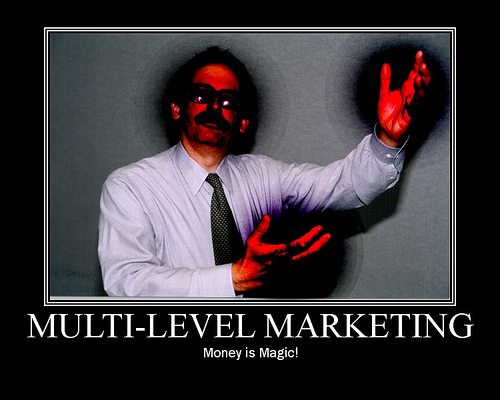
Think Three Times Before Going into Multilevel Marketing (MLM)

A client asked me, "Should I go into a multilevel marketing business?" (They're also known as MLM or network marketing.)

MLMs are businesses in which you try to make most of your income not by selling product but by recruiting others to sell product.

I had known little about MLM except that I knew two people who tried it and neither made money. One ended up with a lot of water filters and the other guy a garage full of laundry products.

So I did some reading about MLMs. In an era gone by, when many people lived rurally and few stores served them, MLMs had some viability. Indeed, Avon, Electrolux, and Tupperware started as MLMs. But today, with value-priced retailers of nearly any imaginable product even in rural areas (e.g., Wal-Mart) and the Internet serving nearly everyone, I believe MLMs are a bad business to get into. One major reason: If a product is worth selling, it will be available online or in stores--no need for an expensive, multil-level distribution network.

Indeed, the Wikipedia profile of multilevel marketing includes these reports on income earned in multilevel marketing:
  • The London Times reports that a British government investigation revealed that just 10% of Amway's British agents made any profit.
  • Newsweek reported that, based on Mona Vie's ($40 a bottle juice) own income disclosure statement "fewer than 1 percent qualified for commissions and of those, only 10 percent made more than $100 a week."
  • USA Today reported that "The Direct Selling Association (an advocate for the industry) says the median annual income for those in direct sales (MLM) is $2,400."
The Federal Trade Commission among others warns than many MLMs are little more than pyramid schemes, in which the goal is not mainly to sell product (like high-priced juice, vitamins, skin cream, etc), but to convince friends and neighbors to sign up to sell those products, which generates money for the recruiter. Too often, the main result is friends and relatives who resent you because of your sales pressure and/or because they ended up not making a living but losing money.

I certainly understand why, with today's high un- and underemployment rate, MLM appeals. After all, President Obama promised that if the taxpayers coughed up the $1 trillion in attempted stimulus spending, the unemployment rate would decline from the already high 8%. Instead it has leapt to 9.8%, and the underemployment rate is twice that.

Nevertheless, in my opinion, for almost anyone, there are wiser approaches to self-employment than a MLM scheme. If you're looking for a structured approach to self-employment, I suggest you forgo both MLMs and franchises, and instead, scout around for a successful simple business (e.g., a gourmet sandwich truck), and hire its owner to coach you in starting one.

My Top Ten Ways to Improve the World

#10. Radical election reform: Replace bought politicians with wisely selected ones. I'm undecided between two approaches:

1. All campaigns would be two to three weeks long, 100% publicly funded, and consisting only of a neutral body such as C-Span or Consumer Reports posting the candidates' voting records and positions on key issues, plus a broadcast debate followed by a simulation of the candidates running a meeting.


2. Our government officials would be selected using passive criteria, like a stock index fund. For example, it might consist of the most newly retired of the nation's 10 largest nonprofits, a randomly selected CEO of the S&P MidCap 400, the Police Officer of America's Cop of the Year, the School Principal of the Year, the most award-winning scientist who finished her/his Ph.D. in the last decade, plus five random citizens.

You protest, "The incumbents would never allow it--the foxes are guarding the hen house." My approach would be to get the media to urge voters to vote against candidates that oppose a fairer electoral system.

#9. Replace ObamaCare with NemkoCare. Patients having (ahem) skin in the game is key to cost control: the invisible hand of 300 million people voting with their feet. So, all but the truly indigent would pay fee-for-service except for catastrophic care, which they'd pay for with private insurance.

To empower consumers to make good decisions, all health care providers would be required to post patient satisfaction rates and success rates for procedures, adjusted by severity of illness.

Caring for the millions of currently minimally cared-for patients will require more doctors, nurse practitioners, etc.
To provide them while improving quality, provider training would be shorter and practical--wrested from the university and provided by master practitioners. Physicians, let alone nurses, do not need a year each of college-level inorganic chemistry, organic chemistry, calculus, and physics. Their training should be provided by the finest clinicians, not by academics, who mainly do research on esoterica.

#8. Replace curricular esoterica with essentials. Kindergarten-through-grad-school curriculum has long been selected primarily by professors, a group that has deliberately opted out of the real world and loves esoterica. Hence today, nearly all high schools students, even those reading on a fifth-grade level, must study the doppelganger, quadratic equations, stoichiometry, the Peloponnesian Wars, etc., even if that means they leave school unable to make change, critique an editorial, resolve conflicts, or prioritize ethics over expediency. Essentials must be prioritized over esoterica.

I'd wrest curriculum choice from the academics and replace them with a diverse panel of people from plumbers to CEOs, nurses to, okay, professors, who have been issued the following mandate: That which is most important for living must be taught and learned before teaching the less important.

#7. Require schools and colleges to post their report card. We require students to receive report cards every few months. We even require tires to have "report cards" molded into their sidewalls.

Well, if education is as important as everyone claims, shouldn't schools and colleges be required to post a report card on themselves? For example, shouldn't they be required to report their students' average annual growth in reading, writing, critical thinking, and mathematical reasoning, compared with national norms for schools with similar student bodies?

Shouldn't colleges additionally be required to post their four-, five-, and six-year graduation rates (disaggregated by high school record and SAT score,) and the actual average total cost of a degree, after financial aid, broken down by family income and assets? Shouldn't all schools and colleges be required to post the results of a student satisfaction survey and a summary of the accreditation visiting team's report?

#6. Replace a nation of variable-quality teachers with online top teachers. The nation has, for example, 30,000 high school math teachers, some magnificent, most not. Why not have ten of the nation's best teachers team-teach courses on video, available on the Internet, with local paraprofessionals or even teachers on site to answer student questions and provide the human touch. That would enable every child, rich and poor, urban and rural, to be taught by a dream team of teachers.

Of course, the reason that hasn't happened is that the teachers' unions have used their mammoth political clout to quash such proposals. Perhaps movies like Waiting for Superman will start to awaken the public that the teachers' unions are children's enemy.

#5. Create an Assistance Army. This would solve the employment crisis while improving America's quality of life. The government should fund a series of public service announcements encouraging people to hire a tutor for their children, personal assistant for themselves, and companion for their elderly relatives. Encouraging that Assistance Army would create millions of ethical, society-improving, widely doable jobs with minimal expenditure of our tax dollars, unlike with government-created jobs.

#4. Replace the media as brainwasher with the media as fair informer. Much wisdom resides left of center but much also exists right of center. Yet, except in the increasingly marginalized Fox News, the largest mindshare, especially among the influential class, is held by liberal media outlets: for example, CNN, New York Times, the TV networks, even Google searches, which on sociopolitical topics, in my experience, generate heavily liberal results, unlike the results of Yahoo! searches, which seem more even-handed.

The media has enormous power to affect our thinking and in turn, public policy. Not long ago, most members of the media felt a near-sacred obligation to present the full range of intelligent views on an issue or candidate. Today, with their professors' encouragement, most journalists consciously or unconsciously manipulate their audience into believing what they believe. And what they believe is overwhelmingly liberal thought because most journalists, like professors, have opted out of the real world and thus have been exposed mainly to the leftist thought hegemonic in universities and especially in prestigious journalism schools. Journalism schools should encourage their students to pull on ropes of restraint and make all efforts to fairly present intelligent perspectives from both right and left of center.

#3. Replace legal advocates with legal fact finders. In our legal system, two advocates devote their considerable intelligence and energy not to getting to the truth but to getting their side to win. That means that the side with the better lawyer has an unfair advantage. I believe that greater justice would be served if, as in the European Court of Justice, along with the judge, the two attorneys were charged with getting to the truth, not advocating, a priori, for one side.

#2. Embrace behavioral genetics. Real solutions to social problems require us to acknowledge that they have both environmental and genetic roots. Just as a VW Bug cannot run like a Ferrari no matter how well tuned-up, a person won't behave intelligently and responsibly unless both genes and environment are sound. Every mother of two or more children knows that each child emerged at birth with a distinctive, enduring personality: No matter how much effort parent and schools make, laconic infants rarely become high-energy, retarded toddlers rarely become intelligent, hyperactive children rarely become laid-back adults.

So we must not reflexively reject genetically oriented approaches to reducing social problems. We tend to viscerally reject such approaches because they evoke comparisons with the horrific Nazis' attempts to create a master race. But there's an infinite difference between the Nazis, who wanted to kill all non-Aryans, and a society that would, for example, attempt to reduce teen pregnancy by making available in schools not only comprehensive sex education but abortion and birth control, including new implantables such as the easily-insertable/removable five-year-lasting Jadelle.

We should even consider, fair-mindedly, the wisdom of funding research that would give parents the uncoerced option, subsidized for the poor, to ensure that their children be born without strikes against them: with high cognitive ability, immunity to cancer, and even perhaps the ability to love.

#1. Legislators must steward our tax dollars as carefully as their own. As every triage medic knows, we must prioritize investing our resources not in those with the greatest deficit but in those with the greatest potential to benefit. Yet we often don't. For example, our hearts reach out to children who are most at-risk, those with the biggest deficit: special education children, inner-city kids, etc. So we've reallocated huge percentages of education spending from the now-eviscerated programs for gifted kids to the lowest achievers. We've spent literally trillions of dollars in a failed attempt to reduce the achievement gap: everything from Early Start to Head Start, No Child Left Behind to dropout prevention, adult literacy to job retraining programs.

Perhaps the most blatant example of poor stewardship of our tax dollars and of our freedoms is that government is making ever more massive efforts to attempt to cool the planet with insufficient analysis of the likely extent of benefit, the opportunity costs, etc. Environmentalism has moved beyond science to religion.

If legislators and policy makers were investing their own money, I predict they'd invest differently.

I welcome your comments.

 

blogger templates | Make Money Online