


Showing posts with label campaign finance reform. Show all posts
Showing posts with label campaign finance reform. Show all posts
Thursday, December 28, 2023


Thursday, November 2, 2023
Tuesday, January 22, 2019
Six Big Ideas for a Better America

Reduce concentration of extreme wealth. Extraordinary wealth is concentrated among a few ultra-wealthy individuals, corporations, and other entities. That is obscene when so many poor people exist and especially so because these entities are involved not in creating better products and services but "financialization," basically moving money around. So I'm not talking here about Amazon, Apple, or Facebook. I'm talking about big banks and hedge funds. These entities must realize some sense of obligation to the public and voluntarily redistribute some wealth or, much as I'm not a big fan of big government, if they resist, some tax increase for them would then be appropriate.
Reinvent how our leaders are selected. The metastasizing length and cost of political campaigns ensures that the best people don't run for office let alone get elected. A wiser system would have our leaders selected not elected. For example, a legislature might consist of the CEOs of the fastest-growing for- and non-profits, winner of Teacher of the Year, Plumber of the Year award etc, the most-cited philosophers and scientists, the most popular novelist, artist, etc. plus 20% selected at random. That would yield an unarguably excellent pool of people, uncorrupted by money from special interests: corporations mainly on the Right and activist groups mainly on the Left. The foxes are guarding the henhouse so the only way this could occur is if society's mindmolders: the colleges and media made this a Cause, so that politicians who refused to sign on, would likely lose.
Restore meritocracy. Starting in the '60s, society's mind-molders (the schools, colleges, and especially media--news (including the so-influential Google Search, entertainment, novels, movies, theatre) have manipulated us into believing that it's wise to redistribute resources from the best-and-brightest to the lowest achievers. Hence, hiring, promotion and college/grad school admission is decreasing emphasis on merit while increasing emphasis on getting more women, minorities, and the disabled.
Less obvious, the nation's financial and human resources are being redistributed from those with the greatest potential to profit to those with the greatest deficit. That Alice-in-Wonderland thinking is no more rational than the owner of oil wells deciding to put the most money and effort into drilling the poorest-performing ones. That is a formula for reducing the U.S. to its lowest common denominator and arguably will be more devastating to the U.S. standard of living and worldwide competitiveness than most aggressions that Russia and China could perpetrate on us.
I am pessimistic that we'll ever restore more meritocracy. I believe we'll continue to increase our Marxist-derived focus on redistribution toward merit-indifferent egalitarianism because the colleges and media have been appropriated by the Left, which brainwashes the next generation to believe in the redistributive religion. And that cohort later will replace society's current mind-molders. So I see the anti-merit trend not as a pendulum but an inexorable descent into mediocrity's pit.
Reinvent education. Think back to all your teachers and college instructors. How many were transformational, not only teaching you the subject so you really understood it while you enjoyed the process but enhanced your appreciation of of the subject and transformed your life? If you're like most people, the answer is few or none. But in this wide world of ours, there is a small percentage of such extraordinary teachers. Thanks to the wide availability of fast internet, interactive-video online courses taught by these super teachers would enable everyone, rich and poor, from Harlem to Beverly Hills (indeed Aden to Zululand) to receive world-class instruction at a fraction of the cost of the assortment of live teachers, a few of which are transformational, many more of whom are not...or worse. The big obstruction here is not technology but the teachers unions, which fear loss of jobs. Yes, teacher jobs would be lost but more important is our children, our future.
The second part of the one-two punch for reinventing education is to blow up the existing curriculum, especially in high school and college. So few students care about or, importantly, need to derive geometric theorems, know the causes of the War of the Roses, the intricacies of Shakespeare, stochastic processes in chemistry, etc. Indeed, there's little evidence for the oft-cited rationale for teaching such esoterica--that it improves critical thinking. What most traditional-age students need, want, and will work hard to learn and retain are such things as practical conflict resolution, financial literacy, career planning, relationship and sexual advice, the life well-led, etc.
Special mention should be made of entrepreneurship education. Entrepreneurship is the only true source of job creation. Government/taxpayer-funded jobs merely eat our seed corn. I am well aware that many businesses are "ethically challenged." So what's required is a K-20 ethical entrepreneurship curriculum.
Redirect research funding. I recommend three areas:
Toward an intelligence and an altruism "pill." We should prioritize development of an intelligence "pill" and an altruism "pill," which in practice will be some sort of gene editing. Of course, environment matters but genetics predispose us in the same way as even a poorly tuned Ferrari will win a race against a well-tuned VW. As long as the "pill" were available free to the poor via Medicaid, as is the case with other medical procedures, it would decrease the achievement gap because the poor have more to gain. Clearly, the change-the-environment model has failed. We've spent $22 trillion over the last half century to close the achievement gap and it remains as wide as ever.
Reducing substance abuse. Instead of racing to legalize marijuana, which is far more dangerous than the Big Tobacco-endorsed advocates would have us believe, we should be doing more social- and hard-science research on how to prevent and cure substance abuse. Alcohol, tobacco, marijuana, opioids, etc wreak unimaginable pain not only on the abusers but on their families, employers, and society. For example, consider the pain and death that come from the victims of accidents caused by impaired drivers. Consider how much of our health care system is overwhelmed by the sequelae of drug abuse both to the abuser and to others.
Nuclear energy. We also must redirect energy spending from solar and wind to nuclear. Solar and wind are nice add-ons but unless we're willing to live like Stone Agers, we need a far more potent yet clean source of energy. That's nuclear. And not withstanding what the hard-line radical green activists would have us believe, nuclear energy is not Chernobyl or Fukushima. For decades now, much of the world's electricity comes from nuclear energy, and the technology is quite safe and becoming more compact. With sufficient investment, I believe we'll see a time when our cars, trucks, buses, trains and planes are powered by clean nuclear.
Exit the Middle East, with one exception. For 2,000 years, the West has attempted to "fix" the Middle East--from Alexander the Great to Churchill to our recent travails in Iraq, Iran, Afghanistan, Syria, and our efforts to stop terrorism from Taliban to Hezbollah to Hamas. We must exit the Middle East except for modest support for Israel, the Middle East's only democracy, woman-friendly country, and the tiny nation responsible for very disproportionate medical and technological discoveries that benefit us all. From the PC chip to Waze, tiny-population Israel has won a dozen Nobel Prizes just since 1966. And Israel is surrounded by enemies sworn to its destruction, including from Hamas, the government voted-in by the Palestinian people.
In conclusion
Of course, I don't have the hubris to believe that these solutions are free of downsides or that this is a comprehensive list--Other items I could discuss include no-tax-return taxation, reducing existential-level government debt, etc. But the aforementioned are my best thoughts in a nutshell. I welcome your comments and questions.
I read this aloud on YouTube.
Thursday, February 25, 2016
Reinventing How We Select Our Poltiical Leaders

Of course, much of it is centered around Donald Trump: How could such a person be the leading GOP candidate?
At least in part, it's testimony to the system, in which money and bombast trump (pardon the expression) competence to do the job.
It is my own growing unhappiness with the system that motivated me to, here, update my WashingtonPost.com article on how to reinvent the way we select our political leaders. The updated version was just published on PsychologyToday.com.
Monday, October 29, 2012
How We Select Our Leaders, Reinvented

Here is my next column in Mensa's The Intelligencer.
The
Life Well-Led
by Marty
Nemko
How We Select
Our Leaders, Reinvented
Is the the lying and deceptions of both
presidential candidates disgusting you? How about that they and their SuperPACS will have spent $2 billion, heavily to pay for truth-obfuscating commercials, slick ads that
clutter your e-mail and snail mailbox, not
to mention telemarketing get-out-the-vote phone calls interrupting your dinner?
And the future bodes worse: The
Supreme Court's Citizens United decision means that they can raise money
without limits to manipulate us into voting for them.
Indeed, today, nearly every sentence
spoken by major politicians is dial focus-group tested by
Madison-Avenue-inspired "messaging teams." Sometimes it seems we're not voting for the
best candidate but for the best propaganda machine.
As troubling, those special
interests wouldn't be pouring billions into campaigns unless they were
confident it would make politicians do their bidding rather than what's best
for the nation.
Perhaps worst of all, the need to
run a four-year-long press-the-fat-cat's flesh campaign deters many of the most
worthy people from running.
I believe that the following two approaches would
ensure we elect better and less-corrupted leaders:
The
Two-Week Publicly-Funded Campaign
- All campaigns would be 100% publicly-funded. That has been proposed and rejected in the past as a denial of free speech. I believe that abridgment is far outweighed by the benefit to society
- All campaigns would be just two weeks long. That would control cost and only minimally reduce voter knowledge: By the time most voters vote, they've forgotten what they heard weeks ago.
- The campaigns would consist only of one or two broadcast debates. Those would be followed by a job simulation: running a meeting.
- A neutral body such as C-Span or Consumers Union would post each major candidate's biographical highlights, voting record, and platform on key issues.
Such a system would reduce
candidates' corruptibility while increasing the quality of information voters
would have about the candidates. As important, better candidates would run,
knowing they needn't run an endless, expensive, beholden-to-special-interests
campaign.
Alas, this problem does create a thorny problem: Who
participates? The best solution I can come up with is that the Democrats,
Republicans, Socialists/Greens, and Libertarians would each have the option to
present a candidate.
An even
more different approach: Don't Elect.
Select.
In Don't Elect. Select, our government officials would be selected, not by voting
but using passive criteria. For example, the Senate might consist of the most
newly retired of the 10 largest nonprofits, a randomly selected CEO of the
S&P Midcap 400, the Police Officer of America's Cop of the Year, the National
Teacher of the Year, the most award-winning scientist under age 30, a randomly
selected Harvard visual/performing arts instructor, plus random citizens. To ensure sufficient but not excessive
continuity, the senators would every four years, anonymously rate each others'
job performance, and the top 25% would retain their job for the next four years
and the other 75% would be selected using the passive criteria mentioned in
this paragraph.
- We’d have a more worthy and ideationally diverse group of leaders.
- The public would view such a leadership with more respect than they have for our elected candidates.
- The absence of campaigns would save the public a fortune. Just our income tax form’s $3-per-person check-off box to political campaigns is projected to, over the next 10 years, cost the taxpayer $617 million[i].
Of course, one might argue that the incumbent politicians would never allow it. After all, the foxes are guarding the hen house.
Another objection is that Don’t Elect. Select would require a Constitutional amendment, which is no easy task, but the Constitution has already been amended 27 times. I can’t think of a more worthy reason for number 28.
This is an
adapted excerpt from from my just-published seventh book: What's the Big Idea? 39 Disruptive Proposals for a Better America.
Friday, February 4, 2011
A Reinvented Election System
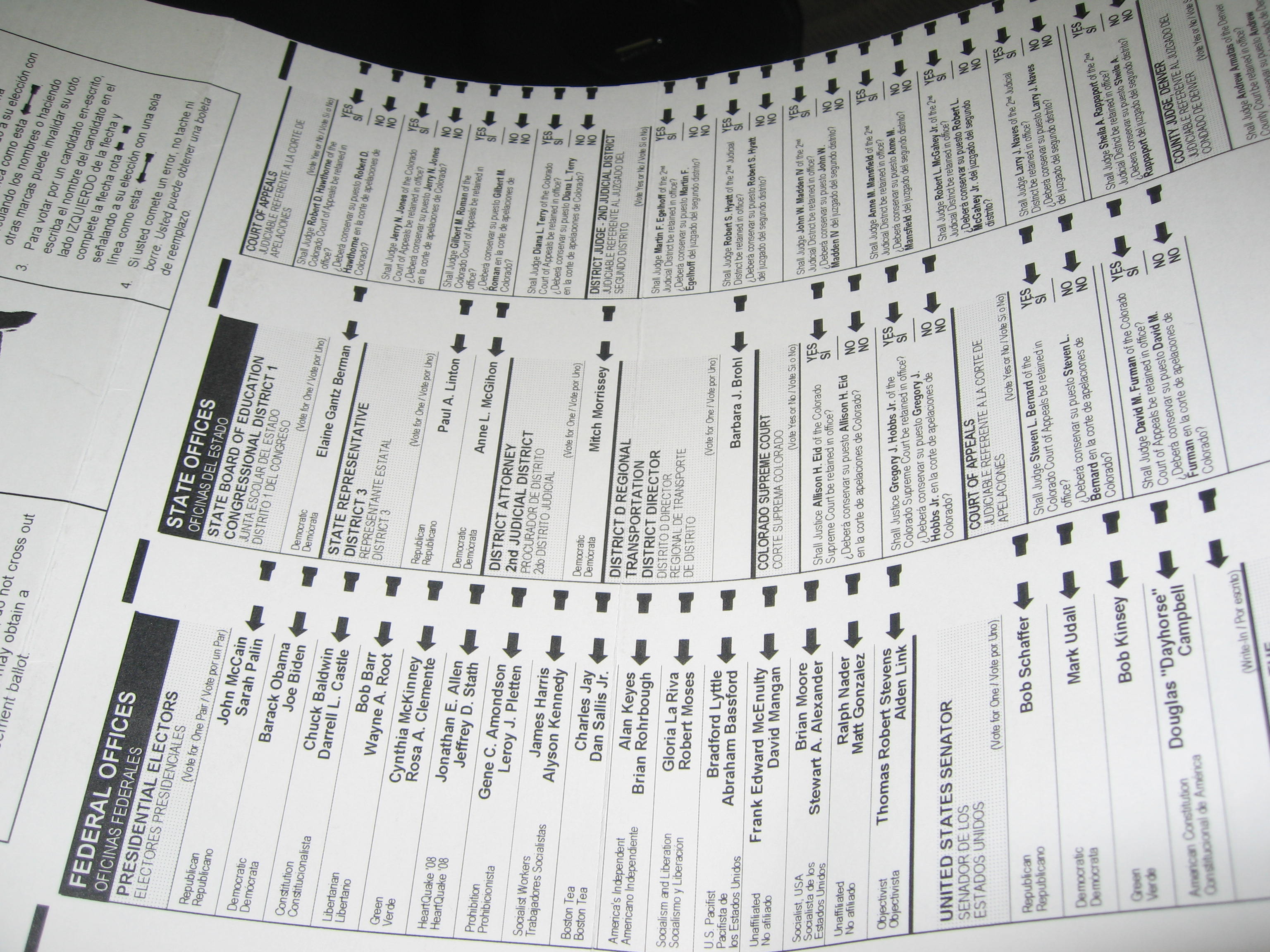 We consider democratic elections among the highest goods. Even in an era of incomprehensibly high federal deficits, the
 Another example of our commitment to highly democratic elections is that literacy tests have, for almost a century now, been virtually eliminated so citizens now need no more qualifications to vote than to have passed their 18th birthday.
I want to argue here that a voting-readiness test should be reinstated. Why? First, because it's much more difficult today to cast a wise vote. Candidates' positions on issues are more much difficult to understand because much more complex issues are at play in our global, information- and technology-centric society. At the same time, candidates are spending enormous sums on highly sophisticated Madison-Avenue messaging consultants from Frank Luntz on the right to President Obama's dream team of influencing experts on the Left. Every campaign commercial or speech is based on computer analysis of focus groups' dial ratings of every word. Such efforts not only dwarf the election propaganda techniques used when voter literacy tests were banned, those efforts dwarf even the efforts of Josef Goebbels, Hitler's infamous Minister of Propaganda. It is extremely difficult to vote wisely.
So it's no surprise that we mainly elect lawyers and even occasionally actors (e.g., Ronald Reagan and Arnold Schwarzenegger,) and comedians (e.g., Al Franken and Tom Ammiano.) All that, at a time when truly wise, brilliant, ethical leaders are ever more important.
I believe those factors tip the scales in favor of requiring a voting-readiness test. More valid than a literacy test would be a test of the ability to critique a political campaign ad, commercial, and debate.
A high level of sophistication would not be required to pass the test--merely enough that a voter demonstrates the ability to acquire basic knowledge of the candidates and issues. That way, the benefits of a broadly participating democratic electorate could be retained while significantly improving the quality of the electorate's decision-making, and in turn, the quality of our elected leaders.
A nice side effect is that some people would prepare for the test, thereby making them better voters and, overall, better thinkers.
Of course, a voting-readiness test would bring liabilities. Obviously, there is the significant cost of even once-in-a-lifetime testing of each voter. More serious may be the alienation and disenfranchisement of people who fail the test. Exacerbating that alienation, even if scrupulous care were taken to ensure the test was fair to all racial and ethnic groups, if disproportionate members of such a group failed, it would yield accusations of racism and thus increase tensions.
Yet I believe the benefits of a voter-readiness test would far outweigh the liabilities. We would see better quality leaders, and in turn, better, fairer laws, a better quality of life for the citizenry, and even perhaps fewer wars.
To further improve the quality of our elected officials, as I've written previously, I advocate replacing our current election financing system with a 100% publicly funded system, which would allow only two- or three-week-long campaigns consisting only of televised debates and job simulations (e.g., running a meeting) plus an online/printed statement of voting records and positions on key issues.
Do you think America would, net, be better if a voter-qualification test were required and campaigns were the few-week-long publicly funded system I propose here?
Thursday, October 21, 2010
How Political Campaigns Should Be Run
 In that I generally lean libertarian, this may surprise you but, observing the obscenely expensive, obfuscatory political campaigns reminds me how much we need 100% publicly funded campaigns. My model:
- Length: two weeks.
- One or two debates, broadcast on TV, archived on YouTube. Debates would be designed to push the candidates off their prepared message and to truly engage. If a debater isn't directly answering the question or otherwise being obfuscatory, the moderator would interrupt, calling the debater on that, and insisting on a direct answer.
- At the end of the debate, still on camera, each candidate would participate in a simulation: running a brief meeting with mock legislators on an issue of the day. Perhaps retired legislators could be used for the simulation.
- A neutral body (for example, C-Span) would create a candidate summary consisting of his/her voting record and platform on key issues. That would be mailed to all registered voters and posted on a website such as CSpan.org.
I believe that model would yield better candidates because they wouldn't have to run a four-year, press-the-flesh, be-beholden-to special interests campaign. Also, the public would get a far better sense of what the candidates would be like as our leaders than with our current commercial-, special-interest-, and speechifying-driven process.
What do you think?
Subscribe to:
Posts (Atom)

