Showing posts with label economic systems. Show all posts

Monday, December 19, 2011

A Case for Economic Agnosticism


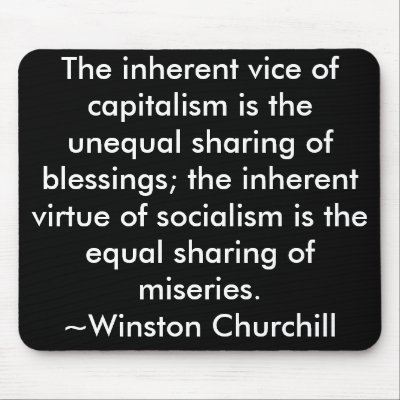
What's the best economic system: Socialism? Communism? Capitalism? A hybrid?

So many factors affect an economy that history nor theory provide adequate basis for dispositive judgment.

Thus, despite today's era of polarized opinions, it strikes me that the only responsible positions on the subject are agnosticism or advocacy of some sort of capitalism/socialism hybrid.

What do you think?

Thursday, August 25, 2011

Simplism: A New Alternative to Capitalism and Socialism

Both the capitalist and socialist systems are deeply flawed:

Capitalism results in too great a gap between a small wealthy class and a large and ever growing poor. Also, capitalism thrives on ever growing materialism, which promotes shallow values and environmental degradation.

Socialism doesn't work because it rewards the lazy and incompetent while punishing the hard-working and capable.

Of course, many countries use a capitalism/socialism hybrid but I believe there's a better approach. I call it Simplism. It requires educating the public about three things:

1. The wisdom of our buying personal services rather than non-essential products. Our lives benefit more from such services as a tutor for our kids, assistant for ourselves, or a companion for our elders than from buying jewelry, new cars every few years, expensive vacations, big houses, etc.

Of course, if the public were to be less materialistic, many jobs creating and distributing those material goods would be lost. Disproportionately affected would be low-skill/low motivation workers. So for Simplism to work, I believe the government would need to create taxpayer-funded jobs for those unable to hold a private-sector job. Those jobs might include, under supervision, building housing, assisting in classrooms, cleaning up blighted neighborhoods, etc.

2. By reducing our spending to the truly important, we'd gain greater benefits than what our purchases would generate: we'd gain the freedom to do the sorts of work we want, the time to pursue our desired non-remunerative pursuits, and the peace of mind that comes from the absence of big unpaid bills.

3. The importance of considering learning to be an entrepreneur, to run your own business. That
avoids your needing to be a wage slave, paid as little as the employer can get away with. It also
provides greater job security than if employed by others, and brings to the public better, faster, or less expensive products and services, thereby improving all of our lives. And of course, creating new businesses creates new jobs. The skill of entrepreneurship may be as important as the 3 Rs. Therefore, I believe it should be taught k-16 as well as through entrepreneurship boot camps available to all.

Saturday, June 25, 2011

Simplism: A New Alternative to Capitalism and Socialism

Both the capitalist and socialist systems are deeply flawed:

Capitalism results in too great a gap between a small wealthy class and a large and ever growing poor. Also, capitalism thrives on ever growing materialism, which promotes shallow values and environmental degradation.

Socialism doesn't work because it rewards the lazy and incompetent while punishing the hard-working and capable.

Of course, many countries use a hybrid of the two but I believe there's a need for a new approach. Here's my proposal for one. I call it simplism. It requires educating the public about three things:

1. the wisdom of our buying personal services rather than non-essential products. Our lives benefit more from such services as a tutor for our kids, assistant for ourselves, or a companion for our elders than from buying jewelry, new cars every few years, expensive vacations, big houses, etc.

Of course, if the public were to be less materialistic, many jobs creating and distributing those material goods would be lost, disproportionately to low-skill/low motivation workers. So for Simplism to work, I believe the government would need to create taxpayer-funded jobs for those unable to hold a private sector job. These jobs might include, under supervision, building housing, assisting in classrooms, cleaning up blighted neighborhoods, etc.

2. by reducing our spending to the truly important, we'd gain greater benefits than what our purchases would generate: we'd gain the freedom to do the sorts of work we want, the time to pursue our desired non-remunerative pursuits, and the peace of mind that comes from the absence of big unpaid bills.

3. the importance of learning to be an entrepreneur, to run your own business. That:
  • avoids your needing to be a wage slave, paid as little as the employer can get away with.
  • provides greater job security than if employed by others.
  • brings to the public better, faster, or less expensive products and services, thereby improving all of our lives.
  • creates new jobs.
The skill of entrepreneurship may be as important as the 3 Rs. Therefore, I believe it should be taught k-16 as well as through entrepreneurship bootcamps that are available to all.

I welcome your reactions.
 

blogger templates | Make Money Online