


Monday, March 3, 2025


Wednesday, December 8, 2021
Acting on Impulse

Sunday, December 5, 2021
5 Keys to Becoming More Conscientious

A large-scale synthesis of studies on conscientiousness, covering more than 100 years of research, merged the findings of 92 separate meta-evaluations covering 2,500 studies, with a combined n of 1.1 million. It identified ten ways that conscientiousness manifests.
To make it easier to implement its findings, my Psychology Today article today merged the ten manifestations into five. For each, I offer a suggestion for how you might make it part of your life.
Wednesday, November 24, 2021
Deciding When to Succumb to Temptation

Tuesday, March 9, 2021
7 Suggestions for Becoming More Diligent
Imagine that your counselor emailed you between sessions to ask how you’re doing. Or that your friend promised to help you on Saturday at 9 and, voila, there s/he was. Or that your romantic partner remembered that you dislike cilantro and when phoning for takeout, made sure that nothing had cilantro.
Diligence is one of those virtues that seem to have gone a bit out of fashion, along with duty, discipline, responsibility, and restraint. Yet diligence has always been and always will be at the hub of accomplishment and, among the discerning, of respectability.
But how to get more diligent? Ay, there’s the rub. My Psychology Today article today offers my best but I fear inadequate suggestions:
Friday, October 23, 2020
The Straight Arrow: An underappreciated type?

Tuesday, October 6, 2020
My Father’s Store: Life Lessons
Thursday, May 14, 2020
On Turning 70 The thing I most want to tell you
Tuesday, January 14, 2020
Tough! Is being intolerant of bad behavior an underappreciated value?

Today’s article aggregates those three: It makes a case for toughness. It's potentially applicable in the widest range of contexts, as the article attempts to demonstrate.
Friday, January 10, 2020
Developing Discipline

Many of my clients are bright, healthy, and had a good upbringing yet flounder, mainly for lack of discipline. My PsychologyToday.com article today offers three tips that have helped.
Monday, October 14, 2019
Becoming a Teensy Bit More Disciplined; Baby steps

You see, some perfectly good people just aren’t perfectly driven. No matter how much I tell them that the life well-lived is about productivity, they think, “Yeah, yeah” and get back to something more fun than that task.
Might any of the baby-step tips I offer in my PsychologyToday.com article today tweak your lazy butt even a teensy bit?
Sunday, February 19, 2017
In Defense of Duty

Wednesday, June 15, 2016
The Decline of Duty: A Cause of America's Decline...and You?

Today, alas, they often are deemed less important than creativity, celebrating difference, and questioning authority.
In my PsychologyToday.com article today, I argue that's reason for lament.
Saturday, April 4, 2015
Four Easier Tips for Increasing Your Willpower

My PsychologyToday.com article today offers four tips have often helped my clients who struggle with discipline. Perhaps at least one will work for you
Wednesday, September 10, 2014
Should I Eat That?: An internal debate on whether it’s worth the calories

My PsychologyToday.com article offers the internal dialogue I’d have with myself as I was deciding whether to go out for an Indian buffet or stay home and have a prudent dinner. HERE is the link.
Saturday, May 3, 2014
Finding the Will to Be Good

We all harbor less-than-benevolent thoughts.
Alas, we don't always have the discipline to restrain ourselves. Oh, for a little more impulse control.
My PsychologyToday.com may offer some help. HERE is the link.
Friday, February 21, 2014
An Ode to Discipline
We wave away such words as puritanical anachronisms, out of touch with newer values: find your passion, do what feels good, life's short; eat dessert first! And the "progress" accelerates:
- State-sanctioned lotteries and casinos have burgeoned despite their predominantly hurting the poor, who can least afford to lose. The ultimate in regressive taxation.
- Two-thirds(!) of workers take sick days when not sick. Twelve percent said they took sick days just to watch March Madness! That's so societally accepted that corporations aren't embarrassed to push their recreational product by telling people to take a sick day. For example, the ad below was sponsored by a consortium of Tahoe hotels and casinos, the one below it by the Weather Network.


The cheat-if-you-can ethos is yet one more reason employers hire as few people and automate as many positions as possible.
- Worst of all has been the increased use of mind- and body-damaging drugs. And now, a majority of Americans favor legalizing pot while almost no one (I'm an exception) advocates banning tobacco or even alcohol. They have long devastated humankind but adding wide use of pot, coke, heroin, meth, and party drugs I can't even name, would cause enormous additional damage to health (disease and traffic accidents,) to families, to workplaces. I have written an essay providing a mountain of evidence that legalizing "mere" pot is a nightmare for America. I challenge you to make a stronger counterargument.
The world would be far better if we all accepted that hard, honest work is not an option but a societal, even cosmic, duty--even if the job is far from ideal. True, there are no longer enough good jobs to go around but there are enough acceptable jobs for all but the weakest employees. And yes, a job as dishwasher, factory worker, sewage-treatment plant worker, or hotel cleaner is--with a reasonable employer--an acceptable job. It seems cosmically wrong for able-bodied people to reject low-level work in favor of letting a family member or the taxpayer pay them for not working.
Lest you wonder if I practice what I preach, no I never worked in a sewage-treatment plant but I was a bookkeeping clerk with a shared desk in Harlem, for two years worked the night shift as a New York City cab driver and, to this day, at almost 64 years old, work 60+ hours a week, at least half of which for no pay. For example, this is my 1,244th blog post, all carefully written and edited. I just finished editing it after midnight.
Yet some people would rather let the taxpayer support them for 99 weeks than accept a mediocre job. I think little of such people.
As magnificent as is Beethoven's Ode to Joy, I believe that at this stage in society's evolution, we might do better to listen to an Ode to Discipline.
Sunday, March 13, 2011
My Musings on Japan's Earthquake
 These are my Twitters following the Japan quake:
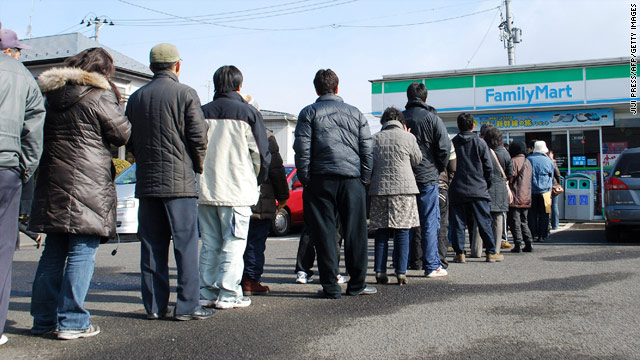
Kudos to the Japanese. Unlike after disasters in the U.S. and other countries, there's been no looting and no rioting. Discipline is key to success.
Note: The picture above is of residents of Sendai, the city suffering the most damage, waiting in line at a convenience store, following the earthquake and tsunami.
Poor Japan, victim of nuclear bombs at Hiroshima and Nagasaki, now facing possible nuclear plant meltdown.
Could there be a God worth praying to if s/he wouldn't stop disasters like the Japan quake/tsunami/nuclear threat, or billions, including infants, dying of excruciating diseases?
Luck is so much more important than we acknowledge. The 40-year old Fukushima nuclear power plant was scheduled for closure in 2 weeks!
It appears the meltdown will be only partial, with the radiation remaining in the containment structure...Let's hope
(Note : two items have been deleted from an earlier version to reflect new facts.
Buy on bad news: I plan to buy SHAW, which builds nuclear plants. I believe Fukushima will increase interest in new-generation, even safer plants. My plan: It has dropped 19% in the first hours the stock market opened. I will wait until SHAW rises 10 percent. That would give me sufficient optimism that downtrend is reversing.
Update: I bought 100 shares at 31.69 after it rose 10% above its low of 27.60. It subsequently rose to 34. There's been more bad news so it's back down to 31.51. I'll keep watching it. When it rises 10% above a more recent low, I'll buy more. Of course, there's a possibility that Fukushima will cause a decade-long slowdown in the nuclear industry. That's why the price has dropped 25% in a week, but I predict that, long-term, there will be much more nuclear building--of course, with super safe (and therefore more expensive and profitable to Shaw) designs. Solar, wind, etc., just can't produce enough energy. And fossil-based fuels are running out, bad for the environment, and make us dependent on the Middle East. Safely located, very safely designed nuclear is going to be key to our energy future. And, believing in the criticality of buying good stocks on bad news, I believe that buying SHAW when it shows early signs of recovery is wise. A perhaps less risky alternative is to similarly buy top-quality Japan stocks: e.g., Toyota, Sony.
Wednesday, December 30, 2009
Another Coach's Ideas on Curing Procrastination
 I've written a number of posts that list ways to control procrastination. You can find them easily by clicking "procrastination" in this blog's tag cloud.
The following list was written by someone else, Kathleen Nadeau. It contains some different ideas, which make sense to me. To read her list, click HERE.
Tuesday, May 19, 2009
The Missing Ingredient in Most People: Discipline
 Discipline has gotten a bad reputation. Since the '60s, it has become associated with rigidity, conformity, militarism, even Nazism.
Yet if I think about all the successful and unsuccessful people I know, the biggest differentiators are intelligence and discipline.
What does discipline mean? A few examples:
- Rather than indulging the natural desire to dabble, remaining focused on becoming an expert in their chosen field.
- Willingness to stay focused on a task, taking breaks only when necessary, until the task or a component of it is complete.
- Willingness to fight past the uncomfortability of not knowing: struggling to master something, willing to expose their ignorance by asking a co-worker a question, and/or hiring a tutor or mentor to accelerate their learning.
- Working longer hours. The longer you work at your profession or craft, the better you'll get.
- Willingness to do extra professional development after work, for example, while on the treadmill, doing professional reading rather than watching Desperate Housewives reruns.

