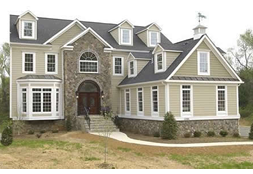
 If, as many predict, the economy continues to struggle, fewer people will be able to afford to rent let alone buy a decent-sized place to live.
We should consider expanded use of factory-built homes. For the most part, we still build homes as we did 100 years ago, stick by stick., pipe by pipe, tile by tile. Not only is that cost-ineffective, it too often results in poorly constructed homes. We should make greater use of factory-built homes, often called modular homes. Today, you can pick from hundreds of models, from basic to magnificent (see above,) designed by architects you couldn't afford if the cost weren't amortized across a design's many customers. Because the home is built in a factory, mainly by machine, it's not only less expensive but more flawless. And with a factory-built home, it's just weeks before you can move into your new home with all the finishes you've selected.
One reason many people feel the need to spend the additional money on a free-standing home rather than a condo or apartment is the noise from the neighbors and the street: multi-unit buildings are more likely to be located on a busy street. And of course, the millions of people who can't afford to buy a home even if they wanted to, would appreciate the quiet and being able to be as noisy as they like. A solution is greater use of the new generation of sound-dampening drywall, for example, QuietRock), flooring, for example QuietBarrier, and windows (e.g., Citiquiet).
Another way to reduce living costs, of course, is to live with others. Alas, finding a compatible roommate isn't easy nor is returning home to live with your family. So, why not have affinity housing, as we do with housing developments for people 55+. There could be homes for people interested in, for example, the arts, pacifism, the medical profession, or with a physical condition from triathlete to cancer patient. And why not have welfare recipients live as college students do: two or three to a small room, cafeteria-style food, etc., with social services provided, for example, parenting education, GED classes, computer training, drug/alcohol counseling, etc.? That would save taxpayer money, make services convenient, and provide a privacy incentive to get off welfare. If dorm-style living is good enough for Harvard students it should be good enough for welfare recipients.
Simple yet potent real estate innovations are also possible with commercial space. For example, most people's apartments and homes sit vacant from morning until night. Why not lease that space, for example, to a school or college wanting classrooms? To a corporation wanting more office space? To a therapist whose own residence isn't as impressive? That would create unexpected income for the owner/primary resident and a zero carbon footprint.