


Showing posts with label anger management. Show all posts
Showing posts with label anger management. Show all posts
Saturday, July 26, 2025


Thursday, January 23, 2025
Saturday, May 4, 2024
Friday, April 19, 2024
Sunday, January 26, 2020
The Case for Anger: Why calmness may not always be as wise as some gurus claim
 My PsychologyToday.com article yesterday made the case for being sad. My article today makes the case for anger.
Sunday, January 5, 2020
Tips for Anger Management

My PsychologyToday.com article today aims to help. First, I offer common scenarios likely to trigger anger and how the anger-prone person might wisely respond. After, I list the embedded principles for dealing with anger-proneness. I conclude with a few tips on how to deal with an angry person.
Sunday, November 17, 2019
Do You Look for Reasons to be Angry or Sad?

It’s easy to understand happiness seekers, but what could motivate people to want to be angry or sad?
My PsychologyToday.com article today offers my hypothesis, the pros and cons of trying to change, and if you want to change, some baby steps that can help.
Friday, September 8, 2017
Tips for Sub-Clinical Sadness, Worry, Anger, ADD/ADHD

- They’re sad by nature or because of external events but they’re not—as in clinical depression— numb or inert, let alone suicidal. They function, just not as happily as they’d like.
- They tend to worry more than they'd like but rarely panic, nor does their anxiety greatly impede their quality of life.
- They’re predisposed to anger but aren’t in an ongoing state of suppressed anger nor are subject to frequent outbursts let alone physical violence.
- They have trouble staying focused but their distractibility doesn’t rise to the level of clinical attention-deficit disorder; neither the spacey version (ADD), or the hyperactive version (ADHD.)
Monday, April 10, 2017
A Bomb: A short-short story about suppressed anger.

Monday, November 28, 2016
Staying Calm
 Some people seem to be able to stay calm in the face of life's annoyances. My PsychologyToday.com article today is for the rest of us.
Sunday, January 3, 2016
We Need a Better Solution for People With an Anger Problem

That made me think about how we might improve our current strategy for helping people with anger issues. I discuss that in my PsychologyToday.com article today.
Sunday, December 13, 2015
Advice to a Lawyer With an Anger Problem

Today, I offer advice to a lawyer with an anger problem.
Tuesday, August 18, 2015
Living With Type-A Behavior

At least in the short-term, it may increase your productivity but increases your risk of cardiovascular disease and being disliked. Longer-term, it's an open question as to whether it benefits your productivity.
My PsychologyToday.com article today identifies common Type A behaviors and offers suggestions for reducing them.
Monday, August 4, 2014
A One-Minute Course in Anger Management
 Most people who have anger issues hate themselves for losing
their temper but can’t make themselves stop.
Most people who have anger issues hate themselves for losing
their temper but can’t make themselves stop.
My PsychologyToday.com article today offers a strategy for controlling your anger. HERE is the link.
Sunday, April 27, 2014
Coping with Type A Behavior

My PsychologyToday.com article today: The angry, intense, rushing person: How to cope if it's you or someone else. HERE is the link.
Tuesday, August 28, 2012
A New Approach to Anger Management
A few years ago,
I finally realized that most successful people are relatively calm. Both
President Obama and candidate Romney are examples. So are Bill and Hillary
Clinton, Colin Powell, Dick Lugar, and John Kerry. I saw the 2004 presidential front-runner
Howard Dean kill his chances with one whoop, a mere moment of irrational
exuberance.
But what I think what most convinced me to change was watching C-SPAN. It's a parade of America's most influential people: not just political leaders but CEOs and eminent experts. Even when discussing terrorism, their demeanor usually remains moderate.
But what I think what most convinced me to change was watching C-SPAN. It's a parade of America's most influential people: not just political leaders but CEOs and eminent experts. Even when discussing terrorism, their demeanor usually remains moderate.
I looked back on
times I displayed anger and never was I glad I did. Sure, positive passion, a measure of enthusiasm, is great. But showing anger is a no-no. (So much for America being a tolerant society.)
For example, I had written the cover story for a major magazine and eagerly bought a copy to see what it looked like in print. To my horror, the second paragraph had been omitted in error. I was furious. All I could think was that many people would stop reading it after the first two paragraphs because that second one was a non-sequitur. I grabbed the phone and laid into the editor. Of course, all I accomplished was to reduce my chance of ever writing for that magazine again. In retrospect, I doubt if anyone was hurt because the paragraph was deleted.
For example, I had written the cover story for a major magazine and eagerly bought a copy to see what it looked like in print. To my horror, the second paragraph had been omitted in error. I was furious. All I could think was that many people would stop reading it after the first two paragraphs because that second one was a non-sequitur. I grabbed the phone and laid into the editor. Of course, all I accomplished was to reduce my chance of ever writing for that magazine again. In retrospect, I doubt if anyone was hurt because the paragraph was deleted.
I've become
aware that, alas, few things matter that much in the larger scheme. Billions of
us are trying to change the world or at least our sphere of influence, and even
when you do everything right, it's hard to see real change. So yes, it's worth
trying hard. Without working diligently toward goals, life has too little
meaning. But being too invested in the outcome may be a fool's game. I do think
the Buddhists have it right: Be in the moment and focus on your current task,
but after it's done, let go of the outcome. That is beyond your control.
I've also used this approach to anger management: If I start to feel angry at someone, I force myself to leave the room, take deep breaths, remind myself to
have perspective, and only then return. When I'm angry at something I see in
writing, I draft a response but delay sending it until the next morning when I
can view it with fresh eyes.
Mainly, I just
try to remember that the most successful, influential people stay calm except
for demonstrating an only moderate amount of enthusiasm. I also work at
staying in the sweet spot of trying hard but letting go of the outcome.
I can't always
make myself retain Obama-like equanimity but I'm getting better. I'm hoping at least some of my approach to anger management will do the same for some of you.
Saturday, January 2, 2010
Lessons from Warren Buffett
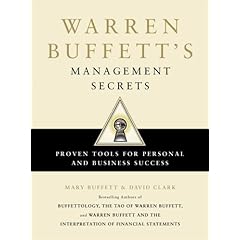 I've just had the pleasure of reading the slim but packed Warren Buffett's Management Secrets: Proven Tools for Personal and Business Success.
Here were my favorite ideas from that book:
On spending
"If we are in a 40 percent tax bracket, we have to earn $10 to have $6 to spend. So if we reduce out living costs by $6 it is the same as making $10. Warren still lives in the house in Omaha he bought for $32,000 and he drove an old VW Beetle long after he became a multimillionaire. The saved money gave him more to invest without hurting his quality of life, which made him both richer and more satisfied with his contribution to the world.
"Borrowing less and saving more is the path to riches and sleeping well. Borrowing more and saving less leads to wild times and bread lines."
"Anything you do to make yourself more valuable will pay off in real purchasing power."
On ideas
The best ideas are not new ones; those are risky. The best ideas are your competitors' tried and true ones. Or as I say, "Don't innovate; replicate." Or as Miles Davis says, "Good artists borrow. Great ones steal."
Don't dwell on failures. Quickly see if you can learn from it and then look for the next opportunity for success.
Put yourself in a position where people apply to you rather than you apply to them.
On management
Warren's managers "gets up in the morning thinking about the business and at night, dreaming about it." He says "I can tell more about how successful a manager will be by whether he or she had a lemonade stand as a child than by where they went to college." Many of Warren's managers continue to work for their companies even though they're multimillionaires. They work because they believe in the primacy of being productive, not to make money. One ran the business until she was 104.
The best managers have an internal locus of control--they believe they can fix whatever's wrong.
"Pick associates better than you and you'll drift in that direction."
Hire few advisors--they are almost always yes-people--for fear of losing their job. Warren says, "Usually, the best group decision is me looking in the mirror."
"Warren is a big believer in performance-based pay, as long as it is based on the value-added by the manager not the business's inherent economics."
On dealing with people.
Warren praises far more often that he criticizes, publicly as well as privately. His daughter describes him as "the consummate cheerleader." When he must criticize, he, for example, told a manager he was a top employee, an inspiration to others, but lately, his work had slipped. And Warren was worried if there was anything he could do to help. Realizing he had a fine reputation to live up to, the manager quickly improved.
If Warren doesn't like a person's idea, he'll typically say it's enticing but then offer a story where Warren or another businessperson had a similar idea that led to disaster, thereby leaving the manager to draw his own conclusion.
"Praise the person; criticize the category." For example, if Warren is unhappy with a banker, he criticizes only the banking profession. The banker saves face and Warren gets his point across without making an enemy.
Warren avoids giving orders. He likes to tell a story that Andrew Carnegie used to tell: "A sales manager at a car dealer, after many failed attempts to motivate his sales staff, asked them what they expected of him as a manager. He wrote their answers on the blackboard. Then he asked what a manager has the right to expect of salespeople. They said: honest, hard-working team players with initiative. They set their own standards and thus lived up to them, bringing in record sales. Other examples of how to avoid giving orders: Instead of saying, "I want that done by Monday," Warren says, "It would be great if we could get that done by Monday. Do you think you can come up with a way to do that?" Instead of, "That isn't the way to do it," Warren says, "Do you think if we did it this way, it would turn out better?"
Warren recognizes the importance of making first encounters friendly. For example, he picks up people he'd like to do business with at the airport and takes them out to dinner (at his restaurant,) rather than asking them to take a cab to his office.
Picking a company to work for or invest in
The best public companies have:
1. A consistent upward ten-year trend in earnings per share.
2. Less debt than its competitors. For the average industry, that's five or less times net earnings. Businesses with significant debt lack the cash to capitalize on opportunities or to survive economic downturns without having to sell valuable assets.
3. High gross margins, for example, Buffett favorites: Moody's rating service, Burlington Northern Railroad, and Wrigley Gum, all with margins greater than 50%.
Monday, November 2, 2009
How to Make Peace with Working in a Bureaucracy
 Whether working in a company, nonprofit, or government agency, many employees are frustrated with the politics, lack of autonomy, and slow pace of getting things done.
But most employees are too scared--often understandably--to quit and become self-employed or to work for a tiny company, where job security is an oxymoron and resources are what one seeks rather than has.
So what's a wage slave to do? Of course, there's no perfect answer but I had a client today who now feels more willing to stay in his corporate job because of a suggestion I made: When experiencing your bureaucracy's inefficiency, if you can't reasonably change it, be not angry but amused.
That's not as difficult as it may seem. It mainly requires keeping the big picture in mind: For example, if your customer buys your competitor's product, will the world be that much worse? If it takes another month for your initiative to be implemented, is it that big a deal? If your co-worker's idea gets adopted, not yours, will your career really be much affected? Actually, you may be more likely to be perceived well if, after unsuccessfully making the case for your idea, you congratulate the other person and move on to the next issue.
Ironically, being less invested in an outcome while still working diligently will usually result in your organization turning out at least as good work, and your co-workers and bosses having better lives because you're not unduly forceful or passive-aggressive.
Subscribe to:
Posts (Atom)

