


Showing posts with label redistributive justice. Show all posts
Showing posts with label redistributive justice. Show all posts
Saturday, July 22, 2017
Privilege? Should We Redistribute More?


Thursday, February 9, 2012
"Redistribution as better than Utilitarianism:" The media's core assumption, which cries out for questioning
 Philosophers like today's hot Richard Rorty, whom the New York Times called, "One of the world's most influential contemporary thinkers" insist we develop wise judgment by seeing have-nots' pain: films, reading, and, of course, through life experience.
But does that not lead society to irrational decision making? For example, even if a film ostensibly documents a real-life event, it hand-picks one that's extreme, designed to increase people's willingness to redistribute resources from those most likely to innovate, create jobs, etc., to those least likely.
Worse, most such films (and indeed much mass media news) are mockumentaries, selectively reporting and/or exaggerating the truth to obtain the desired audience reaction. And of course, in acknowledged fiction, whether on film or in novels, authors so often deliberately create situations specifically to manipulate the audience into behaving in that redistributive way.
That's not a problem if one accepts today's standard postulate among today's mainstream intelligentsia: that redistribution/egalitarianism is a fundamental truth, an axiom, the place from which one starts.
But what if a person's fundamental postulate is the currently out-of-favor utilitarianism: in which the world should be willing to accept inequalities to the extent that, net, the quality of life for the world's people is better.
Such people believe the post-modern position (as expressed by the likes of the intelligentsia's current rock stars Habermas, Derrida, Quine, Rorty, etc.) is immoral, resulting in far greater pain to the world. And those utilitarians are particularly annoyed at such movies and novels because they selectively report, create straw-man opposition, exaggerate, and even outright distort historical fact to manipulate their audience to buy that philosophy of how resources should be expended.
As we watch movies, read novels, consume "news" in print, TV or the Internet, shouldn't we question their usual fundamental postulate--that redistribution is an inherent good?
To explore both sides of this critical question, one could do worse than to read the two essays that comprise the slim book, Utilitarianism: For and Against.
Monday, July 4, 2011
Toward an Honest Conversation About Poverty, Race
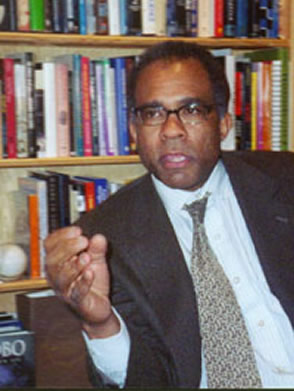 I just watched Harvard law professor, Randall Kennedy (pictured right,) deliver a speech excoriating America for not doing enough for its poor and being especially unfair to people of color.
That moved me to write this letter to him. I thought you might enjoy reading the tough questions I asked him:
Dear Randall,
It was my privilege to watch your recent National Press Club/C-Span speech on America's treatment of poor people and of people of color. You made the case with rigor and emotional restraint, which I believe is key to being heard.
Your talk moved me to run to my computer to invite you on my show to have a conversation with me about poverty and race.
I should let you know that I am not an Ehrenreich/Alter leftist yet I believe your excellently articulated position deserves greater attention and I know that my NPR-San Francisco listenership would be well served by a respectful conversation in which I raise questions about it, for example:
- Metaevaluations of efforts to address poverty, from EarlyStart to HeadStart, from job training to job retraining, have--other than some pilot studies the results of which have proven to be unreplicable--been failures, certainly yielding extremely poor value for the literally trillions of taxpayer dollars spent since the War on Poverty began when you and I were young.
Some empiricism and much logic suggest that such redistributive "justice," has dispositively outweighing negative side effects. For example, welfare payments to able-bodied people (cash, housing, food stamps, MediCal,etc) encourages the working poor to not work because, to earn a similar amount of money,they'd have to earn roughly $50,000 a year in after-tax dollars, which their skills/work ethics etc will not come close to commanding. Such payments--just as when rich people give trust funds to their children--discourage people from wanting to be productive. And mid-to-upper-income people, who are working 40-80 hours a week in societally productive activities, grow more resentful of the poor upon seeing that many of the poor (including prisoners) receive better health care than many middle-class people get and that many welfare recipients do live in decent-to-nice housing (Have you seen low-income housing developments lately?--they look like the condos that middle-class people must spend hundreds of thousands of dollars on) with the mice you mentioned being the result not of the housing but of residents' leaving food wastes out and about, urinating in a doorway when annoyed at a neighbor, etc. I have been in many low-income residences and I was, indeed, often welcomed by the smell of urine.
- You said that anyone who has spent significant time with the poor would realize that much of their situation is beyond their control. I have spent more time with the poor than you might imagine. I was born in and spent more than five years living in a tenement in the Bronx. I left a prestigious biomedical research position at the Rockefeller University when, in 1970, swept up by civil rights fervor, I became a drug counselor and teacher in inner-city New York City and Richmond, CA (heavily Black and Latino) schools, visited my students' families in their home many times, and had intimate conversations with their parents, grandparents, or aunts with whom they lived. While indeed, much of people's poverty lies beyond their control and your position deserves broader exposure (although the likes of Alter and Ehrenreich certainly got much more positive press attention than do conservative views), I believe that a more full-dimensioned exploration of how to address poverty as we move forward, requires addressing the aforementioned and other controversial questions.
The first available slots on my show are 8/21, 8/28, 9/4, 9/11, and 9/18 all at 2 pm eastern time. Of course, we can do it by phone. Alternatively, if you plan to be in the San Francisco Bay Area at any point in the coming months, we should do the interview when you're in town.
What do you think?
Marty
--
Marty Nemko, producer, host, Work with Marty Nemko, KALW-FM (NPR-San Francisco)
UPDATE: He will appear on my show on Aug 21 at 11 am Pacific time. The show will be archived on the npr site for a week and permanently on www.martynemko.com.
Monday, May 2, 2011
Is Helping a Weak Candidate to Land a Job Ethical?
 I just posted this to a forum for career counselors but it has relevance to anyone who has or might try to help a weak candidate land a job.
I'd like to ask a question. America is mired in arguably the toughest job market since The Great Depression. And, worse than in the Great Depression, structural factors in the U.S. suggest that our jobless non-recovery may continue for a long time: job-killing technology innovations are advancing ever more rapidly, ever more jobs are being offshored to countries with intelligent, hard-working workforces willing to work for so much less than are American workers, and without employers forced to pay the ever greater government-mandated costs of and paperwork in hiring an American: on top of Social Security, Workers Comp, SSDI, FMLA, ADA, ever increasing employee lawsuits for wrongful termination, sexual harassment/hostile environment, there's now ObamaCare. And paid leave has just been okayed in Wisconsin. Can the rest of the states be far behind?
Those costs, of course, put additional pressure on employers to not hire, to automate, offshore, etc, and when they must hire Americans, to hire people only for a short-term contract or part-time/unbenefited position. And those costs to employers are likely to rise further. U.S. immigration trends and differential birth rates are such that there will be ever more Democratic-leaning voters and so the pressures to place even more burdens on U.S. employers will likely increase further.
In light of the paucity of jobs and likely exacerbation of that paucity, is it clear that top career counselors like yourselves are performing a net good for society by devoting--as you've reported here--so much knowledge and commitment (even making phone calls to employers on the candidate's behalf) to helping candidates like that person with Asperger's Syndrome so severe no one has hired him during his entire 20 years of adulthood, to beat out a candidate more likely to do a better job? As we're all painfully aware, even mediocre jobs typically get many applicants. The same question could be asked about the efforts you describe to help ex-offenders, who, as you know, have high recidivism rates and personalities and ability/skill deficits more likely to make them, on average, worse employees than are non-offenders.
When you choose to package and advocate for such candidates, is that unfair to the more qualified candidate who can't afford or isn't lucky enough to get an advocate as good as you are?
In addition, might your choosing to package and advocate for such candidates be unfair to the employer who ends up hiring an inferior employee because we the career counselor did such a good job of packaging and promoting our candidate?
And ultimately, might your choosing to package and advocate for such candidates, net, be bad for society? We all suffer when a weak person is hired. For example, think of how we suffer when we get an ineffective customer service rep or a car repairperson who doesn't fix our car or charges us too much, let alone a nurse who can't get the catheter in right or makes a more serious mistake---over 100,000 Americans die every year because of medical errors.
And ultimately, might your choosing to package and advocate for such candidates, net, be bad for society? We all suffer when a weak person is hired. For example, think of how we suffer when we get an ineffective customer service rep or a car repairperson who doesn't fix our car or charges us too much, let alone a nurse who can't get the catheter in right or makes a more serious mistake---over 100,000 Americans die every year because of medical errors.
In an economy in which there are plenty of jobs to go around, that is less of an ethical problem. But in our economy, even mediocre jobs are difficult to obtain even when a candidate is fully competent and without major personality issues, let alone when the candidate suffers from something like the severe Asperger's Syndrome that afflicts the person you described. Even in the SEO job you suggested--his condition will--as implied in your comments--likely make this person a net worse employee than the employer could otherwise find without undue difficulty.
In light of all that, would we be wise to ask ourselves whether our efforts to package and promote job candidates would do greater good if focused not on the people with the greatest deficits but on the people who--in a well-suited job--are more likely to be good employees?
Update: The response from the career counseling group's members? Nearly universal opprobrium.
Update: The response from the career counseling group's members? Nearly universal opprobrium.
Tuesday, January 25, 2011
Underdogma: How our love of the underdog is ruining America

A new, praised book, Underdogma, asserts that America's now replacing meritocracy with egalitarian policies such as redistributive "justice" is a formula for accelerating the decline and fall of the American Empire.
While the benefits of egalitarianism may have exceeded those of meritocracy in the agrarian or even industrial era, in the complexity-demanding global information age, meritocracy will ever more trump egalitarianism--look, for example, at Singapore's trajectory versus the U.S.'s.
Wednesday, January 12, 2011
Why I'm Libertarian-LEANING
 My blog's subtitle says I'm "libertarian-leaning." A reader asked me what that means.
I believe the free market yields the best products and services for the most people. However, free-market capitalism in today's and especially tomorrow's global, high-tech, information-centric, high-IQ-requiring economy, will leave MOST people unable to compete and therefore, without receiving charity, destitute.
Socialist and liberal-democrat policies provide that charity, albeit with mind-boggling inefficiency. Part of that forced taxpayer charity, alas, likely includes our paying for an ever more bloated government, often hiring three low-performing people to what one reasonably competent, motivated person could do, work that may be only marginally beneficial to and even hurtful to society.
I cringe, for example, at the net effects of governments' massive regulatory and paperwork and financial requirements even of small business. A partial list: Workers Comp, SSDI, Social Security, ADA, FMLA , EEOC, MediCare, ObamaCare, Sarbanes-Oxley, Dodds-Frank--and then there are the state and local government mandates!
That virtually ensures that the U.S. will be--not withstanding blips--in a permanent jobless nonrecovery. How can U.S. companies compete with China, India, etc., when U.S. salaries are three times as high, and on top of that, all those government burdens?
Especially with the people most likely to be highly productive, non-violent citizens having the fewest babies, there are no really good solutions.
Thursday, January 6, 2011
A Case for Replacing a Government Safety Net with Private Charity
 A client just left and I just have to tell you what she said.
Elena (name changed) is a social worker. In 2005, she wanted to buy a house but couldn't afford one.
But then at work one day, she attended a presentation to the social workers by a representative of the quasi-governmental entity Fannie Mae. (Perhaps it was Freddie Mac; she wasn't sure.)
The presenter explained that the federal government wanted more minorities to own a home, so income, asset, and down payment requirements would be relaxed. It might only require 1% to 3% down--the borrower had almost no skin in the game.
Off the record, the presenter told the group that because banks want to stay on the right side of the government and because many banks package and resell their loans in bulk, lenders often weren't verifying income and employment.
Elena ran out and found a house she loved--for $470,000. She knew she couldn't really afford it but, if they weren't checking income and assets, she figured she'd lie on her loan application to ensure she got it: She claimed to earn more and have more savings than she really had. Her loan was approved, requiring just 5% down.
In 2006, the value of her home had increased and Elena took out a second mortgage to redo the kitchen and buy an SUV.
In late 2009, her house was worth $140,000 less than what she paid for it and she only had $35,000 of her money in it. So she simply stopped paying her mortgage, forestalled moving out as long as she could with coaching from a non-profit "homeowner's advocacy organization." Part of that was to start and drag out loan modification/renegotiations with the bank. In November, 2010, facing imminent foreclosure (the sheriff was going to take her keys,) she walked away from her debt and declared bankruptcy.
Elena came to me for career counseling because, "I need to make more money than I'm making as a social worker." Why? Because she wants to move from the apartment she's renting and buy another house!
No surprise, I told her I don't feel comfortable working with her.
The popular 2010 movie Inside Job blames the mortgage meltdown exclusively on bankers. Yes they share responsibility but despite it being politically incorrect, isn't it fairer and a crucial lesson to all Americans to describe the meltdown's causes more fairly: to add that Fannie/Freddie encouraged lending to unqualified borrowers, and that countless people knowingly bought more home than they could afford, often submitting fraudulent loan applications?
Hearing Elena's story makes me wonder whether greater good would accrue from replacing our government-run safety net. Perhaps it's just too hard for the government to develop and monitor a process that applies to 300,000,000 people without inordinate fraud, waste, and abuse.
Instead, building on a recent post, I'm wondering whether the many billions of dollars spent on the government safety net should be returned to the taxpayers tax-free if the taxpayer donates it to the charity of his or her choice. That way, the invisible hand of the market, millions of decisionmakers, would likely make wiser charitable choices and, in turn, provide a better safety net.
What do you think?
Tuesday, January 4, 2011
A Case for Near-Libertarian Government
- Encourages sloth. Every time unemployment payments are extended, most of my unemployed clients say something like, "Good. Now I don't have to look for work for another 13 weeks." Conversely, when President Clinton set a time limit for welfare recipients, when their welfare checks were about to run out, most of the seemingly unemployable people managed to find a job.
And of course, there's the example of the Soviet Union. Guaranteed jobs, equal pay, and full benefits resulted in legendarily poor quality (Remember the Russian cars: the Lada, Moscvich, and Volga?). It also resulted in legendarily poor quantity: long, long food lines and rationing. The average U.S.S.R. woman spent two hours a day, seven days a week in food lines.) The photo above is a U.S.S.R food ration coupon, sometimes required even for basics like sugar.
- Imposes high opportunity costs. Redistributive "justice" transfers wealth from the people and businesses with the greatest likelihood of creating jobs and life-enhancing innovations to the people with the lowest probability of doing so. Yes, in the short run, that results in more cash pumped into the economy--the poor spend a higher percentage of their money while the rich save more. But long-term, that's a negative: less saving means less money for banks to lend to businesses, which would create jobs and innovation.
Then there are the opportunity costs of the government's redistributive programs: an enormous amount of taxpayer money spent on programs already proven to be cost-ineffective programs from Head Start to job retraining; often $25,000 per job obtained and often the person doesn't hold the job for more than a few weeks. The total amount of waste, fraud, and abuse in government redistributive programs is, as reported in the Washington Post, incomprehensibly large.
That money would likely more wisely be left in taxpayers' pockets, thereby rewarding them for their productivity and allowing them to pump their money into more beneficial parts of the economy (the goods, services, and charities selected by the taxpayers) rather than the aforementioned money-down-the-drain programs.
- Sends a destructive societal message. It's Psychology 101: you get more of what you reward, less of what you punish. Redistributive "justice" is an appealing-sounding term concocted by its advocates, but it in fact means that society's productive members have their money wrested from them and given to those who are less productive. What sort of message does that send to all of us? To our children?
Note: Of course, some people are productive but don't earn money--for example, volunteers--but, on average, the pool of payers for redistributive justice are more productive, even if non-remunerative productivity is included.
Many people thus believe it's foolish to work hard--After all, if you don't work much, the government will take care of you: The National Review reports a study that found that an American family of three has to earn $60,000 a year to net the same income as someone who makes just $14,000 a year and thus qualifies for all sorts of government handouts. Can you not see why the millions of people who are not intrinsically motivated make the choice to sit on their butt? "Why work at some dumb-ass job when you can get the same money for hanging out?"
I suspect that if there were no safety net for the poor, many such people would become more self-reliant and those who didn't probably would be sufficiently helped by private charity. But candidly, I'm not very confident in the previous assertion.
That's why my current thinking is that the best political/economic system is a near-libertarian government: a modest military, modest regulation, and a humane safety net for the truly needy, with those programs provided not by the wildly and unavoidably inefficient, fraud- and waste-filled government, but by the private sector.
Perhaps the wisest approach to that is, a la Milton Friedman, to spend the money saved in cutting those cost-ineffective government programs on a negative income tax--cash to the poor--so the poor could spend the money on the services and products they deemed most cost-beneficial.
Perhaps the wisest approach to that is, a la Milton Friedman, to spend the money saved in cutting those cost-ineffective government programs on a negative income tax--cash to the poor--so the poor could spend the money on the services and products they deemed most cost-beneficial.
Dear readers, what do you think?
Monday, January 3, 2011
A Case for "Cushioned Capitalism" or "Libertarian Socialism"
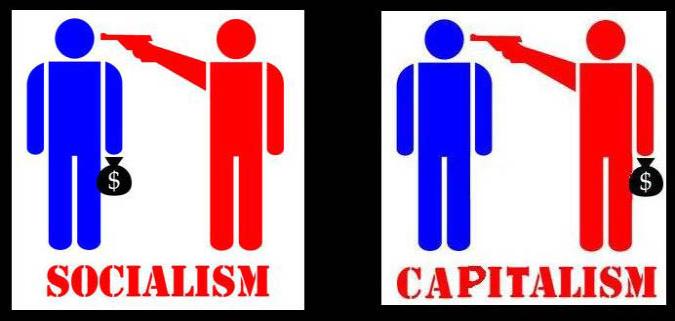 I end each of my radio shows by saying: "We find comfort among those who agree with us; growth among those who don't."
In my own effort to keep growing, I thought that I--who lean libertarian--would do a thought experiment: make the best case I can for socialism.
When I was younger, I believed that one pretty much gets what one deserves. Now I believe that luck plays a large role in one's success. For example, I'd be far less successful if:
- I were born to retarded parents in Bangladesh, or
- I inherited genes predisposing me to low intelligence, laziness, and poor impulse control, or
- I inherited a horrible disease, or
- I inherited an unattractive face or propensity toward obesity. Alas, study after study shows that attractive, slim people derive career and personal advantages.
- You met someone who gave you a great job.
- You happened upon someone who gave you a suggestion that turned your moribund idea into a successful invention.
- You happened upon someone who turned out to the perfect spouse and cheerleader for you, enabling you to be far more successful than you otherwise would have been.
- Getting crippled by a car that ran a red light.
- You entered nursing school because the government projected high demand for nurses but by the time you graduated, the market had become saturated.
Therefore it seems appropriate that government help compensate for the unfairnesses that accrue to the winners and losers in the genetic and environmental lotteries. Socialism does that: everyone gets paid, gets the same benefits, etc.
But you say, "If everyone gets the same pay, benefits, etc., what incentive is there for people to work hard?" Of course, external incentives matter but I wonder if they matter as much as pure capitalists claim. Studies find that most, though certainly not all, people are motivated to work less by cash than by praise, wanting to a good job for its own sake, etc.
Whatever decrement in motivation would accrue from eliminating dollar incentives for quality work could at least in part be compensated for by a more concerted effort by parents, schools colleges, and media to emphasize the primacy of productivity and contribution to society.
Any residual decrement in productivity would be outweighed by everyone having a humane level of housing, food, health care, etc. From the aforementioned cosmic perspective, there's something wrong about a society in which some people have mansions and optimal health care while others are homeless and have minimal health care. Socialism addresses that.
That said, I'm not completely convinced that socialism is, net, better than capitalism. After all, I am well aware of how grossly inefficient and wasteful government is, and that many people are motivated to work harder and longer by money and competition. But I can't with utter confidence assert that pure capitalism is the wise way.
Perhaps the answer is an amalgam of socialism and libertarianism. In what I'm calling libertarian socialism, the government would pass a law mandating that all people get roughly equal pay, health care, housing, etc. but leave how that all would be accomplished to the private sector.
Or perhaps the right approach is America's status quo: what I call cushioned capitalism, capitalism with a humane safety net for the many people with the cards stacked against them in capitalism's ever more fierce competition.
Or perhaps the right approach is America's status quo: what I call cushioned capitalism, capitalism with a humane safety net for the many people with the cards stacked against them in capitalism's ever more fierce competition.
Dear readers, your thoughts?
Monday, September 27, 2010
"Making a Difference:" A Foolish Fad
Sounds good, right? Not to me. "Making a difference" is code for redistributing fiscal and human resources from the haves to the have-nots. Still sounds good, right?
Not to me. For example, let's say a financial or intellectual "have" decides to devote money and time to a "make a difference" initiative, say, to the cause du jour: environmentalism: trying to cool the globe or restore some swamp (oops, wetland) to a more pre-human state. Do you think he'd make more of a difference doing that or devoting his time and money to providing a program for intellectually and/or emotionally gifted kids: those with the greatest potential to cure our diseases, create an ever more helpful iPhone or Google, or revolutionalize (finally) education? For me, it's not even close--especially when most funds for gifted programs have been redistributed to programs for special education and other at-risk students.
Another example: Let's consider a literacy program. Its students, by definition, have long struggled in learning to read. Even extensive, expensive, one-on-one tutoring will raise their average reading score only modestly--at best, say from a third to a fifth grade level. That will have only a minor impact on that person's ability to be even self-sustaining. Even assuming that government-run literacy program were run efficiently (dubious,) a have who invested time and money on that would likely be of less benefit to society than if he had invested the money and time in high-ability kids.
Let's turn to career. Let's say there's a pair of identical twins. One chose a "make-a-difference" career like social work, teaching the at-risk, or administering a government or nonprofit program for the have-nots. The other twin chose a career, for example, developing a better search engine, car engine, disease cure, or even something more mundane, more accessible to more people, like selling items that offer good value to the consumer: Whirlpool appliances, Toyota cars, or even no-iron cotton. Do you honestly believe the "making a difference" twin would actually have made a bigger difference?
No doubt, this essay evokes an "ugh" response, especially from liberals (oops, "progressives.") That visceral response will likely be followed by a slightly more intellectualized version of "ugh," labeling me "elitist," "mean-spirited," or some such.
I challenge such readers to put aside their reflexive response and instead try to be really honest with themselves: If your goal is really to make a difference, wouldn't you--beyond a humane level of investment in all humans--invest your time and money not on those with the greatest deficit but on those with the greatest potential to profit?
Alas, most of us cannot resist fads--we'll feel compelled to "make a difference."
Wednesday, February 4, 2009
My Final Post on Obama
 I am dispirited by the media's accelerating failure to do what it has heretofore always considered its primary responsibility: to provide tough, fair-minded investigation of the issues of the day.
Alas, as CBS veteran Bernard Goldberg says in his new book, A Slobbering Love Afair: The True (And Pathetic) Story of the Torrid Romance Between Barack Obama and the Mainstream Media:
"The media's liberal bias has crossed an important line-moving from their usual unthinking liberal bias to crass partisanship of the crudest kind, practically acting as spin doctors for Barack Obama."
I teach my career coaching clients to assess the probability of an effort being worth the time. In light of the ever accelerating tidal wave of media-driven ObamaMania, I've decided to move on to topics where my efforts are more likely to make a difference.
So here, I'll just offer my summative thought regarding Obama's policies: Those policies, at their core, are united by one principle: that resources should be redistributed from the haves to the have-nots. In practice, that means redistributing from the pool of people and businesses with the greatest potential for using the resources wisely and for creating positive societal ripple effect to those people and businesses with the least. That formula ensures America's failure.
That's especially true when Obama's spending will be so massive. On top of the Republican-initiated $700 billion TARP bank bailout which heretofore has been a disaster, Obama wants to spend an incomprehensibly large $1 TRILLION dollars in this spending spree. And experts agree that more TRILLIONS will be spent in Obama's next round or two of spending sprees. And these are trillions the government simply doesn't have and can't get with the proposed tax increases. So, the result will be yet more taxes, including on the middle class, an attempt to borrow huge sums of money from what may be an unwilling world of lenders, and/or print lots of money, which will create painful inflation.
Alas, I believe Obama will able to get his policies enacted to a greater extent than any president in history thanks to his perfect storm of communication skills, a liberal Congress, and an unprecedentedly unquestioning media.
So I predict that Obama's policies will yes, short-term, create jobs and do other public-pleasing things but by the time he's completed his eight years in office, he will have done more to destroy this country than all our enemies combined.
Of course, the public will not think that: The media has overstated the economy's problems to give Obama nowhere to go but up (for example, today's 7.6% unemployment rate is near the historical average,) will hyperinflate his accomplishments, and blame America's troubles on remnants of conservatism and libertarianism.
That all said, I'd love to be wrong and for Obama to succeed--His intentions are most noble.
Wednesday, May 28, 2008
The Problem with Meritocracy
Readers of this blog know that I believe strongly in meritocracy, but all ideologies have weaknesses.
The weakness of meritocracy is that a significant percentage of people lose in a meritocracy, largely due to factors beyond their control: their genes, which parents and what community they were born into, etc.
I believe that citizens, the government, and nonprofits have a moral obligation to attempt to mitigate some of that random unfairness.
The controversy comes in how much to distribute from those with the greatest potential to contribute to society to those with the least.
Controversy also comes from the dishonest Leftists who play the race, class, and gender cards to arm-twist for support for social programs. Nearly all those programs have shown little benefit, even the vaunted Head Start, and certainly not enough benefit to justify taking tax dollars from the ever-more strapped middle and working class to pay for them.
As someone with a social science Ph.D. from Berkeley, specializing in the evaluation of such programs, I am convinced that almost no education or other such programs yet exist that yield sufficient benefit to force taxpayers to pay for it. One possible exception would be top-quality, one-on-one mentoring/tutoring programs.
What I would fund are bold research initiatives aimed at finding truly new and more promising sorts of interventions.
The weakness of meritocracy is that a significant percentage of people lose in a meritocracy, largely due to factors beyond their control: their genes, which parents and what community they were born into, etc.
I believe that citizens, the government, and nonprofits have a moral obligation to attempt to mitigate some of that random unfairness.
The controversy comes in how much to distribute from those with the greatest potential to contribute to society to those with the least.
Controversy also comes from the dishonest Leftists who play the race, class, and gender cards to arm-twist for support for social programs. Nearly all those programs have shown little benefit, even the vaunted Head Start, and certainly not enough benefit to justify taking tax dollars from the ever-more strapped middle and working class to pay for them.
As someone with a social science Ph.D. from Berkeley, specializing in the evaluation of such programs, I am convinced that almost no education or other such programs yet exist that yield sufficient benefit to force taxpayers to pay for it. One possible exception would be top-quality, one-on-one mentoring/tutoring programs.
What I would fund are bold research initiatives aimed at finding truly new and more promising sorts of interventions.
Thursday, April 3, 2008
Is Career Counseling a Waste?
It's odd for me to be raising that question in that I'm a career counselor. Yet stories like this one a client told me just an hour ago (I'll change a few irrelevant details to protect his anonymity,) does give me pause:
After four years studying at Harvard, he came to believe money was a shackle and the root of much evil. So he went to his CitiBank and withdrew all his money, in $100 bills. He then stood at the main entrance to the Harvard campus (the gateway to one of America's hub of liberal thought) and gave away all the $100 bills at random.
He was shocked that well-heeled Harvard students who had been filled with "redistributive justice" rhetoric and indeed probably espoused it in class discussions and term papers, pushed homeless people away to attempt to get a second $100. Distraught as perhaps only Hamlet has been, he fled to his Harvard advisor's office and screamed at the meaningless of it all. What did his advisor do? Called the police and had him involuntarily committed to the local mental hospital.
After my client was released, he took a job--at a bank, the icon representing everything he had reviled. The punch line: He liked his job and succeeded there, eventually earning a six-figure salary.
This is the most extreme such story I've heard, but I've known many people who ended up happy in careers that no career counselor could have predicted to be well-suited.
Although I am a career counselor/coach, my best advice to those seeking aid in choosing a career: Forgo seeing a career advisor. Instead, for a week or two, keep musing about career and write any clues in a memo pad, which you keep with you at all times. After that, look at my Best Careers, 2008 and my book, Cool Careers for Dummies, to trigger additional ideas.
After four years studying at Harvard, he came to believe money was a shackle and the root of much evil. So he went to his CitiBank and withdrew all his money, in $100 bills. He then stood at the main entrance to the Harvard campus (the gateway to one of America's hub of liberal thought) and gave away all the $100 bills at random.
He was shocked that well-heeled Harvard students who had been filled with "redistributive justice" rhetoric and indeed probably espoused it in class discussions and term papers, pushed homeless people away to attempt to get a second $100. Distraught as perhaps only Hamlet has been, he fled to his Harvard advisor's office and screamed at the meaningless of it all. What did his advisor do? Called the police and had him involuntarily committed to the local mental hospital.
After my client was released, he took a job--at a bank, the icon representing everything he had reviled. The punch line: He liked his job and succeeded there, eventually earning a six-figure salary.
This is the most extreme such story I've heard, but I've known many people who ended up happy in careers that no career counselor could have predicted to be well-suited.
Although I am a career counselor/coach, my best advice to those seeking aid in choosing a career: Forgo seeing a career advisor. Instead, for a week or two, keep musing about career and write any clues in a memo pad, which you keep with you at all times. After that, look at my Best Careers, 2008 and my book, Cool Careers for Dummies, to trigger additional ideas.
Subscribe to:
Posts (Atom)

