


Showing posts with label school reform. Show all posts
Showing posts with label school reform. Show all posts
Friday, November 28, 2025


Thursday, May 15, 2025
Thursday, February 27, 2025
Wednesday, January 24, 2024
Monday, December 11, 2023
Friday, April 21, 2017
My Favorite Tweets on Education

We
spend billions to improve education yet we're legalizing pot, which now is
proven to damage brains. (Don't trust the activists, which are heavily funded by Big Tobacco. See the
new National Academy of Sciences metaevaluation.)
In the name of rigor, courses focus too
much on the hard and arcane, with too little weighing of whether that’s the
best use of student time.
Most people would rather be entertained
than educated. So sugar-coat.
How-to
books that claim “It worked for me, it can work for you” aren’t helpful because
typical readers aren’t as smart and driven as are book authors.
You’ll
likely learn more of enduring value from an hour of wise googling than from any
course.
Banks are forced to modify, that is, take
a loss on mortgages but colleges, which don't disclose risks, wring every penny
even from its many unemployable grads.
College
tuition up 1,200% since 1978, That’s four times
the inflation rate. There’s little learning—36% grow not at all in critical
thinking. 44% don't graduate even if
given six years, and 1/2 are un-underemployed. Crazy.
I read these aloud on YouTube.
I read these aloud on YouTube.
Saturday, July 30, 2016
Could School Cause PTSD?

I tell a composite story of such a person in my PsychologyToday.com article today.
Wednesday, November 5, 2014
Education Reinvented: Could this actually make education live up to its promise?

Thursday, July 19, 2012
Dream Homework

For me, it's "Ugh!" I suspect I'm not alone.
I recall my school days: I was an active (okay, hyperactive) kid forced to sit still from 8:30 to 3...and unable to. If I had gone to school after Ritalin became the kid drug of choice, my teachers would have slammed a Ritalin leash on me faster than I leaped to my feet when she finally said, "Recess!"
Yet among all the calls for education reform, I've yet to hear a call to reinvent homework, that reviled after-school torture: Yet more sitting still?! "Do this worksheet." "Read the chapter and answer the questions at the end." Do problems 1-47, the odds."
Is it any surprise that parents lose hair trying to get kiddie to comply? Is it any surprise that kiddie blows-off homework anyway?
Especially for subjects that many students find difficult, for example math, why not replace problems 1-47 with visual-rich lecturettes by the world's most effective, transformational teachers? I remember not getting Algebra 1. Seymour Schwimmer (That really was his name) would cover the board with formulas and rapid-fire not-explain them with the clarity expected of a math teacher. He usually ended the class period with "Do problems 1-47." I left class sad or scared. I got home, looked at those problems with no more clue on how to do them than when I had left class, usually threw the worksheet back into my (messy) notebook binder, and ran out to play basketball.
Now imagine that instead of that, I turned on my computer or smartphone and watched a YouTube video of The Amazing One: that rare teacher who makes complicated stuff simple, even fun. True, I'd still have to sit still but wouldn't I be more likely to learn from that? To enjoy that? To grow from that? Maybe even to like math, that supposed gateway to all sorts of careers?
I am self-funding a pilot program of that very thing. I call it Dream Homework. At a diverse California public high school, on August 20-25, the first week of actual instruction, the Algebra I teachers will assign half their sections the regular homework while the other sections will instead, watch visual-rich lecturettes covering the same material by Luis Anthony Ast, the math instructor that Pearson Learning, Casio, and Texas Instruments picked to create their video algebra lessons. I'm also hiring WestEd, a top third-party evaluator, to see if the kids in the Dream Homework group do indeed learn more algebra and enjoy it. Stay tuned.
Saturday, July 14, 2012
My Next Book
I'm thinking of writing these books. Do you think either is worth the effort?
What It's Really Like to Teach in Oakland
30 Teachers Tell Their Story
Manipulated
40 Ways They Deceive You in Politics and in the Workplace30 Teachers Tell Their Story
Manipulated
Friday, July 29, 2011
Reinventions: My best ideas on jobs, education, health care, and campaign reform
 I hope to write a book, Reinventions, consisting of my ideas for reinventing 30 of society's linchpins.
My agent suggested I first write an article presenting a few of my best ideas. I've done so and thought you might enjoy seeing the article. HERE is the link.
Friday, June 24, 2011
Reinventions: K-12 Education
Here's a video of my six-point plan for reinventing K-12 education.
The six points, without the helpful explanation in the video, are listed below.
My six-point plan for reinventing K-12 education:
1. Naturally gifted teachers could get a teaching license merely by teaching a demo lesson before a master teacher---no boring teaching education program required. Other candidates would complete a teacher training program provided by a school district's master teachers, not by university professors who have never been master K-12 teachers.
2. Classes should be grouped by ability. Efforts should be made to ensure that racism is not a factor in selection, and that students are moved up and down as appropriate.
3. The fact-larded curriculum should be delarded, replaced with big projects--for example, developing a model city, building a rocket, creating an online student newspaper, etc.
4. The teacher's unions must be reined in. They've insisted that the best and worst teachers are paid the same--there's no better formula for ensuring that quality people don't enter the profession. In addition, they have forced school districts to, after just two or three years, give teachers tenure for life. To get rid of a teacher after getting tenure requires a long, expensive, painful undue process. Most principals decide it's just not worth the massive documentation and a dog fight with the union lawyers.
5. Use dream-team-taught courses, especially for difficult-to-teach courses such as algebra. These would be developed by a team of nation's best instructors under the U.S. Office of Education's auspices and distributed free on the Net to all school districts. A local teaching assistant would be in the actual classroom to provide the human touch. Using dream-team-taught classes would enable all students, rich and poor, to receive world-class instruction. Nothing would more improve the quality of education, but again, the unions would balk.
6. The school year should be lengthened. Currently it consists only of five hours a day for 175 days.
Sunday, April 24, 2011
Education: America's Most Overrated Product
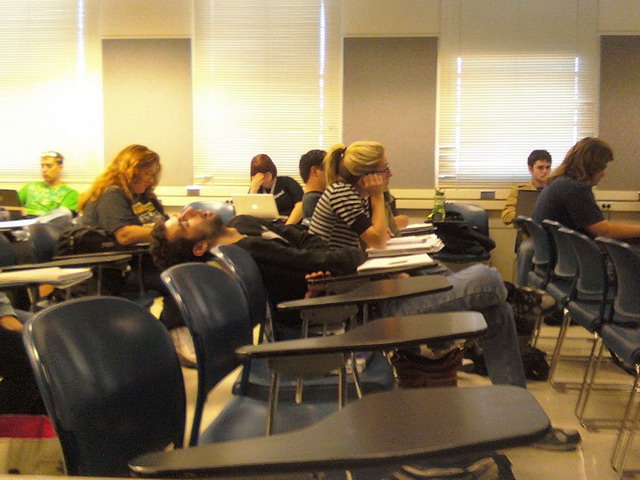
For two decades, I've written books and articles and given speeches documenting that education is overrated. Education generates surprisingly small benefits relative to its costs, time, and opportunity costs.
I've been particularly critical of higher education and of education as a tool for lifting people out of poverty. I've felt like a lone voice.
But suddenly there's been a spate of research and articles in prestigious publications that have come to the same conclusion.
I've occasionally blogged about education here but more often, I've simply tweeted about it, usually providing a link to one of those recent articles. Here are the tweets I've written on education since March 1.
The first group of tweets is on K-12 education. The second is on college & graduate school.
On K-12 Education
U.S. is #2 in per capita spending on education http://j.mp/eb0OeY, yet ranks #23 in achievement: http://j.mp/gXWkcT
The Atlantic: The Failure of American Schools: http://t.co/pTo3ciL
Promising educ. programs are Page 1 news & on 60 Min, but page B17 when they turn out to be far less (e.g., KIPP, or Michelle Rhee's bogus "miracle" in DC.)
Education cries out for reinvention: replace the mammoth arcana with immersive, simulation-rich opps to build thinking, writing, etc.
A smarter, simpler way to start a school: http://bit.ly/eg4Kxf
What I said to a school of profoundly gifted teens. (Yes, there's relevance in it for everyone): http://bit.ly/eUNUJ1
One summary of the case against college: http://bit.ly/keoUiQ
Title of a current commentary in Marketwatch: "College is a Scam: "http://j.mp/m9f27z
Chronicle of Higher Ed: A devastating warning to weak students choosing college over other options: http://j.mp/lTZmjg
Title of a current commentary in Marketwatch: "College is a Scam: "http://j.mp/m9f27z
Chronicle of Higher Ed: A devastating warning to weak students choosing college over other options: http://j.mp/lTZmjg
The unmasking of higher ed accelerates. This time it's New York magazine: A "degree is essentially worthless." http://shar.es/H7c5F
NYT: 36% of students' thinking/writing scores rise 1 point or less on 100-point scale from 4 yrs of college! .http://j.mp/mK8Gpn
Yet another ridiculing of higher education's poor value, this time from the world's best bond valuer: Bill Gross: http://bit.ly/jyKNw4
L.A. Times Op-Ed: Colleges have abandoned responsibility for shaping students' academic development: http://j.mp/iPMY6s
Yet another ridiculing of higher education's poor value, this time from the world's best bond valuer: Bill Gross: http://bit.ly/jyKNw4
L.A. Times Op-Ed: Colleges have abandoned responsibility for shaping students' academic development: http://j.mp/iPMY6s
Despite a libertarian bias & some hype, a compelling video indictment of higher ed's lack of value: http://inflation.us/videos.html
The six most important things you must UNLEARN from your college education: http://j.mp/l3lwno
Pew: % of college presidents that think U.S. higher ed is best in the world: 9%. % that think it will be so 10 yrs hence: 7%.
Pew: 58% of college prezes say public HS students less prepared than a decade ago. Duh--MOST colleges now admit nearly all.
Pew: % of college presidents that think U.S. higher ed is best in the world: 9%. % that think it will be so 10 yrs hence: 7%.
Pew: 58% of college prezes say public HS students less prepared than a decade ago. Duh--MOST colleges now admit nearly all.
Thomas Sowell: Today's college/graduate educ makes people LESS employable & creates ideologues, NOT clear thinkers: http://j.mp/iJjn8K
College cost has gone wild while its ROI declines yet the media nor govt says, "Cut your bloat!" when colleges scream for yet more tax dollars. Why?!
Law grads face huge debt: $69K public $106 private PER YEAR! x 3 years!!. Then "extensive, grueling" job search..http://j.mp/j8vxdd
USA Today: Gross oversupply of science PhDs: Only 13% get tenure-track U jobs, and there are few corp jobs: http://j.mp/gDrsFR
WSJ: Yet more on why getting an MBA may be ill-advised: http://on.wsj.com/dHJ78Z
Unlike what the colleges try to manipulate us into believing, here's how average folks CAN find good jobs: http://t.co/CnBp8iU
Don't like your college financial aid "award?" Appeal.
Black 4-year grad rate @ Cal State U's is just 6%!! Should we provide yet more support or redirect weak apps to 2-yr coll, OTJ trng, etc?.
The Economist joins chorus: Higher Ed is a Bubble: the degree, the education, even the vaunted research: http://j.mp/erVzli
CNN: A record high 85%(!) of college grads are feeling forced, jobless, to move back in with their parents. http://j.mp/c24P3v
The College Report Card: A great tool for deciding which college to choose: http://bit.ly/fdQwZi
PayPal founder Peter Thiel: We’re in a Bubble... and It’s Higher Education. tcrn.ch/fRdMz7
Forbes/#CCAP: Govt upping finan aid moves $ from taxpayer to colleges, NOT to students--colleges simply up tuition: http://j.mp/mGmBqy
Forbes/#CCAP: Your tuition pays for things other than your educ: e.g., professors' arcane research. http://j.mp/i76uOb
WSJ: Great piece by Dilbert's Scott Adams: Most students need to learn how to run a business http://on.wsj.com/eoaLdT
I just wrote what I think is my best article on how to become successfully self-employed: an un-MBA: http://bit.ly/h63l3a
To dramatically improve higher ed, require all colleges to post my College Report Card on itself; http://bit.ly/fGBX8k
Harvard study: BA nor MA ups teacher effectiveness. Per my recent tweets, it's ever clearer that educ is overrated. http://bit.ly/gGAdSE
I'm watching professor Rufus Fears on Churchill http://cs.pn/hP5hG7 You can cherry-pick world's best instructors on YouTube, TED, CSpan.org.
Washington Post: it may be wise to skip higher ed: wapo.st/9S9Yti. Higher ed cries out for reinvention.
Finally: U.S. senator demands law schools to stop lying about their employment stats; abovethelaw.com/2011/03/watch-…
Major authoritative new study says that students learn little or nothing at college. http://yhoo.it/grcHNn
My lecture at U.C. Berkeley: America's Most Overrated Product: Higher Education: wp.me/pQChF-P4
Yet another piece on why college is overrated http://su.pr/8B2Ni7
Finally, HERE is an article of mine, America's Most Overrated Product: Higher Education, which first appeared in the Chronicle of Higher Education and was republished in a number of other places. I like to think it encouraged the current examination of higher education, which had been America's most underexamined icon.
I want to thank readers of this blog, for example, Peter Christensen and Mark Drevno for sending me a number of the cited articles. I apologize for not recalling the other contributors' names.
Friday, June 11, 2010
A Blueprint for Reinventing Education
 I've just written an article, A Blueprint for Reinventing Education. It will appear as a cover story in the August issue of Mensa's national magazine. I thought you might enjoy an advance look: Click HERE.
 There's still time for me to change it, so I welcome your comments.
Wednesday, May 26, 2010
Will Obama Finally Take On the Teacher's Unions?

This article in the New York Times reports that the U.S. spends more money per student than any country in the world yet its achievement is in the bottom 1/3 of developed nations.
Not all of the blame can be laid at the teacher's feet. Some of it, for example, is the result of America's insistence on putting students of all abilities in the same class and forcing ever more of them to read Shakespeare even if they're reading on the 5th grade level and to solve quadratic equations when they can't do simple arithmetic in their heads.
But certainly some blame must go to the teachers' unions who, because the Democrats so fear their political power, have managed to continue to get contracts which give teachers virtual lifetime job security after just two or three years--even if a teacher burns out and her/his students learn less than similar students in other classes. In another blow against quality teaching, teachers get paid exactly the same whether they're excellent or poor.
The article suggests that President Obama may be willing to try to convince Democrats to take a stand. If anyone has the ability to persuade, it's him. Let's hope he succeeds.
Monday, May 17, 2010
A Blueprint for Reinventing Education
 A Blueprint for Reinventing Education
Notes for a presentation to the Marin Philosophical Society, May 17, 2010 by Marty Nemko
Here are the blueprint's core components:
SuperTeachers. Nation's-best teachers would, in collaboration with an expert on online education, create highly immersive, interactive courses, to be available online. An inferior approach for improving the status quo: live teachers trained by master K-12 teachers rather than by professors who are rarely master K-12 teachers.
Criticality-selected curriculum. We should ensure that kids graduate with the knowledge needed by most before we try to teach them knowledge needed by few. Examples of proposed substitutions: risk/reward analysis would replace geometry, learning how to design experiments and critique research designs would replace algebra, practical one-on-one and group conflict prevention and resolution would replace detailed study of historical events, scientific method would replace chemical reaction analysis, ethical entrepreneurship would replace foreign-language study.
More big projects. Students are minimally motivated by assignments such as worksheets, book chapters, and doing the math problems 24-96, the evens--or the odds. Students are far more likely to be motivated to read, write, think, and collaborate when participating in a play to be performed for the entire school, to create a student newspaper, build a robot for an interschool competition, etc.
Ability-grouped classes. Logic and metaevaluations indicate that mixed-ability, nondifferentiated classes are a vivid manifestation of politics trumping pedagogy. For a balanced review of the metaanalyses, see: http://www.sharingsuccess.org/code/bv/abilitygrouping.pdf. But the logic, which must be given primacy when so many covariates exist, incontrovertibly favors the heavy use of ability-grouped classes.
A high-quality non-college-bound path for students who are not academically oriented. Contrary to the trend to one-size-fits-all, everyone-to-college education, there should be high-quality junior high school and high school paths for those not academically oriented. Such students are far more likely to derive personal and career success in a path preparing them for a good career straight out of high school (e.g., robotics repair) than being one of the 200,000 students each year who graduated in the bottom 40% of their high school class who go to so-called four-year colleges. Of those, 3/4 of those never graduate, even if given 8 1/2 years. Yesterday's New York Times reports similar findings.
Mentor-centric curriculum.Transformative change is most likely to occur one-on-one. Students, K-20, would be given far greater opportunities for peer and adult mentoring (e.g., a MentorMatch website.)
Use scaled-down high school campuses: only for extracurricular activities. Most academic work would be done at home, with interactivity provided by videoconferencing software, bulletin boards, and email exchanges with students and local tutors. Teachers' homes would be used for some instruction.
A College Report Card: All colleges would be required to prominently post on their website: four- and five-year graduation rates, and average freshman-to-senior growth in critical thinking, reading, mathematical reasoning, writing, public speaking, etc. These would be disaggregated by high school grades and SAT scores.
To make college affordable: a minimal campus. Courses would usually be taught online or in professors' homes. Major recreation facilities (e.g., gyms, pools) would be shared with community facilities. Administration would be minimal. No country-club-like lush-lawn-filled campuses. Substance not shrubs.
A separate track for teaching faculty, with a separate sub-track for instructors of pre-professional courses. All teaching faculty would be required to complete a teaching boot camp followed by peer observations, video reviews, and master-teacher evaluations. Teaching faculty would be hired and promoted on the quality of their teaching not their research.
How realistic is this blueprint? I believe that the relentlessly politically correct media and even the intelligensia fearing even unfounded charges of racism will ensure that politics will always trump pedagogy.
Would it make a big difference? I'm not sure. We have not seen evidence that any educational intervention, no matter how extensive or long-lasting, is a game-changer.
Friday, April 16, 2010
Wanted: Under-served Gifted Boys
 I will be interviewing intellectually gifted boys and/or a parent who feels the child's needs are being poorly met in their public school.
I'll conduct the interviews by phone, or if the family lives in the San Francisco Bay Area, I'll video the interview and, if his teacher agrees, I'll video the boy in his classroom.
I'll post the best interviews and videos here as well as attempt to publish them in major media.
If you'd like to nominate someone, let me know: post it as a comment on this blog, email me at mnemko@comcast.net, or phone me at 510-655-2777.
Saturday, July 4, 2009
My Plan for Closing the Achievement Gap
 As promised, here is my draft plan for closing the achievement gap between Blacks and Whites/Asians.
In preparation, I've reread the many comments on high school teacher Christopher Jackson's dispiriting (even if too, ahem, black and white) report from the trenches What it is Like to Teach Black Students, read current research to update my knowledge about what works in improving African-American achievement, took a few long hikes to contemplate it all, wrote a draft, which I sent to my wisest colleagues and friends (who happen to be diverse in ideology, race, and gender, I might add.) What you see is the resulting draft, which I continue to revise as your comments come in.
I strongly encourage your comments: where you agree, disagree, or have other recommendations you believe should be added or substituted.
I plan to submit the revised plan, the aforementioned teacher's article, a distilled version of your fascinating albeit often shocking comments, to the media, and to education and government leaders. As I said, following the previous post, my goal here is to make a small effort in response to Attorney General Eric Holder's calling us a nation of cowards about race and urging a full-dimension discussion of the issue, just as Bill Clinton urged some years ago.
Because most of my blog posts focus on issues other than education, I feel the need to establish a bit of credibility in this area, so here is a link to my bio. On that page, scroll down to read my background in education. Perhaps most relevant here is that I hold a Ph.D. in education from the University of California, Berkeley, specializing in the evaluation of education programs. My dissertation was on reading achievement in African-Americans, which my advisor nominated for Dissertation of the Year. (It was not selected.) I subsequently taught in graduate schools, culminating with Berkeley. I then became the senior author of California's procedures for high school accreditation and for California Department of Education Program Review. But I'm not just an ivory tower guy. I left my work as a medical researcher at the Rockefeller University to run drug education "rap groups" with 7th and 8th graders in I.S. 61, a largely minority low-income New York City public school, and later taught similar kids in Richmond, California public schools. And I'm no stranger to prejudice: I am the child of Holocaust survivors--my mom, for example, was in Auschwitz. I attended New York City public schools, from kindergarten in a Bronx slum to college at the $34 a semester City University of New York.
I have sometimes been accused of being too idealistic so I have tried here to strike the balance between practicality and likely effectiveness.
1. Reduce teen pregnancy. It's well established that children of teenage parents are at greater risk of school and life failure. So junior and senior high schools, especially those with high teen pregnancy rates, should implement data-driven teen-pregnancy prevention programs. The research does not support abstinence-only programs and so political pressures to restrict such programs to those should be resisted.
Creators of programming aimed at teens (sitcoms, news, movies, video games, music videos, record labels) should be encouraged to create more content that would compellingly display the risks of teen pregnancy to the parents and child. For example, a girl's deciding when to have a child and who should be the father of her child may be her life's most important decisions. The consequences of a good and poor choice can be vividly portrayed in the media.
2. Provide parenting education early. To increase the chances that from Day One, parents have the tools to be good parents, full effort should be expended to ensure that high-quality parenting education is highly accessible, especially to pregnant teens in low-income locales. The best parenting education involves interactive video of critical incidents in parenting--for example, what to do if your baby won't stop crying? What to do to ensure your child develops good language skills? Ethics?
True innovation in delivery systems is required. For example, high school websites and others heavily visited by at-risk teens, for example, mtv.com, should be encouraged to post the aforementioned parenting training course. To ensure its availability to people without computers, the community center in low-income housing developments should have a computer installed, which includes the parenting education program as well as other high-quality interactive-video programs, for example, on teen pregnancy prevention and on preventing and curing substance abuse. In hospitals, especially those serving at-risk communities, the TV in each obstetric patient's room should have a TV offering the aforementioned parenting training.
3. Parenting training for welfare-receiving teen parents. As a condition for receiving welfare benefits such as TANF funds, teen or perhaps all parents should be required to successfully complete the online or an in-person parenting education course, much as we require aspiring drivers to complete a driver's education course.
4. Fully fund Head Start/Early Head Start IF the results of the just-completed major study support its cost-effectiveness. Logic suggests that Head Start (largely parent-run preschool education) should be of benefit. However, the data for its providing long-term education benefit has not revealed the outstanding results many politicians claim. Indeed, the early results of the latest major federally funded evaluation finds Head Start to yield only small benefit but the full study period ended on March 31 of this year. So I assume the report will be published in a few months. The extent of future taxpayer funding of Head Start should be affected by what that report indicates.
5. Better train teachers. Absurdly, pre-K to grade 12 teachers are trained primarily by theory-oriented academics who have never taught in a pre-K to grade-12 classroom, let alone been master teachers there. That must change. The primary instructors of would-be teachers should be master K-12 teachers, including those who have produced excellent results in educating heavily African-American classes.
That high school teacher who wrote the essay referred to earlier as well as many of the commenters suggest that teachers of heavily African-American classes may well need to be masters at motivation, using a skill set beyond that which is taught in most teacher education programs. So the increasingly required multicultural education course should include master-teacher-taught lessons on the art of classroom management, including strategies particularly likely to be effective in working with low-income African-American students.
Training should not end upon the teacher's obtaining a license to teach. Teachers experiencing the frustrations expressed by the essayist and commenters should be able to phone or email a hotline staffed by teachers who have successfully taught heavily African-American classes.
6. Flexibly group classes. In part, to avoid African-Americans being placed in low-track classes, ability-grouped classes have in many schools, largely been eliminated K-8, and reduced in many high schools. Unfortunately, that causes too great a teaching challenge for most teachers: teaching a very wide range of kids in the same class--from very-low achieving to very high achieving, from very slow learners to very fast learners.
The answer is what I call flex classes. For academic subjects at least, group classes by achievement level but conduct frequent reviews to ensure that all students, especially children of color, are given the opportunity to move up (or down) as appropriate to their learning needs.
7. Dispel the belief that working hard is "acting white." Berkeley researcher John Ogbu found that many black students believe that being studious is "acting white," and therefore is unacceptable. That is echoed in the aforementioned essay and in the resulting comments. "Cool" blacks, both peers and adults, who are studious, must compellingly convince students and their parents that studying hard is equally important for students of all races.
8. Chronically disruptive students must be placed in special classes. If a student, despite the teacher's best efforts (with help from the principal) continues to disrupt his or her classmates' opportunity to learn, that child must be moved to a special class taught by someone with special skills in working with such kids.
9. Begin career exploration in grade 6. Finding an exciting yet realistic career can be motivating to many students. And it reduces the problem of many high school and college graduates having no idea what they want to pursue as a career.
10. Give students a choice: college-prep or career-prep curriculum. Increasingly, in the name of high standards, all students, even high schoolers who read on a sixth grade level and who have far more ability in working with their hands, are being forced to take a college-prep curriculum, replete with Shakespeare, quadratic equations, the causes of the Peloponnesian Wars, and stochastic processes. In California, you cannot get a high school diploma without passing a special exam based on a college prep curriculum. Not surprisingly, this causes many to drop out of high school. Or if they graduate and attend college (today, many colleges are open-admission even to the grossly underprepared), they disproportionately drop out. And even if they manage to defy the odds and graduate from college, they are likely to join the ranks of the countless people with a bachelor's degree in a low-rigor, low-demand major from a not very selective college who are unable to find better employment than they could have found with just a high school diploma--meanwhile they incurred huge student debt, boredom, and ongoing assault to self-esteem from being forced to study academic material for which they were unprepared.
Junior high and high schools should offer a high-quality career-prep as well as college-prep curriculum. If I had a son or daughter who through grade 7 showed clear signs of not being likely to succeed in a college-prep curriculum, I'd encourage him or her to choose a career-prep program, which, for example, taught her reading, writing, etc but in the context of preparing her for a career that doesn't require college, for example, robotics repair or entrepreneurship.
11. Require a course in life skills. Before requiring at-risk, indeed all kids to learn simultaneous equations, the halide series of chemical elements, and the use of the doppelganger, students should be required to pass a course in life skills:for example, budgeting, interpersonal communication, and the aforementioned sex education and parenting education. To not do so is to be guilty of the very elitism that many educators and politicians decry.
12. Institute a debate (forensics) program in all high schools, including those with low achievement scores. There's some evidence (and a lot of common sense) to suggest that this could yield significant benefit.
13. Require colleges to provide full disclosure to prospective students. In their attempt to woo students, especially minority students, colleges and high school counselors, as in the Tuskegee Experiments, often hide the information students need to use to decide whether to enroll:
- the four-, five-, and six-year graduation rate
- the average amount of growth that students with particular high school records make in reading, writing, thinking, leadership, and quantitative reasoning.
- the average amount of student debt assumed, disaggregated by family income and assets
- the employment prospects for students who graduate, disaggregated by major.
- alternatives to four-year colleges that the student should consider: short-term community college programs, apprenticeship programs, the military, on-the-job training, etc.
- Pair at-risk kids with nursing home residents or hard-to-adopt animal-shelter dogs and cats who otherwise would be euthanized. I've seen hard-bitten people grow loving when involved with a non-threatening person or animal.
- Have kids plant vegetable and fruit gardens, cook and eat what they've grown and sell the rest. They'd learn science, cooking, nutrition, and how to run a business. In addition, they might join me in awe of the miracle of growth.
- Create peer mentor pairs: for example, at-risk sixth graders with at-risk first graders.There's no better way to learn than to teach.
- Provide free genetic counseling to at-risk prospective parents. We all are a product not just of our environment but of our genes. Educating prospective parents may help them make more fully informed and thus wiser choices.
Sunday, June 7, 2009
Commencement 2.0: How I'd Change the Graduation Ceremony
 Traditional rituals have benefit. Older people especially find comfort in them.
But the young are, well, too young, to feel much nostalgia. At commencement ceremonies, many mainly feel bored: "I can't wait for it to be over. I'm starved."
I've written often on reinventing education but not heretofore on education's capstone. Here's my vision for Commencement 2.0.
- Every graduate, as she or he crossed the stage to get the diploma, would give a one Twitter-length (less than 140 characters) speech. The audience would be encouraged to tweet each other about it in real-time.
(To avoid the ceremony being longer than an hour, if there were more than 100 graduates, there would be a separate ceremony for graduates within each of a university's colleges or majors. In a large high school, there'd be a ceremony for each academic subject. Each student would attend the ceremony of his or her favorite subject.)
- One non-graduate would get to give a blog-post-length (200 words ) speech.
- All the above would be enshrined on a monument to be prominently placed on campus. (or if a virtual university, on its website.)
Thursday, August 28, 2008
American Education; A Little Shop of Horrors
I've long wished that education could be the magic pill for curing societal ills. That's what motivated me to get a Ph.D. from Berkeley specializing in the evaluation of education.
Alas, subsequently, I've had the opportunity to review a number of so-called "national models" for education, for example, Jaime Escalante's Ganas math program, Debbie Meier's Central Park East, and yesterday, another one. (I am precluded, at this point, from mentioning its name.) Invariably, I've found "model programs" to be wildly disappointing: usually the teaching and learning are--not withstanding transient, unreplicable blips--no better than in other schools. And in the "national model school" I reviewed yesterday, it was, on average, worse.
After 35 years in education, I have come to the conclusion that a "model school" is one you haven't visited. They become "models" more because of PR than of substance. These schools create a compelling soundbite: "an urban public school that's like a New England prep school," "a school that suffuses technology throughout the curriculum, "a program that enables inner-city kids to do well in calculus." The school or district's PR machine then orchestrates media tours and promulgates data that obfuscate what's really going on. Hollywood loves "teachers that make a difference" stories, so they make movies about such schools or teachers, replacing the inconvenient truths with feel-good fictions.
I've also concluded that among the most potent ways to improve education while returning significant money to the taxpayer would be to eliminate 95% of the education bureaucracy. Right now, in, for example, California's public schools, a teacher's behavior is restricted by six separate bureaucracies' rules: school-level administration, district administration, county administration, SELPA administration (a special regional entity regarding special ed kids), state administration, and federal administration.
Each bureaucracy imposes on teachers its own assemblage of rules and restrictions: occasionally contradictory, often motivated more by politics than pedagogy, usually complicated and costly, and rarely sufficiently benefiting what goes on in the classroom to justify the time, costs, restrictions of teacher freedom, complications, and contradictions.
Remember the failure of the government to even marginally address the Hurricane Katrina disaster? The largest cause was overlapping, labyrinthine bureaucracies that rendered each other paralyzed, inert. That's analogous to what goes on in the public schools.
I believe that education could be dramatically improved if our mammoth education bureaucracy were replaced by a single, small federal agency or private entity. Its main functions would be to pay the bills, recruit the best teachers, and develop and disseminate model curriculum developed by teams of the nation's best teachers.
That would, at once, improve teaching quality, eliminate the strangling regulations impeding teaching, and provide teachers with excellent curriculum. Some of the cost savings would go directly to teachers to spend on materials, field trips, etc. Some would go back into taxpayers' pockets.
Alas, such a proposal doesn't stand a prayer of enactment. Extraordinarily powerful interests benefit from the status quo, and somehow, the media rarely questions the cost-effectiveness of the Education Blob. The media merely advocates that we feed it more money, like the metastasizing plant in Little Shop of Horrors that grows by feeding it employees' blood.
Sigh.
Alas, subsequently, I've had the opportunity to review a number of so-called "national models" for education, for example, Jaime Escalante's Ganas math program, Debbie Meier's Central Park East, and yesterday, another one. (I am precluded, at this point, from mentioning its name.) Invariably, I've found "model programs" to be wildly disappointing: usually the teaching and learning are--not withstanding transient, unreplicable blips--no better than in other schools. And in the "national model school" I reviewed yesterday, it was, on average, worse.
After 35 years in education, I have come to the conclusion that a "model school" is one you haven't visited. They become "models" more because of PR than of substance. These schools create a compelling soundbite: "an urban public school that's like a New England prep school," "a school that suffuses technology throughout the curriculum, "a program that enables inner-city kids to do well in calculus." The school or district's PR machine then orchestrates media tours and promulgates data that obfuscate what's really going on. Hollywood loves "teachers that make a difference" stories, so they make movies about such schools or teachers, replacing the inconvenient truths with feel-good fictions.
I've also concluded that among the most potent ways to improve education while returning significant money to the taxpayer would be to eliminate 95% of the education bureaucracy. Right now, in, for example, California's public schools, a teacher's behavior is restricted by six separate bureaucracies' rules: school-level administration, district administration, county administration, SELPA administration (a special regional entity regarding special ed kids), state administration, and federal administration.
Each bureaucracy imposes on teachers its own assemblage of rules and restrictions: occasionally contradictory, often motivated more by politics than pedagogy, usually complicated and costly, and rarely sufficiently benefiting what goes on in the classroom to justify the time, costs, restrictions of teacher freedom, complications, and contradictions.
Remember the failure of the government to even marginally address the Hurricane Katrina disaster? The largest cause was overlapping, labyrinthine bureaucracies that rendered each other paralyzed, inert. That's analogous to what goes on in the public schools.
I believe that education could be dramatically improved if our mammoth education bureaucracy were replaced by a single, small federal agency or private entity. Its main functions would be to pay the bills, recruit the best teachers, and develop and disseminate model curriculum developed by teams of the nation's best teachers.
That would, at once, improve teaching quality, eliminate the strangling regulations impeding teaching, and provide teachers with excellent curriculum. Some of the cost savings would go directly to teachers to spend on materials, field trips, etc. Some would go back into taxpayers' pockets.
Alas, such a proposal doesn't stand a prayer of enactment. Extraordinarily powerful interests benefit from the status quo, and somehow, the media rarely questions the cost-effectiveness of the Education Blob.
The media merely advocates that we feed it more money, like the metastasizing plant in Little Shop of Horrors that grows by feeding it employees' blood.Sigh.
Subscribe to:
Posts (Atom)

