


Showing posts with label perfectionism. Show all posts
Showing posts with label perfectionism. Show all posts
Wednesday, December 7, 2022


Monday, November 26, 2018
Ready-Fire-Aim: Taking a low-risk action is usually wiser than extensive rumination

My clients and I find it more helpful to, after modest reflection, jump to a low-risk action. I offer examples in my PsychologyToday.com article today.
Friday, November 25, 2016
The Upsides of Perfectionism

Thursday, May 5, 2016
Managing Your Perfectionism or Lack Thereof

Saturday, February 13, 2016
A Scientist's Search for Meaning

In my PsychologyToday.com article today, I offer a short-short story about her.
Saturday, May 24, 2014
Do You Really Need to Cure Your Perfectionism? And if so, how?

That's the topic of my PsychologyToday.com article. HERE is the link.
Saturday, January 7, 2012
Curing the Impostor Syndrome: Work hard then forgive yourself
 I've had the privilege of being career coach to some of the world's most successful executives, lawyers, physicians, professors, etc. And it may surprise you to know that even most of them often feel like impostors.
 It's not that they're inferior. It's that there's a gap between what even stars can do and what complete knowledge and perfect judgment would enable. It's simply impossible for a CEO to know for sure whether it's wisest to be incremental or bold, for a lawyer to be certain s/he's picked the right defense, for a physician to be sure when saying, "You're fine," Even eminent experts, those who appear in the media, according to U.C. Berkeley research, have prediction rates no better than chance!
So after you've done what you can reasonably do to become competent and you've reached that sweet spot where yet more study is likely to only minimally improve your success rate, it's time to give yourself a break, time for acceptance of your fallibility, of humankind's fallibility.
I heard a perhaps apocryphal story that at one of America's leading medical schools, the chief resident welcomes each year's interns by telling them, "Each any every one of you is entitled to one clean kill. A patient will enter the hospital reasonably expecting to leave healthy and you'll kill him. Sure you must learn from your mistakes but you must forgive yourself, because medical errors are part of the cost of a medical education. Your worth as a physician is defined by the net effects of your lifetime as a physician."
Whether or not your workplace decisions are life-and-death, work hard to become competent, learn from your mistakes, and then forgive yourself. We're only human.
Sunday, May 22, 2011
A Case For and Against Perfectionism
 I go back and forth on the wisdom of aiming for perfection versus aiming for the best work that can be done in a reasonable amount of time.
In an attempt to gain some clarity on where I stand, I thought I'd make the case for both:
The Case for Perfectionism: There's too much stuff out there: too much content, too many products. The last thing we should do is contribute to the burying of the excellent amid the mediocre. Another reason to strive for excellence: We all want to feel special. Why produce just the easily duplicable or exceedable?
The Case for Time-Effectiveness: Few of us, even if we spend huge amounts of time, have the talent to create something truly great. Better to aim for the sweet spot: What will, for a particular task, strike the ideal balance between quality and time-expended? That's a more attainable goal.
I guess my conclusion is this: If you feel that if you took the time, you could create something that would be appreciated as clearly superior, it may be worth striving for perfection. But if you likely lack that potential, you may be wiser to aim for the sweet spot of time-effectiveness.
But then there's the matter of motivation. I delude myself into thinking that if I took lots of time, I could, for example, write the definitive book on why education is America's most overrated product and what we should do about it. But I lack the patience and the discipline to stay focused on writing such a book--To avoid being torn apart by the higher education establishment would require abundant, air-tight documentation. It's more fun to dabble around--for example, writing this blog.
Wednesday, October 1, 2008
Lessons from a Failure
 Articles usually focus on success stories, in part because they make the author look good. But much can be learned from failures. So here is one I had today.
I failed with a client, one of my favorites. After 10 sessions over an year's period, we agreed that she wasn't making enough progress to justify continuing.
Note: I have changed a few details to protect her anonymity.
She was a medical researcher on soft money who was unhappy at work and wasn't sure if she needed a new career or strategies for becoming happier on her current job.
So, we came up with a number of alternative careers that seemed to amalgamate her skills and motivations, but she wasn't excited enough about any of them to justify the major effort required to make a career change.
We also tried to figure out how to make her happier in her current job. Her greatest malaise there was that she couldn't motivate herself to write big grant proposals even though she needed those grants to stay employed.
We discovered that the problem was that she was so perfectionistic (partly caused by an overbearing mother) that she made any big task unnecessarily painful. In addition, even if she were to get a big proposal funded, she'd dread having to run such a big project--her perfectionism in doing every detail would make running the project painful. It also would require her to manage people and a big project when her preferred style is to stay immersed in her own research.
To try to reduce her perfectionism, we agreed that her mantra will be "Make it fun; more will get done." When she stayed fully vigilant about doing that, she made significant progress on the proposals, but in the end, she didn't feel motivated enough to stay with it.
She left my office today her perfectionism not much changed, her contentment not much greater, her motivation to change not much higher, and concluding that she isn't meant to be in such a high-powered organization and needs a stable, lower-level job. I fear that she won't be happier in her new job--her perfectionism will go with her and she'll feel bad that she can't even be very successful in that lower-level job.
What did I learn from the experience?
1. When someone, especially someone intelligent, comes to me saying they need to change jobs or careers, I need to honor that and spend less time trying to tweak the current job into acceptability.
2. Don't get seduced into the counselor's trap of always believing that cheering the client on will help him or her rise to the challenge. Sometimes, even if a person has a Ph.D. from a top university, is impressive in intelligence and personality, and employed by a prestigious institution, the person may indeed have risen to his or her level of incompetence or is burned out from having worked so long at it.
3. Scientists do burn out. Most spend years going down blind alleys and rarely discover much of importance. That, of course, is dispiriting enough to make even a once-driven person want to change careers.
4. Sometimes, nothing works. With this client, I used coaching techniques, cognitive-behavioral methods, exploration of the childhood origins of her problem, career counseling techniques, and even with this most capable client, nothing worked. I just have to accept that, remember the lessons above, and move on.
Do you want to examine a recent failure to see if there are lessons to be learned?
4. Sometimes, nothing works. With this client, I used coaching techniques, cognitive-behavioral methods, exploration of the childhood origins of her problem, career counseling techniques, and even with this most capable client, nothing worked. I just have to accept that, remember the lessons above, and move on.
Do you want to examine a recent failure to see if there are lessons to be learned?
Tuesday, July 22, 2008
Getting Motivated
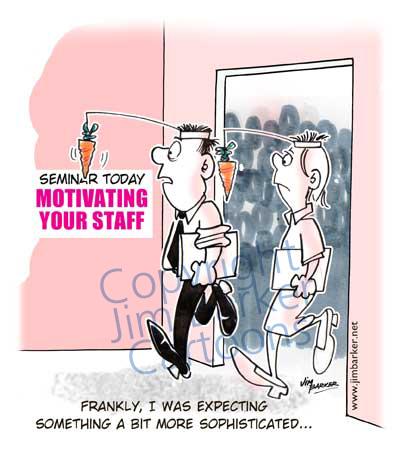 Here's a list of ideas that I derived from one of today's career counseling sessions. I've written about most of these ideas before, but feel it might be useful for you if I list them here:
- Figure out how you can make each task as fun as possible.
- Break the task down into little bites and feel good when you get a bite done.
- Don't be perfectionistic. That way, tasks will be less painful to do.
- Do a crappy first version. It's easier to revise your way into excellence than to come up with it out of thin air.
- When you reach a hard part, don't struggle long with it. Usually, if you can't make progress within 15-60 seconds, chances are you won't make enough progress to justify taking any more time on it. Go on, maybe come back to it later, or get help with it.
- Feel grateful for your situation. Instead of resenting having to work, adopt the approach so common among the World War II generation: Accept that you have to work, no questions asked: You have an almost a spiritual obligation to not be a parasite on the world, and more positively, to use your abilities and training to make the world better, even if it's just to dig a drainage ditch.
Monday, July 7, 2008
A Cure for Perfectionism
 A number of my clients are so perfectionistic that they make every task painful to complete. So, they procrastinate until they must get it done, when usually it's, ironically, too late to do a good job.
I suggest that for every major task, they set a timer for 3 minutes and, in that time, list all the steps needed to complete the task. Then tackle each step sloppily, perhaps in just three minutes each. Then keep revising each step until it's done well enough.
So, for example, today alone, I used a variation of that technique with two clients:
An epidemiologist at one of the nation's most prestigious universities had been procrastinating writing a megaproposal. I said, "You have three minutes to list all the steps to getting that proposal done." After the three minutes, he had a complete list of bite-size tasks and said he now feels more motivated to get the proposal done.
An architect has trouble creating designs in a timely manner. Indeed, the longer his deadline the more trouble he has getting it done. We set a timer for 3 minutes and I said, "Draw the most brilliant design for that home addition that you can sketch in 3 minutes." He said that his three-minute design was better and less painful to create than if he had taken a month.
Subscribe to:
Posts (Atom)

