


Showing posts with label self-esteem. Show all posts
Showing posts with label self-esteem. Show all posts
Tuesday, May 14, 2024


Monday, December 13, 2021
Do You Often Succumb to Self-Serving Bias?

Self-serving bias occurs when you overestimate your role in your positive outcomes and overestimate the power of external factors in your negative outcomes. My Psychology Today article today helps you reduce that bias so you can more rationally plan next steps forward.
Wednesday, October 9, 2019
Clear-Eyed Self-Assessment, Not Inflated Self-Esteem

Saturday, March 18, 2017
Worth: A short-short story

Wednesday, February 17, 2016

Saturday, September 26, 2015
Helping Your Son Develop Moderate Self-Esteem

Sunday, May 10, 2015
A Workover: A High Performer Feels Inadequate

The edited transcript of our exchange is my PsychologyToday.com article today.
Friday, May 3, 2013
You May Be Wise to LOWER Your Self-Confidence
I am of the belief that self-confidence,
beyond a bare minimum, is more likely to abet complacency and even narcissism than to make people more productive.
Most highly productive people often worry they're not good enough--That's part of what drives them to keep striving. From George Washington to Abraham Lincoln to most of the many highly accomplished people I know, they're all driven by moderate insecurity and feelings of unworthiness. I hypothesize that lower achievers are too unintelligent or defended to feel that worry, that insecurity.
I believe that self-esteem programs do more harm than good. Enduring self-esteem comes only from ongoing accomplishment, not by virtue of being human, of a particular background, etc.
Most highly productive people often worry they're not good enough--That's part of what drives them to keep striving. From George Washington to Abraham Lincoln to most of the many highly accomplished people I know, they're all driven by moderate insecurity and feelings of unworthiness. I hypothesize that lower achievers are too unintelligent or defended to feel that worry, that insecurity.
I believe that self-esteem programs do more harm than good. Enduring self-esteem comes only from ongoing accomplishment, not by virtue of being human, of a particular background, etc.
When I write and speak, in my professional as well as personal life, I often worry if it's good enough. More broadly, I worry whether, en toto, my life's contributions are valuable enough. I'm not worried into anxiety or depression but just enough that the worry, borne of only moderate self-confidence, does help me be my best self.
Friday, May 20, 2011
What Matters in Education: A New Approach to Figuring it Out
Here's another video of me doing an unscripted brain dump on some topic. This time, it's "What Matters in Education." But I'm doing it in an unconventional way.
Like most PhDs in education, I usually evaluate education analytically, with experiments and reviews of data and the literature. But here, I'm trying an inductive approach: I simply turned on the webcam and said what I remembered from my education--kindergarten through graduate school. Perhaps that would offer hints of what educational practices are and aren't of enduring value.
I think you'll find it mildly entertaining and maybe even borderline enlightening. It's 12 minutes long, so if that's too long for you: my summary conclusions are:
1. From K-24, I mentioned only one bit of content I learned from a lecture: how advertisers try to manipulate you. Everything else that was top-of-mind was from an interactive experience.
2. We're more fragile than I realized. I don't think of myself as being unduly insecure, yet getting my one and only A+ (in philosophy) stays vividly reassuring to me and getting a B- in a course I cared about (advanced expository writing) made me feel like a loser.
3. School may be a poor judge of us. Just as Einstein and successful people were given bad grades in school, I was inaccurately judged to be a poor writer. In graduate school, a professor said I was a terrible writer and sent me to the writing center, where, in fact, I learned little of value. Indeed, graduate school taught me to be a worse writer. There was such an emphasis on precision of language that the writing ends up impenetrable or downright soporific except to the most motivated reader. I learned how to be a writer who can communicate when I decided to write in plain English and then got feedback on my drafts from just-plain people: my neighbor the plumber and my neighbor, the teacher.
4. It's frightening how little I remember from all that schooling. I'm not sure if it's me or what I've so often written in this blog and other articles: that education is America's most overrated product.
Saturday, August 21, 2010
Coping with Self-Hatred, Self-Loathing
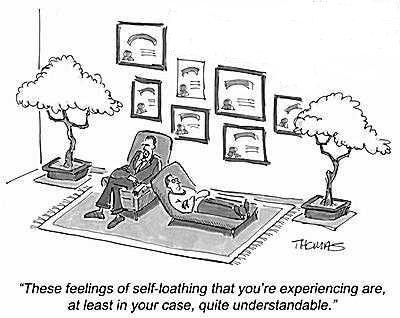 Some of my clients admit to self-loathing.
Okay, so do I. Despite my impressive list of accomplishments and current work, I honestly hate myself. I hate that I'm ugly, kind of a curmudgeon, and virtually a hermit. I overeat, am intense, am not quite as capable as I was just a few years ago. I hold libertarianish political views that most people hate. I roll my eyes at unthinking liberals who believe all wisdom resides left of center. I too often forgo tact and hit people between the eyes with candid input, often unsolicited. Plus I decry my aging self.
I'm well aware that my glass is more than half full but that awareness doesn't make me feel better. So I can't tell you to focus on your positives.
Perhaps like most things, the answer is simply self-acceptance. Loathe yourself if that's how you feel. Maybe, like me, doing that for a while will desensitize you, take the edge off your self-hatred. You'll still hate yourself but it will bother you less.
There is an important silver lining to self-loathing, at least mine: It motivates me to work ever harder. And indeed, as Michael Lopp, author of Being Geek told me yesterday, nearly every successful person in Silicon Valley suffers from the same malady. Indeed, no less than Abraham Lincoln suffered from grave self-doubt. The opposite syndrome--high self-esteem--usually leads to complacency and no growth.
Saturday, January 31, 2009
A Wise Form of Self-Esteem
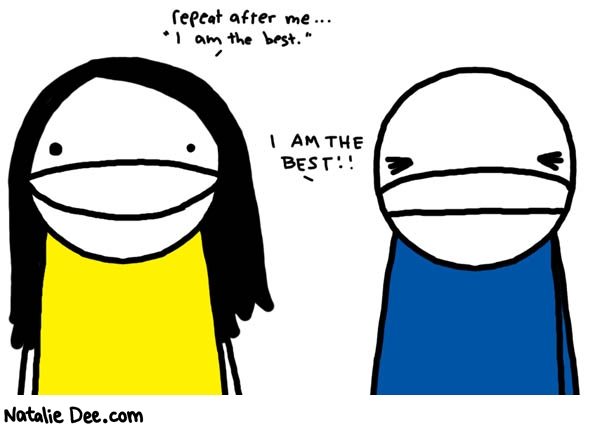
A reader of my website emailed me to say that he was proud that "I now realize I am smart."
Here's how I responded:
The art is in feeling you are smart while remaining open to learning from others and not showing off how smart you are.
On rereading that response to him, I thought you might find it helpful.
Subscribe to:
Posts (Atom)

