


Showing posts with label choose a career. Show all posts
Showing posts with label choose a career. Show all posts
Sunday, February 11, 2018
Tips for Choosing a Career: Text version


Saturday, June 25, 2016

Saturday, March 26, 2016
Choosing a Career: Quick takes on 21 good careers

Sunday, June 28, 2015
Workover: Should You Follow Your Passion?

Friday, September 12, 2014
Career Dialogues Between High School Students and Me
 I was asked to come to a high school class to do what I do
on the radio: Workovers: a few-minute
exchange to help a person decide what career s/he might want to explore.
I was asked to come to a high school class to do what I do
on the radio: Workovers: a few-minute
exchange to help a person decide what career s/he might want to explore.
While simple and terse, I believe the exchanges embed career
lessons useful whether you’re a teen, much older, or you want to provide career
guidance for someone you care about. The transcript of those Workovers is my PsychologyToday.com article today. HERE is the link.
Saturday, September 6, 2014
23 Under-the-Radar Careers

The 1353-page 2014-2015 Occupational
Outlook Handbook profiles hundreds of careers.
For my PsychologyToday.com article today, I picked out 23 under-the-radar ones that you might find appealing. For each, I offer a very quick hit plus a link for learning more about it.
If you or someone you care about is looking for a career, perhaps one or more of these might at least whet your appetite for looking at the many little-known options that can be found in the aforementioned Occupational Outlook Handbook or in the 500+ in my book, Cool Careers for Dummies.
HERE is the link.
For my PsychologyToday.com article today, I picked out 23 under-the-radar ones that you might find appealing. For each, I offer a very quick hit plus a link for learning more about it.
If you or someone you care about is looking for a career, perhaps one or more of these might at least whet your appetite for looking at the many little-known options that can be found in the aforementioned Occupational Outlook Handbook or in the 500+ in my book, Cool Careers for Dummies.
HERE is the link.
Monday, August 11, 2014
For You, Will That "Dream" Job or Career be a Dream or Nightmare?

My PsychologyToday.com article today offers tips on how to assess how happy you're likely to be in your "dream" job or career. HERE is the link.
Sunday, July 6, 2014
13 Metaphors and Analogies to Help Your Career

Monday, May 6, 2013
Finding a Career: A quick but not dirty approach

Many people spend decades trying to choose a career. I believe this article's approach, though quick, enables you to choose more wisely than do most people.
Friday, October 15, 2010
Identifying Your Ideal Job
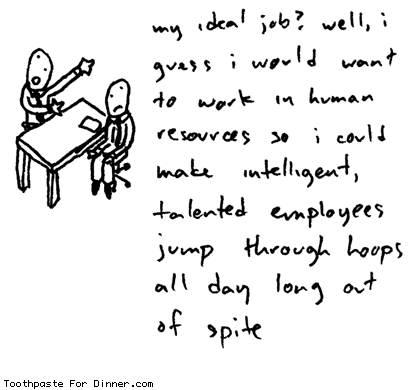 This is from my colleague Steve Piazzale:
My ideal job description? It's hard enough finding any job let alone an ideal one!
Yes, yes that's true but since you're looking for a change anyway, isn't it better to start from a position of knowing what you do best?
It's vital to know what work brings out the best in you--that is jobs where you both enjoy the work and are productive for your employer. Once you understand this, you'll know what you're looking for and will be more likely to recognize it when you see it.
So how do we go about doing this?
1. List the characteristics of your ideal work.
Without necessarily listing a job title, start writing work qualifications, duties, and environment that resonate with you. Maybe you'd start with:
- I spend 25% of my time traveling.
- I get to use my financial and analytical skills on a regular basis.
- I have a manager who provides direction, but doesn't micromanage me.
- I work with a small collaborative team.
- I interface with end users (or the general public) 10% of each day.
- My commute is under 30 minutes and I work from home once a week
- I'm in a minimal number of meetings.
- I believe in the mission of the company.
- I own my own project but contribute on others.
- Promotion is a possibility.
- Management encourages career growth
- I can earn $100K within 3 years.
Ok, so now you have a dozen or so aspects of work that would be ideal in that you'd be both interested in the work and productive. Now put them in order of importance. And after finishing that, draw a line between the entries that MUST be in your future work and those that would be nice to have.
Now, let's take a moment to explain these "must" haves. If you don't know where your next meal is coming from then you take whatever job you can. But if one of the must haves is missing, you know that from the get-go, you're going to keep looking for a better job. A must have is just that--an aspect of work without which you wont be happy and/or will not be maximally productive.
3) How to use the ideal job description
By identifying your ideal work environment, you can compare any job you're applying for or networking about to this ideal. You know what questions you need answered for the job to be a "go" for you. You can even tailor your personal brand (elevator pitch, resume profile, success stories) to match this ideal vision.
Potential employers whose vision of your role doesn't match yours can back away from you without losing face. Instead of having to say "we micromanage here and don't allow our managers much freedom," they only have to say "I don't think we have a good match here" and they back away from you, but if that freedom is a non-negotiable for you, you want them to back away.
On the other hand, if they like the role and vision you describe, they will be attracted to you. Then there is a win-win scenario—you’re happy and they get the best effort and value you can produce.
Now we all know that there's no perfect job any more than there's a perfect person. But the question to ask yourself is "how far off my ideal is the potential position I’m considering and can I live with the aspects that aren't ideal; are there any show stoppers?"
As I mentioned before, do not use this strategy if you're desperate for work and want the job at all costs. But in situations in which you have some latitude, this strategy maximizes the likelihood that you'll find work that makes you come alive and you deserve that!
Saturday, August 29, 2009
A Career in Three Minutes
 People often ask me how, on my radio shows, I help people find a career in three minutes. Here's an approach I often use:
1. Take 30 seconds to tell me what makes you different than most people?
2. What career fits your answers to that question? (Need ideas? Scan the careers in the Occupational Outlook Handbook or the 500 often more under-the-radar careers in my book, Cool Careers for Dummies.)
3. What does that career score on The Meter: 0 means you hate it. 10 means you love it?
4. What keeps that from being a 10?"
5. Repeat steps 3 and 4 until one or more careers score a 9 or 10.
Of course, you shouldn't make your final career choice in three minutes:
- Learn more about the career(s) scoring 9 or 10 in the Occupational Outlook Handbook and/or Cool Careers for Dummies. Or google the name of that career and the word "careers." for example, "electrician careers."
- If the career still sounds interesting, speak with or, better, visit a few (not one) people who work in that career to get a better sense of what it's like.
- If a career still scores a 9 or 10, congratulations. You've found what will likely be a well-suited career.
Thursday, July 2, 2009
The World's Shortest Course in Finding a Career
 A reader emailed me this question and I hope that my answer will be of value not just to him but to anyone who's still not sure what they want to be when they grow up---even if they already are 20, 40, or even 80.
Dear Marty,
I love your posts. For years, I've taken the advice you've given and tried to apply them directly to my life. I feel like I've grown immensely from it. I was hoping that you could spare a minute to help me with one more step? It isn't explicitly covered in your posts, which is why I thought I'd contact you directly. My problem is that I live with an overbearing father who won't accept the possibility that his son wants to become something other than a doctor, lawyer, or banker. My options in life were simple: Become a doctor, lawyer, banker, or a failure. When I graduate next year, I want to go as far away from him as possible in order to build my own life. Problem is, I don't know what I want to do with my life because I was so busy studying towards going to law school because I thought it would make my dad proud. I thought about the military. It would give me what I want most: independence from my parents. But I don't want to make that kind of decision just so I can escape living at home. How do I find my purpose in life so that I can finally move forward with my life instead of being pressured into doing what my dad tells me? Thank you for any advice you can share on the topic. I would be deeply gratified for any advice you can give.
Yours,
Jim (James Kalder)
Dear Jim,
Play around in the campus career center. Also, identify candidate careers by perusing the annotated lists of careers in the Occupational Outlook Handbook, (bias alert here), my Best Careers lists on usnews.com, and the 500+ careers in my book, Cool Careers for Dummies. Each of those offers a profile of lots of careers followed by a suggested website or book for additional information. If that proves insufficient, email me (mnemko@comcast.net) what you've learned from that in narrowing down your career choices, and I'll either offer some free advice or suggest that you and I do a session or three by phone, Skype, or in-person.
Marty
Thursday, June 26, 2008
How to Finally Figure Out What You Want to Be When You Grow Up
 It’s often scary. You're seeing lots of your peers in full career flower: good income, power and influence, and a job title their parents just love to brag about.
 And there you are, still fumbling around, toting a copy of What Color is Your Parachute or the results of the Strong Interest Inventory or Myers-Briggs Type Indicator.
Here are some other ways to figure out what the hell you want to be when you grow up, even if you’re already supposed to be a grownup:
— Check the website of your undergraduate and, if you've got one, graduate degree program. They often contain a list of careers that people have entered with your degree.
— Attend alumni events where graduates from your program will be in attendance.
— On an online discussion group in your field, post a query such as, “What sorts of careers are people entering with a masters in physiological psychology (or whatever)?”
— Google terms such as careers philosophy or Ph.D. careers “molecular biology.”
— Visit the exhibit area at professional conferences in your field. Those booths are often staffed by senior people with the power to hire you. You'd ordinarily have a hard time gaining access to such people, yet at a conference, they're available to you in quantity.
One approach to a booth is to scan the written material on the booth’s table, then approach its staffer. Explain the sorts of things you might do for that organization and ask if that might be of interest. Then ask if the person could imagine other ways the organization might use someone like you. If you find a hot prospect, you might invite the person to a meal or a drink. That request might be too forward under normal circumstances, but at a conference, if it feels right, it’s probably an appropriate request.
— Browse annotated lists of careers. For example, there’s the Occupational Outlook Handbook, which comprehensively profiles 250 careers. Or consider (Warning: bias-alert here!) my misleadingly titled, Cool Careers for Dummies, 3rd Edition (Wiley, 2007), which offers brief, more subjective profiles of 500 careers, each with a recommended website or book for more information. The book also contains “The 35 Most Revealing Questions,” which also may help you home in on the right career choice.
Subscribe to:
Posts (Atom)

