


Showing posts with label race. Show all posts
Showing posts with label race. Show all posts
Sunday, February 2, 2025


Saturday, February 4, 2017
From Stress to Genes, Baboons to Hormones: An interview with Robert Sapolsky

Wednesday, December 3, 2014
Toward a Truly Honest Conversation About Race

That’s understandable. Race is a most difficult topic to discuss in full-dimension. My Psychology.com article today proposes an approach that might be better.
Friday, July 19, 2013
A Wise Response to the Trayvon Martin/George Zimmerman Decision

In my view, fairness is more likely to emerge from such reasoning than from the political theater being staged by the Obama administration.
Inciting Racial Paranoia
by Linda Chavez
In speaking to the NAACP last week in the wake of the acquittal of George
Zimmerman in the killing of Trayvon Martin, Attorney General Eric Holder
performed a serious disservice to his audience and to his office. By suggesting
that the Department of Justice might pursue civil rights charges against
Zimmerman for Martin's death, Holder encouraged the belief that racism motivated
the shooting.
Calling the shooting "tragic and unnecessary," Holder said, "Independent of
the legal determination that will be made, I believe this tragedy provides yet
another opportunity for our nation to speak honestly -- and openly -- about the
complicated and emotionally charged issues that this case has raised."
But his remarks were anything but honest or open. Instead of focusing on
the actual events that led up to the shooting, he chose to talk about his own
brushes with prejudice and police bias.
"Years ago," he said, "some of these same issues drove my father to sit
down with me to have a conversation -- which is no doubt familiar to many of you
-- about how as a young black man I should interact with the police, what to
say, and how to conduct myself if I was ever stopped or confronted in a way I
thought was unwarranted."
Though Holder didn't divulge the contents of his talk with his father or
his subsequent talk with his own son on the issue, one can assume it didn't
include a recommendation to confront the person suspected of being a racist,
much less pound his head against the ground. But evidence at the trial suggests
that's what happened on the night Zimmerman shot Martin.
Eyewitness testimony coupled with photographs of injuries to Zimmerman's
head and face suggests that at the point of the shooting Martin had become the
aggressor and Zimmerman the one under attack -- which one can speculate is why
the jury voted to acquit Zimmerman.
If Holder had been honest with his audience, he would have admitted that
both Zimmerman and Martin made bad decisions that ended in Martin's death. We
never will know exactly what happened that night, but we do know some of what
occurred and how events spiraled out of control.
In the wake of a flurry of break-ins in the gated community where he acted
as a neighborhood watch volunteer, Zimmerman was overzealous in pursuing Martin.
He should not have gotten out of his vehicle after he was instructed to remain
in it, even to locate the nearest address to properly direct police, as he
claimed. Had he stayed in place, Martin would be alive.
But Martin also exercised bad judgment, which culminated in his death. When
he realized he was being followed, he could have proceeded home without stopping
or, as the defense alleged, circling back. He also could have hung up with the
girl he was talking to and called the police to report what was happening.
Instead, he chose to confront Zimmerman and, from the cuts and bruises on
Zimmerman's face, none too gently.
Once Martin was on top of Zimmerman and punching him in the head, Zimmerman
had a right to defend himself. The state's stand-your-ground law wasn't a
factor. No one has to take a beating before protecting himself.
"There has always been a legal defense for using deadly force if -- and the
'if' is important -- no safe retreat is available," Holder told the NAACP -- but
he nonetheless blamed such laws for "senselessly expand(ing) the concept of
self-defense and sow(ing) dangerous conflict in our neighborhoods."
The same logic, however, applies to Martin's actions that night. Martin was
the one who stood his ground in the face of a perceived racial insult. And
Holder's words will make it more likely that other black teenagers may look for
reasons to believe they are being singled out because of their skin color and
perhaps act as tragically as Martin did.
In the end, Holder is unlikely to bring civil rights charges against
Zimmerman. There is simply no evidence to suggest Zimmerman acted as a result of
racial animus. Zimmerman's history of good -- exemplary -- racial interactions
makes it clear he was no bigot looking to kill an innocent black kid for
sport.
Holder should have used his time with the NAACP to talk down racial
paranoia, not increase it. Instead, he chose to inflame passions for political
advantage.
Linda Chavez is the author of "An Unlikely Conservative: The
Transformation of an Ex-Liberal." Her column is nationally syndicated by Creators Syndicate. She is the Chairman of the Center for Equal Opportunity.
Wednesday, November 16, 2011
Deathbed Courage

May deathbed courage yield a 10.3.
And a tsunami.
Note: No, I'm not dying.
Saturday, November 12, 2011
Is it Too Risky to Advocate for Men and Boys?

I have written much on the terribly unfair--relative to their merit-- treatment of white men and boys.
Just one example: the longevity gap between men and women has increased from just one year in 1920 to 5.2 years now. Yet 95+% of the gender-specific medical research over the last 60 years has been on women's health. There's a federal agency and 39 state agencies on women's health, none on men's.
The Obama Administration has created a powerful White House Council on Women and Girls but rejected our compelling proposal for a White House Council on Boys and Men. Forbes recently did a long article on it.
Perhaps even more frightening are the distortions on race and gender issues. For example, the media and even the president continue to promulgate the misleading statistic that women earn 77 cents on the dollar, when there is solid evidence, for example, THIS, that for the same quantity and quality of work, women earn--depending on the study--only slightly less or slightly more than men. And that when women earn less, while there of course are a few Neanderthal sexists out there, the main reason is not prejudice but the choices women make. For example, see THIS National Academy of Sciences study about why women scientists are "underrepresented."
An easy way to access some of my writings on race and gender is to click on "men's issues" and "race" in the label cloud on the right side of this blog.
The unfairnesses to men and boys are terrible not just for them but for society. My most deeply held belief is that meritocracy is more likely than egalitarianism to yield the greatest long-term good.
But we must know which battles are worth fighting lest we squander the precious little time we are given. As the Serenity Prayer wisely says, "Grant me the serenity to accept the things I cannot change, the courage to change the things I can, and the wisdom to know the difference."
Alas, after fighting this fight for two decades now, I'm forced to conclude that the net impact of my efforts to bring merit-based fairness to men and boys has been negative. I have written perhaps 100 articles, op-eds, letters to the editor, and a book, The Silenced Majority, submitting each to 10 or more media outlets and they're almost always rejected. HERE is one reject that particularly disappointed me. Perhaps their being rejected is simply because my work is inferior, although somehow when I write about politically correct matters, my work is routinely published. I'll leave you to judge my work's quality, but certainly my long-sustained efforts seem not to have helped the situation at all. Indeed, white men and boys are, net, treated more unfairly than when I began writing and speaking on the topic. The main effect of my efforts seems to be damage to my career.
Alas, after fighting this fight for two decades now, I'm forced to conclude that the net impact of my efforts to bring merit-based fairness to men and boys has been negative. I have written perhaps 100 articles, op-eds, letters to the editor, and a book, The Silenced Majority, submitting each to 10 or more media outlets and they're almost always rejected. HERE is one reject that particularly disappointed me. Perhaps their being rejected is simply because my work is inferior, although somehow when I write about politically correct matters, my work is routinely published. I'll leave you to judge my work's quality, but certainly my long-sustained efforts seem not to have helped the situation at all. Indeed, white men and boys are, net, treated more unfairly than when I began writing and speaking on the topic. The main effect of my efforts seems to be damage to my career.
So I've concluded, subject to revision, that this is the wrong era to write honestly about race and gender. It seems that today, we can hear only that women and minorities are victims or heroes. And in my judgment, that is unlikely to change for the foreseeable future.
So if you notice that my future writings discuss such issues less or not at all, that's why.
Monday, July 4, 2011
Toward an Honest Conversation About Poverty, Race
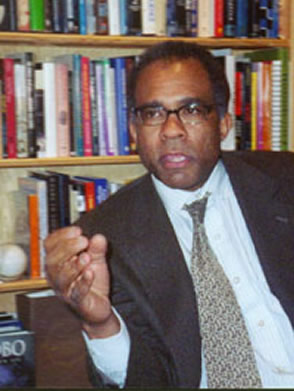 I just watched Harvard law professor, Randall Kennedy (pictured right,) deliver a speech excoriating America for not doing enough for its poor and being especially unfair to people of color.
That moved me to write this letter to him. I thought you might enjoy reading the tough questions I asked him:
Dear Randall,
It was my privilege to watch your recent National Press Club/C-Span speech on America's treatment of poor people and of people of color. You made the case with rigor and emotional restraint, which I believe is key to being heard.
Your talk moved me to run to my computer to invite you on my show to have a conversation with me about poverty and race.
I should let you know that I am not an Ehrenreich/Alter leftist yet I believe your excellently articulated position deserves greater attention and I know that my NPR-San Francisco listenership would be well served by a respectful conversation in which I raise questions about it, for example:
- Metaevaluations of efforts to address poverty, from EarlyStart to HeadStart, from job training to job retraining, have--other than some pilot studies the results of which have proven to be unreplicable--been failures, certainly yielding extremely poor value for the literally trillions of taxpayer dollars spent since the War on Poverty began when you and I were young.
Some empiricism and much logic suggest that such redistributive "justice," has dispositively outweighing negative side effects. For example, welfare payments to able-bodied people (cash, housing, food stamps, MediCal,etc) encourages the working poor to not work because, to earn a similar amount of money,they'd have to earn roughly $50,000 a year in after-tax dollars, which their skills/work ethics etc will not come close to commanding. Such payments--just as when rich people give trust funds to their children--discourage people from wanting to be productive. And mid-to-upper-income people, who are working 40-80 hours a week in societally productive activities, grow more resentful of the poor upon seeing that many of the poor (including prisoners) receive better health care than many middle-class people get and that many welfare recipients do live in decent-to-nice housing (Have you seen low-income housing developments lately?--they look like the condos that middle-class people must spend hundreds of thousands of dollars on) with the mice you mentioned being the result not of the housing but of residents' leaving food wastes out and about, urinating in a doorway when annoyed at a neighbor, etc. I have been in many low-income residences and I was, indeed, often welcomed by the smell of urine.
- You said that anyone who has spent significant time with the poor would realize that much of their situation is beyond their control. I have spent more time with the poor than you might imagine. I was born in and spent more than five years living in a tenement in the Bronx. I left a prestigious biomedical research position at the Rockefeller University when, in 1970, swept up by civil rights fervor, I became a drug counselor and teacher in inner-city New York City and Richmond, CA (heavily Black and Latino) schools, visited my students' families in their home many times, and had intimate conversations with their parents, grandparents, or aunts with whom they lived. While indeed, much of people's poverty lies beyond their control and your position deserves broader exposure (although the likes of Alter and Ehrenreich certainly got much more positive press attention than do conservative views), I believe that a more full-dimensioned exploration of how to address poverty as we move forward, requires addressing the aforementioned and other controversial questions.
The first available slots on my show are 8/21, 8/28, 9/4, 9/11, and 9/18 all at 2 pm eastern time. Of course, we can do it by phone. Alternatively, if you plan to be in the San Francisco Bay Area at any point in the coming months, we should do the interview when you're in town.
What do you think?
Marty
--
Marty Nemko, producer, host, Work with Marty Nemko, KALW-FM (NPR-San Francisco)
UPDATE: He will appear on my show on Aug 21 at 11 am Pacific time. The show will be archived on the npr site for a week and permanently on www.martynemko.com.
Monday, October 11, 2010
Another Failed Attempt at an Honest Conversation About Race
 I read that the U.S. Small Business Administration provides minorities with specially favorable loans, mentors, and sole-sourcing(!) in obtaining government contracts. Case studies were provided. Here's an example.
 On my radio show, while I acknowledged that vestiges of racism may remain even 150 years after slavery, I wondered about the fairness of set-asides to the already strapped taxpayers who are forced to pay for it is well as to non-minority businesses who have to compete at such a disadvantage.
I received furious calls from minorities, mainly citing anecdotal evidence that racism is still alive and well in America. For example, one man said, "I was in sales and I had fine rapport with this customer on the phone and then he met me and he wouldn't make the deal." Could that not be because the customer, on seeing the product, didn't like it? Or because he, in the interim, found a better product? Or decided he really didn't need it or found a better use for the money? But the caller could only view it as evidence of America's being racist.
Another caller cited as evidence of racism that his boss told him, "I really like you so I'll be straight with you. A Black man can't get anywhere in advertising." Perhaps that boss was a racist. Or perhaps that boss tried to appear candid to prove he wasn't racist. But in fact: 6% of all managers and professionals in the advertising industry, many thousands of people, are Black. Yes that's an "underrepresentation" but does anyone decry as reverse-racist Blacks' overrepresentation," for example, in professional sports or in government jobs, which today are among the most attractive and employ far more people than does the advertising industry? But the caller insisted this was evidence that America is racist.
A caller cited as an example of racism that Blacks earn less per capita than all other groups. How much of that really is caused by racism? Could a more valid explanation be that fewer Blacks graduate from college? And very few complete majors in high-pay fields such as physics, engineering, and computer science? And might the racial income disparity have less to do with racism than the belief prevalent among many Black teens that studying hard is "acting white?" How about the gangsta rap culture? How about the high black high school dropout rate and crime rate?
A caller pointed out that Blacks are more often denied or charged a higher rate on bank loans. He angrily insisted that was a clear sign of racism. But as Paul Sperry, Fellow at Stanford University's Hoover Institution and author of the new book, The Great American Bank Robbery, wrote in a New York Post op-ed,
Yet all the minority callers to my show insisted that set-aside giveaway programs for minorities are necessary because of we're still a racist society. It didn't end there. I returned home to find emails, all from African-Americans, all calling me "ignorant" and "racist." Their reasoning (not to mention their writing) was worse than the callers' and their threats more dispiriting than frightening. For example, Zaid wrote, "It’s safe for you start crying now, for in 50 years or less you will lose the reigns of White Male Over POWERING in this WORLD because of education and multiplication of People of Color. Then you’ll be treated like the today’s minorities- goes around, comes around."
America desperately needs an honest national conversation about race but the way our frightened-to-be-honest schools, colleges, and media portray the issues, I, at least, despite a number of serious attempts (here's one example), have been unable to do my part to start one.
Friday, July 24, 2009
"A Nation of Cowards About Race?" A Full-Dimensioned Discussion of the Racial Achievement Gap
This summary is not available. Please
click here to view the post.
Subscribe to:
Posts (Atom)

